
How to Get Your Full Rental Deposit Back: A Practical Tenant Guide

In this article
- Key Takeaways
- Table of Contents
- How to Get Your Full Rental Deposit Back: What Actually Determines the Refund?
- How to Prepare for a Full Rental Deposit Return Before Move-Out
- How to Assess Rental Deposit Deductions for Cleaning, Damage, and Wear
- How to Clean and Document the Rental Home Before Handover
- What to Do If You Don't Get Your Full Rental Deposit Back
- Leave Well Prepared for Your Rental Handover
- Frequently Asked Questions
What if the best way to protect your rental deposit isn’t simply to clean harder, but to leave clear evidence of the property’s condition? If you’re wondering how to get full rental deposit back, focus on the details that can affect the handover: the agreement’s requirements, pre-existing marks, cleaning and ordinary wear. A careful process helps you identify what needs attention and what should be documented.
Start with your tenancy agreement, then compare the home with your move-in records. This guide walks you through a practical move-out checklist, from reviewing handover requirements and cleaning room by room to taking dated photos and keeping communication with your landlord clear. You’ll also learn how to respond calmly if a proposed deduction or refund is disputed. A professional end-of-tenancy clean can help prepare the home for inspection, but it’s one part of a documented handover, not a guarantee of a full refund.
Key Takeaways
- Review your tenancy agreement early so you can plan around its specific handover requirements.
- Compare the property with move-in photos, inventory notes and records of reported defects before assessing any claimed deductions.
- Use a room-by-room cleaning checklist that prioritises kitchens, bathrooms, floors, fixtures and areas mentioned in your agreement.
- Learn how to get full rental deposit back by keeping a clear record of the property’s condition and your handover.
- If part of your deposit is withheld, request an itemised explanation in writing and organise the documents that support your position.
How to Get Your Full Rental Deposit Back: What Actually Determines the Refund?
To understand how to get full rental deposit back, begin with what “full” means: the agreed deposit returned, with any deductions assessed against the tenancy agreement and applicable rules. The landlord’s explanation, your records and the home’s condition all matter. Cleaning can support a professional handover, but it doesn’t settle every obligation or determine whether a deduction is justified.
Assess the refund against several pieces of information: the signed agreement, the property’s documented condition at move-in and move-out, records of rent or other payments, and written communication with your landlord. A general overview of how deposits work is available in Security deposit, but it isn’t specific to Singapore. For a dispute, check current Singapore guidance or seek appropriate advice rather than relying on a general explanation of deposit rules.
Quick answer: Review your agreement, document the property and existing issues, clean according to the handover requirements, record its final condition, then return the keys and keep a written record of the handover.
Which tenancy terms can affect your rental deposit?
Read the agreement before arranging the final clean or handover. Find the clauses covering the deposit, cleaning, repairs, reinstatement, inspection and refund. Check for stated requirements about notice, key return, utilities and the handover process. Make a short checklist from the wording: note each required task, any stated deadline and what evidence or confirmation you’ll need. Follow what your agreement actually says rather than relying on assumptions about what tenants usually do.
Keep signed terms separate from informal conversations. If a message appears to change an agreement, save it and clarify the point in writing. Where the wording is unclear, or you’re unsure how a term applies under Singapore law, don’t treat a broad online statement as a definitive legal answer.
What can a clean handover, and cannot, do?
A thorough clean can remove dirt, dust and residue, making the home easier to inspect and presenting its condition clearly. It can’t repair a broken fixture, resolve an unpaid obligation or override a written agreement. Cleaning is one part of deposit preparation, not a promise of a full refund. An end-of-tenancy clean can help prepare the home for inspection and handover.
A clean home is not automatically a damage-free home, and a clean handover alone doesn’t establish whether a deduction is appropriate. Keep those questions distinct: document cleanliness, record damage or existing defects, and refer to the agreement when reviewing the final account.
How to Prepare for a Full Rental Deposit Return Before Move-Out
A calm, organised move-out starts before cleaning day. Work through the steps in order so you can settle practical obligations, compare the home with its move-in condition and create a clear handover record. This preparation can help prevent avoidable oversights and make questions easier to address, although it can’t guarantee a particular refund.
- Reread the agreement. Note the stated move-out, cleaning, repair, utility, inspection and key-return requirements.
- Resolve outstanding obligations. Check rent or bills due, and keep receipts or written confirmation of payments, approvals and agreed repairs.
- Prepare the home. Arrange cleaning and any agreed work based on the property’s condition and the contract.
- Inspect and compare. Check each room against move-in photos, inventory notes and defects you previously reported.
- Record the handover. Confirm arrangements in writing and save the inspection outcome and key-return details.
What to check in each room before the final inspection
Use your move-in records as a comparison, not memory alone. Review floors, walls, ceilings, windows, fixtures and supplied appliances. In kitchens and bathrooms, look closely for grease, residue, stains or soap deposits. Keep two separate notes: one for cleaning tasks and another for damage, defects or maintenance issues. For example, a dusty shelf is a cleaning item; a crack recorded at move-in belongs in your condition notes. If a defect was reported later, save the message and any reply with the relevant photos.
How to create a useful move-out evidence trail
After cleaning, take clear, dated photos or videos of each room, then add close-ups of relevant marks, fixtures or defects. Make sure room-wide images show where close-ups were taken. Keep original files and group them by room, date and issue rather than relying on cropped or edited versions. Save the agreement, payment proof, receipts, inspection notes and messages in the same folder. Written communication helps preserve what was agreed and when.
Where applicable, note meter readings, when and how keys were returned, and the inspection outcome. Confirm handover arrangements with the landlord or agent in writing. This creates a useful record without assuming that one particular process is legally required. For help preparing the property, end-of-tenancy cleaning can support a tidy, inspection-ready handover.
How to Assess Rental Deposit Deductions for Cleaning, Damage, and Wear
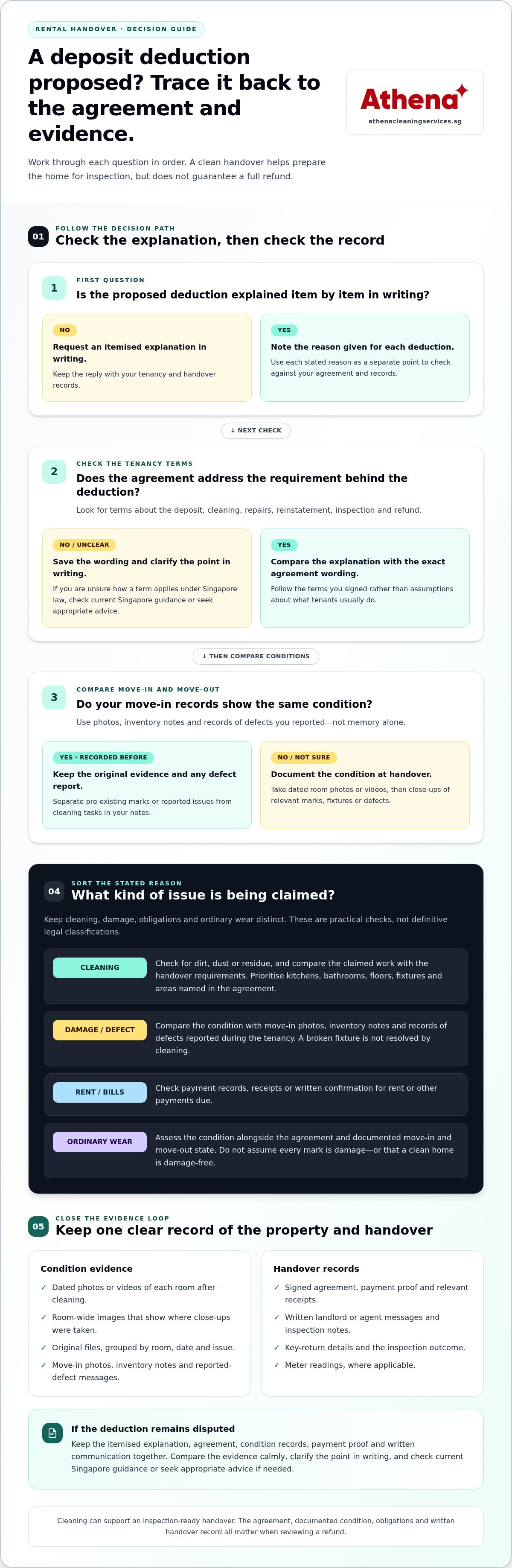
A proposed deduction is easier to assess when you identify what it relates to and compare it with your records. Don’t treat every mark as damage or every cleaning concern as ordinary wear. The same condition may be viewed differently depending on the tenancy agreement, the home’s documented move-in state and the evidence at handover. These examples are practical guides, not definitive legal classifications.
| Claim type | Examples to assess | What to compare |
|---|---|---|
| Cleaning | Grease on a kitchen surface, residue in a bathroom or dirt left on floors | Cleaning or handover terms, move-in condition, move-out images and any itemised cleaning explanation |
| Tenant-caused damage | A broken fixture or a new, substantial mark that may not have been present at move-in | Inventory notes, earlier defect reports, approval for work and evidence of the condition before and after |
| Pre-existing defect | A stain, crack or faulty fitting recorded or reported before move-out | Dated move-in evidence, written reports, replies and any repair records |
| Ordinary wear | Minor changes that may result from everyday use, depending on the item and tenancy | The item’s recorded starting condition, evidence about its age or condition, and the agreement |
Is it cleaning, damage, or ordinary wear and tear?
Start with the specific area named in the claim. Ordinary use and neglected cleaning aren’t the same issue: a faint change to a frequently used surface may call for a different discussion than accumulated grime. Neither example settles the question by itself. Compare the claimed condition with move-in photos, inventory notes and previously reported defects, then check what the agreement says.
What to request when a landlord proposes a deduction
Ask calmly, in writing, for the relevant agreement clause, an itemised amount, the reason for each deduction and supporting photos or documents. Keep your questions specific. If a repair is claimed, compare it with your defect reports, approvals and any available information about the item’s age or earlier condition. Save every reply, even if you disagree with the explanation.
“Betterment” may arise where a proposed charge appears to leave the property or an item in better condition than before, but it isn’t a universal calculation formula. Ask how the amount was reached and what evidence supports it; don’t assume one standard method applies to every tenancy. Check current Singapore-specific official guidance for relevant rules, and verify any legal interpretation or tribunal standard before relying on it.
A measured, evidence-led review is a practical part of how to get full rental deposit back. Clarify each claim first, then decide whether your records support agreement, further questions or a formal next step.
How to Clean and Document the Rental Home Before Handover
Use your tenancy agreement and the home’s actual condition to set cleaning priorities. A practical checklist helps you focus effort where it matters, rather than assuming every rental has the same handover standard. If you’re working out how to get full rental deposit back, treat cleaning and documentation as connected steps: prepare the property, then record what it looks like before returning the keys.
Which cleaning tasks should tenants prioritize?
Work room by room, giving particular attention to kitchens, bathrooms, floors, fixtures and any areas named in the agreement or flagged during the move-in inspection. Remove visible dust, food residue, grease and soap deposits from relevant surfaces. Check cupboard interiors and appliance exteriors where they’re part of the handover expectations.
- Kitchen: Wipe counters, cupboard surfaces and appliance exteriors; clear visible grease or food residue.
- Bathroom: Clean accessible surfaces and fixtures, paying attention to soap deposits and visible residue.
- Floors and living areas: Remove dust and debris, and clean floors according to the care requirements for their material.
- Throughout the home: Check accessible fixtures and interior surfaces, then revisit any areas specifically mentioned in the agreement.
Use methods suited to each surface. A product or technique that works on one floor or fixture may not suit another, so follow the surface care instructions. Keep a separate note of damage or maintenance issues; cleaning can improve presentation, but it doesn’t repair defects.
When can professional end-of-tenancy cleaning help?
A professional end-of-tenancy clean can help prepare the home for a consistent final inspection, particularly when several rooms or specific cleaning needs require attention. Athena Team Cleaning provides residential end-of-tenancy cleaning in Singapore, with flexible scheduling. The service supports the handover, but it can’t guarantee a full deposit return or replace other move-out responsibilities.
After cleaning, make one final walkthrough before returning the keys. Photograph completed areas in good lighting, including room-wide views and close-ups of relevant surfaces or fixtures. Keep the dated images with your move-in records so the final condition is easy to review. Details of the service are available through end-of-tenancy cleaning.
What to Do If You Don't Get Your Full Rental Deposit Back
A partial refund or an unexplained delay can feel frustrating, but start with a clear written request rather than an accusation. Ask for the refund status and, if money has been withheld, an itemised explanation of each deduction. A calm, specific message gives both sides a chance to identify missing information and creates a useful record of your efforts to resolve the issue.
How to write a clear deposit-refund request
In your private correspondence, state the tenancy address, tenancy dates and deposit amount. Refer to any relevant agreement clauses, summarise the refund or explanation you’re requesting, and specify a reasonable response date without presenting it as a legal deadline. Attach concise, clearly labelled records rather than a large, unorganised file. Keep the tone factual, save proof of delivery and retain the reply.
Organise your supporting documents before you send the request:
- Signed tenancy agreement and relevant written variations
- Proof of deposit and other relevant payments
- Move-in and move-out inspection notes, dated photos and videos
- Cleaning receipts or records, if applicable
- Messages about defects, repairs, approvals, handover and proposed deductions
Compare each claimed amount with the agreement and condition evidence. If the explanation is unclear, ask focused follow-up questions and keep the exchange in writing. This evidence-led approach is more constructive than escalating before you understand the basis of the deduction.
When might formal dispute resolution be relevant?
If a direct discussion doesn’t resolve the issue, formal dispute resolution may be an option, but the available route depends on the facts and current eligibility requirements. Singapore’s Small Claims Tribunals may be relevant for some disputes; don’t assume a tenancy deposit claim automatically qualifies. Before taking action, use current official Singapore Courts information to verify the tribunal’s jurisdiction, applicable procedures, deadlines and claim limits. Consider getting appropriate legal guidance if you’re unsure how the rules apply to your case.
Keep your records together and your communication measured, whether the matter resolves through discussion or needs a formal next step. Cleaning can help prepare a home for inspection, but it cannot settle a deposit dispute or guarantee a particular refund. Athena Team Cleaning provides end-of-tenancy cleaning to help prepare the property for handover. You can request an end-of-tenancy cleaning quote.
Leave Well Prepared for Your Rental Handover
A strong move-out plan starts with your tenancy agreement and ends with a clear record of the handover. Compare the property with your move-in evidence, distinguish cleaning from damage or ordinary wear, and keep dated photos and written communication together. If a deduction is proposed, ask for an itemised explanation and review it calmly against your records.
These practical steps can help you understand how to get full rental deposit back while reducing avoidable misunderstandings. A thorough clean supports a well-prepared inspection, but the final refund also depends on the agreement, property condition and any valid deductions.
Athena Team Cleaning provides residential end-of-tenancy cleaning in Singapore, with flexible scheduling. Make cleaning one organised part of your move-out plan, then request an end-of-tenancy cleaning quote. With careful preparation and clear documentation, you can approach handover with greater confidence.
Frequently Asked Questions
Does hiring a cleaner guarantee that I will get my full rental deposit back?
No. A cleaner can help remove dirt, grease and residue, making the home more presentable for inspection, but cleaning can’t repair damage, settle unpaid obligations or change the tenancy agreement. A refund depends on the agreement, the property’s condition and any deductions that are properly supported. Treat professional cleaning as one practical part of move-out preparation, not a promise of a full deposit return.
What should I do first if my landlord wants to deduct money from my deposit?
Ask in writing for an itemised explanation of each proposed deduction, including the reason, amount and relevant agreement clause. Compare the claim with your move-in records, move-out photos and any earlier defect reports or repair approvals. Keep the exchange calm and save the response. If you’re working out how to get full rental deposit back, clear questions and organised evidence are a sensible starting point.
Is a tenant responsible for fair wear and tear in Singapore?
Responsibility depends on the tenancy agreement, the property’s condition and the circumstances of the claimed change. Ordinary effects of everyday use may differ from damage or neglected cleaning, but a description alone doesn’t settle a specific deduction. Compare the item’s move-in and move-out condition, and review relevant records and contract terms. For a legal interpretation in Singapore, check current authoritative guidance or seek appropriate advice.
How thoroughly should I clean a rental home before moving out?
Clean in line with your tenancy agreement and the home’s actual condition rather than assuming one universal standard applies. Prioritise kitchens, bathrooms, floors, fixtures and any areas specifically mentioned in the agreement or handover instructions. Remove visible dust, food residue, grease and soap deposits from relevant surfaces. Check cupboards and appliance exteriors where appropriate, then photograph the finished rooms before returning the keys.
Can my landlord deduct cleaning costs from my rental deposit?
Whether a cleaning deduction is appropriate depends on the agreement, the condition at handover and the explanation and records supporting the claim. Don’t assume every cleaning charge is automatically valid or invalid. Ask for the relevant clause, an itemised amount and supporting details, then compare these with your move-in and move-out evidence. Singapore-specific legal questions should be checked against current authoritative guidance.
What evidence should I keep to get my rental deposit back?
Keep the signed tenancy agreement, proof of deposit payment, inventory or inspection notes, and dated move-in and move-out photos or videos. Save messages about defects, repairs, cleaning expectations, approvals and handover arrangements, along with relevant receipts or cleaning records. Preserve original image files and organise documents by room, date or issue. A clear record helps you explain your position if a deduction is disputed.
What can I do if my landlord does not return my deposit?
Send a calm written request asking for the refund status and, if any amount is withheld, an itemised explanation. Keep your agreement, payment proof, inspection records, dated images and correspondence together. Try to clarify the issue directly first. If it remains unresolved, verify current Singapore Courts information on whether the Small Claims Tribunals can hear your claim, including eligibility, procedures, deadlines and claim limits.
Frequently Asked Questions
Which tenancy terms can affect your rental deposit?
What can a clean handover, and cannot, do?
Is it cleaning, damage, or ordinary wear and tear?
Which cleaning tasks should tenants prioritize?
When can professional end-of-tenancy cleaning help?
When might formal dispute resolution be relevant?
Does hiring a cleaner guarantee that I will get my full rental deposit back?
What should I do first if my landlord wants to deduct money from my deposit?
Is a tenant responsible for fair wear and tear in Singapore?
How thoroughly should I clean a rental home before moving out?
Can my landlord deduct cleaning costs from my rental deposit?
What evidence should I keep to get my rental deposit back?
What can I do if my landlord does not return my deposit?
Related articles