

Improving Office Air Quality: A Practical Guide for 2026

In this article
- Key Takeaways
- Table of Contents
- How to Improve Office Air Quality: Start by Finding the Likely Sources
- How Ventilation, Filtration, and Humidity Shape Office Air Quality
- Which Office Air-Quality Improvements Should You Prioritise?
- How to Build an Office Air-Quality Action Plan
- How Professional Office Cleaning Supports a Healthier Workspace
- Make Your Office Air-Quality Plan a Lasting Habit
- Frequently Asked Questions
A clean office can still have stale air. If the workspace feels stuffy, dust returns quickly or employees notice lingering odours, cleaning alone may not address the cause. Knowing how to improve office air quality starts with looking beyond visible surfaces to ventilation, filtration and potential sources of indoor pollutants.
It’s understandable to wonder which step should come first. Limited air circulation, loaded filters and dust in carpets or upholstery can all contribute to an uncomfortable workspace, but each calls for a different response. A practical plan investigates likely sources and supports the building’s air systems rather than relying on one measure.
This guide will help you spot common signs of office air-quality concerns and prioritise sensible improvements, from reviewing ventilation and filtration to reducing dust through routine cleaning. You’ll also learn where professional office cleaning, including periodic carpet and upholstery cleaning, fits into the wider strategy: it helps maintain a clean workspace, but does not replace effective ventilation or filtration.
Key Takeaways
- Stuffy air can have several possible sources, even in a clean-looking office. Learn what to observe before choosing a fix.
- Understand how source control, outdoor-air ventilation and particle filtration work together rather than as competing solutions.
- Find out how to improve office air quality with a prioritised approach that matches each measure to the concern it can address.
- Use a simple action plan to record concerns, review visible conditions and ventilation, assign next steps, and reassess.
- See how routine office cleaning and targeted carpet or upholstery cleaning can support a wider air-quality strategy without replacing ventilation or filtration.
How to Improve Office Air Quality: Start by Finding the Likely Sources
A workspace can look spotless and still feel stuffy. Visible cleanliness is only one part of the picture: air may also be affected by limited air exchange, particles entering from outdoors, moisture or substances released during everyday activities. Before deciding how to improve office air quality, record what people are noticing and where. Treat those observations as clues, not proof of a particular cause.
What can affect air quality in an office?
Indoor air quality (IAQ) describes the condition of air inside an occupied space and the factors that can influence it. In an office, people, printers and other equipment, furnishings and routine activities can all contribute to indoor pollutants. Outdoor particles may enter through openings or building air systems, while some cleaning products can leave odours or airborne substances. Dust can collect on desks, floors, carpets and upholstery, making soft furnishings one potential source to manage through suitable cleaning.
Moisture deserves attention too. In warm, humid conditions, watch for damp areas, condensation or signs of water intrusion, without assuming that humidity alone explains an air-quality concern. Note the location and visible condition. Don’t infer a hidden problem from a single observation.
Which warning signs should facilities teams record?
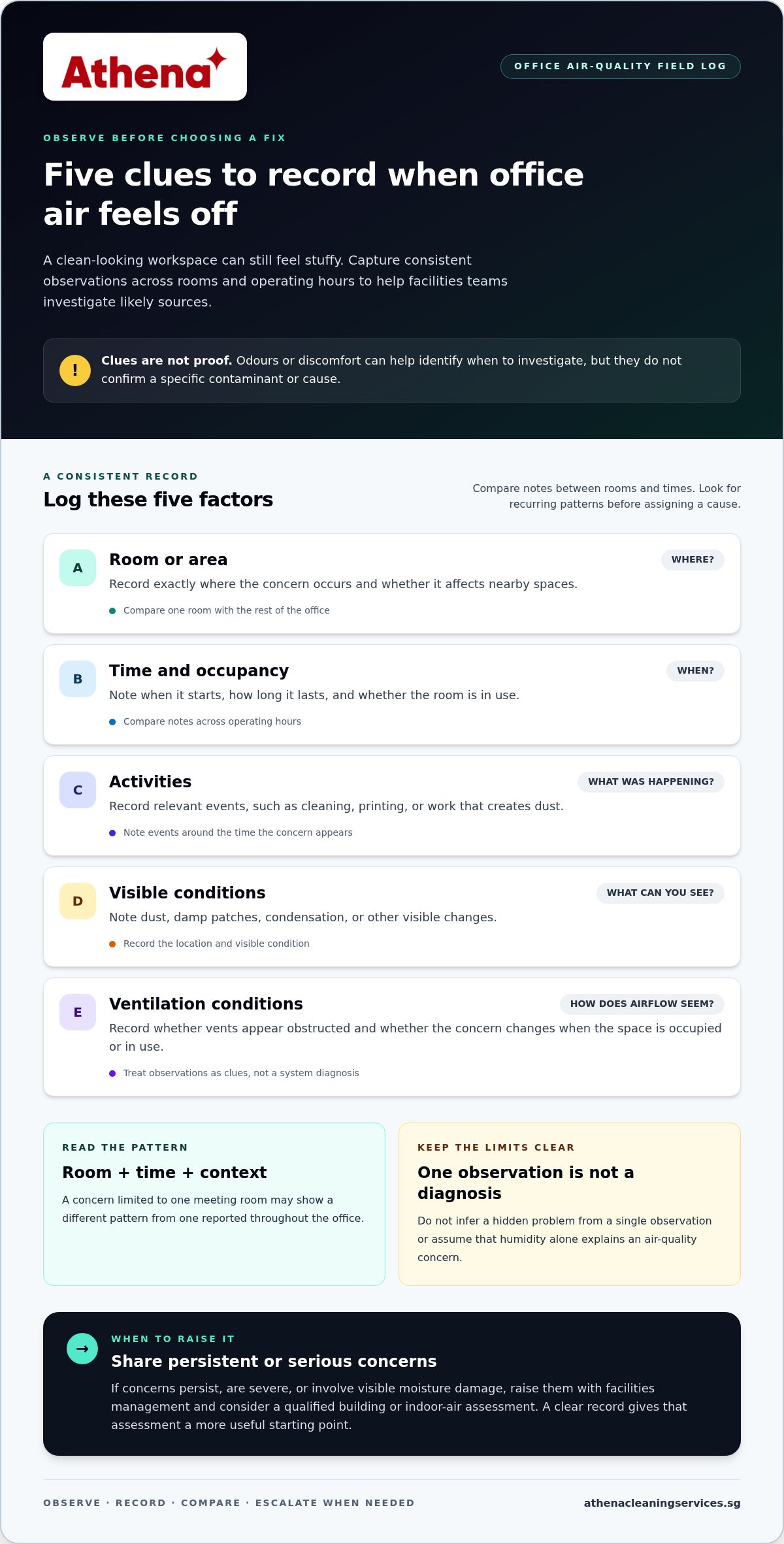
Keep a brief, consistent log rather than relying on memory. Compare notes between rooms and operating hours: a concern limited to one meeting room, for example, may point to a different pattern from one reported throughout the office. Odours or discomfort can help identify when to investigate, but they don’t confirm the presence of a specific contaminant.
- Room or area: Record exactly where the concern occurs and whether it affects nearby spaces.
- Time and occupancy: Note when it starts, how long it lasts, and whether the room is in use.
- Activities: Record relevant events, such as cleaning, printing or work that creates dust.
- Visible conditions: Note dust, damp patches, condensation or other changes you can observe.
- Ventilation conditions: Record whether vents appear obstructed and whether the concern changes when the space is occupied or in use.
Look for recurring patterns before assigning a cause. If concerns persist, are severe or involve visible moisture damage, raise them with facilities management and consider a qualified building or indoor-air assessment. For facilities dealing with extensive water intrusion or structural issues, discover TBC Restoration to explore comprehensive commercial property recovery services. A clear record gives that assessment a more useful starting point.
How Ventilation, Filtration, and Humidity Shape Office Air Quality
Indoor air quality is the condition of the air in an occupied indoor space. It reflects more than whether a room smells fresh: different sources can affect particles, gases, odours and moisture. To understand how to improve office air quality, consider three complementary layers: control pollutants at their source, bring in outdoor air through suitable ventilation, and filter particles from the air. None is a complete substitute for the others.
Ventilation brings outdoor air into a space to replace or dilute indoor air; filtration removes certain particles from air passing through a filter. The distinction matters. Ventilation supports air exchange when the building system is designed to provide it, while a particle filter works only on the air that passes through it and captures particles according to its design and rated performance. A filter shouldn’t be treated as a remedy for every gas, odour or moisture issue.
What does ventilation do, and what can filtration do?
Office ventilation is usually connected to the building’s heating, ventilation and air-conditioning system. Its performance depends on the system’s design and operation, so a blocked vent, a setting or a room’s use may be relevant clues, not a diagnosis. The EPA's guide to office air quality explains how building systems and everyday sources can relate to office air concerns.
Filters are designed to capture particles, but their effectiveness depends on the filter and how it fits the system. Follow the building system’s requirements for filter selection and replacement. Installing a filter that the system isn’t designed to use may not be appropriate. Source control still matters: reducing avoidable sources complements ventilation and filtration rather than asking either system to do everything.
Sensors can add useful context, especially when readings are tracked over time and compared across rooms. But a reading is an indicator, not a full assessment of every pollutant. A single number cannot identify every source or explain every odour, so interpret measurements alongside observations and building-system information.
Why should Singapore offices pay attention to moisture?
In warm, humid conditions, keep moisture on the facilities team’s radar. Persistent dampness can become a building-maintenance concern, particularly if materials remain wet or moisture keeps returning. Report leaks, condensation or visible mould promptly through the building’s maintenance process. Don’t rely on smell alone or apply a universal humidity target without considering current, appropriate guidance and the space’s conditions.
Keep the response coordinated: facilities teams can review building-system concerns, while consistent professional office cleaning helps manage dust and soil on accessible surfaces as part of routine source control.
Which Office Air-Quality Improvements Should You Prioritise?
The best first step depends on the concern you’ve recorded. Reduce avoidable sources where practical, then address ventilation or filtration issues with facilities support. Cleaning helps manage dust and soil, but it doesn’t replace fresh-air provision. The guide to indoor air quality explains why office air concerns can involve several contributing factors rather than one fix.
Use this comparison to decide what to raise first and what each measure can realistically do:
| Measure | Purpose | Suitable situations | Important limitation |
|---|---|---|---|
| Source control | Reduce avoidable pollutants at their origin. | Unnecessary product use, avoidable dust-generating activities, or concerns linked to a particular task. | Doesn’t address inadequate air exchange or remove pollutants already present. |
| Ventilation checks | Identify potential issues with outdoor-air supply or system operation. | Persistent stuffiness, unusual odours, blocked vents, or reported system faults. | Building-system changes require appropriately qualified facilities professionals. |
| Filtration | Capture particles from air passing through a suitable filter. | Particle control is a relevant concern and the building system can support the selected filter. | Filters don’t replace ventilation, source control, or measures for every type of pollutant. |
| Routine cleaning | Manage dust and soil on accessible surfaces and soft furnishings. | Regular upkeep of desks, floors, carpets, and other frequently used areas. | Surface cleaning can’t provide fresh air or correct a building-system problem. |
| Targeted deep cleaning | Address accumulated soil in carpets or upholstery. | Soft furnishings show visible build-up or need periodic maintenance beyond routine care. | It’s targeted cleaning, not a guaranteed air-quality treatment. |
When should an office focus on source control and ventilation?
Start with practical source control: reduce unnecessary pollutant sources and follow product-use instructions. If staff report recurring stuffiness or an unusual odour, or if vents appear blocked or the system seems faulty, record the details and report them to facilities management. Don’t disable or alter mechanical ventilation without qualified guidance. Building-system inspection and adjustment belong with appropriately qualified facilities professionals.
When can filtration and professional cleaning help?
Filtration may complement other steps if airborne particles are a relevant concern and the filter suits the building system. Regular surface and carpet cleaning supports dust management, while targeted carpet or upholstery cleaning can address accumulated soil. These measures have distinct roles: cleaning manages some surface and soft-furnishing soil, but it doesn’t supply fresh air. A consistent office cleaning routine can support that broader plan.
How to Build an Office Air-Quality Action Plan
A simple, consistent process makes it easier to move from scattered complaints to practical next steps. If you’re deciding how to improve office air quality, assign someone to maintain the record and distinguish everyday housekeeping from building-system work that needs facilities expertise.
- Record concerns. Note the room, time, activity, occupancy and what people observed, such as stale air, odours, visible dust or dampness.
- Inspect visible conditions. Look for dust build-up, signs of water intrusion, condensation and vents that appear obstructed. Record what you can see without assuming it proves a particular cause.
- Review ventilation. Pass suspected faults, blocked vents or recurring stuffiness to facilities management. Don’t adjust mechanical systems unless appropriately qualified to do so.
- Assign actions. Housekeeping steps may include following product instructions and keeping to the planned cleaning schedule. Leave filter, ventilation and other system changes to facilities professionals.
- Reassess. Record what was done and compare later observations under similar room-use conditions. If concerns continue, escalate them for qualified assessment.
What should an office air-quality checklist include?
Keep the checklist practical enough to use consistently. Record the room’s purpose and occupancy patterns, visible dust, odours, moisture concerns and whether vents appear obstructed. Include the date, person responsible, action taken and follow-up observation. Track routine cleaning schedules alongside recurring concerns, so you can see whether an issue returns after a task or in a particular area.
In humid conditions, note leaks, water intrusion, persistent dampness or visible mould and report them promptly through the building’s maintenance process. Where severe dampness leads to deeper structural contamination, teams can explore Property Restoration and Environmental Remediation to safely tackle root causes beyond everyday custodial reach. Keep housekeeping actions separate from building-system requests: cleaning can manage surface soil, but it won’t resolve a ventilation fault or ongoing moisture source.
How can you tell whether actions are helping?
Compare records over time, ideally when the room is used in similar ways. If concerns ease after a housekeeping action, that’s useful information, but it doesn’t prove the cause or confirm that every air-quality concern has been addressed. Instruments can add context only for the factors they’re designed to measure. Don’t use a single reading as a complete assessment.
Sample action log: Date and time | Room and use | Observation | Vent or moisture note | Action and owner | Follow-up observation
Example: Monday, afternoon | Meeting room | Stale-air concern during a meeting | Vent appears partly obstructed | Facilities team notified | Record conditions after review
Consistent records help teams act with care and judge when more expertise is needed. Pair a clear housekeeping schedule with professional office cleaning to support routine dust and soil management as part of a wider plan.
How Professional Office Cleaning Supports a Healthier Workspace
Professional cleaning supports office air-quality efforts by managing dust and soil on surfaces and soft furnishings. It works alongside source control, ventilation and suitable filtration, not in place of them. A clean desk or carpet can make a workspace feel orderly, but cleaning alone can’t provide fresh air or address every pollutant.
What can routine office cleaning contribute?
A planned routine can address dust on accessible surfaces, care for floors and keep commonly used office areas consistently clean. The right approach depends on the surface, workplace requirements and product instructions. Clear schedules also help teams understand which areas are maintained and when, making cleaning a practical part of day-to-day workspace care.
For a broader overview of planning and maintaining this work, read The Essential Guide to Professional Office Cleaning. Keep expectations measured: sanitization supports hygiene practices, but it doesn’t remove all pollutants or independently prevent illness. If staff raise concerns about persistent stuffiness or odours, consider those observations alongside ventilation and other potential causes.
When should an office consider deeper carpet or upholstery cleaning?
Visible soil, accumulated dust or a planned maintenance cycle can be reasons to consider deeper care for carpets, rugs or upholstered furniture. These materials can hold soil between routine cleans, but the appropriate cleaning method depends on the fabric or floor covering. Match the work to the surface and its care requirements rather than assuming one method suits every material.
Athena Team Cleaning provides office cleaning, carpet and rug cleaning, and upholstery cleaning. These services support a well-maintained workspace by addressing accessible surfaces and soft furnishings as part of a wider plan. They don’t guarantee a particular air-quality result, and they don’t replace ventilation or suitable filtration.
Include office cleaning in your workspace maintenance plan and coordinate it with facilities actions on ventilation or moisture concerns. A consistent routine can help keep dust and soil under control while other parts of the air-quality plan are addressed.
Make Your Office Air-Quality Plan a Lasting Habit
Better office air starts with understanding what may be contributing to discomfort, then choosing measures that address those concerns. Source control, ventilation and suitable filtration each have a role; regular cleaning supports the plan by managing dust and soil on surfaces and soft furnishings.
To decide how to improve office air quality, keep a record of recurring concerns, assign clear follow-up actions and review what changes over time. Bring facilities professionals into building-system issues, and treat cleaning as one valuable layer, not a replacement for fresh-air provision.
A consistent cleaning schedule can help maintain accessible office areas, while carpet, rug and upholstery cleaning offers targeted care for soft furnishings. Athena Team Cleaning provides commercial office cleaning alongside carpet and rug cleaning and upholstery cleaning.
Explore Athena Team Cleaning’s professional office cleaning services to support a cleaner, more carefully maintained workspace. A coordinated plan and steady attention can help your office feel more comfortable and ready for the workday.
Frequently Asked Questions
How can I improve air quality in an office quickly?
Start by reducing an obvious source and reporting ventilation concerns to facilities management. Follow product instructions, remove avoidable dust from accessible surfaces and check that vents aren’t visibly obstructed. If the building’s guidance and outdoor conditions allow, fresh-air ventilation may be relevant, but don’t alter mechanical systems yourself. These practical first steps can help you act promptly while the team investigates persistent or more serious concerns.
Does office cleaning improve indoor air quality?
Office cleaning can support indoor air quality by managing dust and soil on accessible surfaces, floors, carpets and upholstery. Its role is limited: cleaning doesn’t provide fresh air, correct a ventilation fault or address every airborne pollutant. A planned routine, using suitable methods and products according to workplace requirements, works best as one part of a broader approach that also considers sources, ventilation and suitable filtration.
Can office plants improve air quality?
Plants can make an office feel more welcoming, but don’t rely on them as a practical substitute for ventilation, source control or filtration. A few potted plants shouldn’t be treated as a dependable way to resolve stuffiness or remove pollutants throughout a workplace. Keep plant containers and surrounding areas clean, and pay attention to excess water or dampness. Address persistent air concerns through facilities management rather than adding plants as the only response.
How often should office carpets be deep cleaned?
There isn’t one suitable deep-cleaning interval for every office carpet. Consider foot traffic, visible soil, accumulated dust, the carpet’s care requirements and the planned maintenance schedule. Regular routine care can help manage surface dust between deeper cleans. If carpets show build-up or need targeted maintenance, choose an appropriate method for the material. Deep cleaning supports carpet care, but it shouldn’t be treated as a guaranteed air-quality remedy.
What is the difference between ventilation and air filtration?
Ventilation brings outdoor air into a space to replace or dilute indoor air when the building system is designed to do so. Filtration captures certain particles from air passing through a filter, according to its design and rated performance. The measures have different roles: filtration doesn’t supply fresh air, and ventilation doesn’t necessarily remove every particle. Filter selection and replacement should follow the building system’s requirements.
How can I tell if my office has poor air quality?
Look for recurring patterns such as stale air, unusual odours, visible dust or moisture concerns, and record where and when they occur. Compare rooms, activities and occupancy conditions. These observations can flag an issue, but discomfort or odour alone doesn’t identify a specific pollutant or confirm poor air quality. If concerns persist or are severe, report them to facilities management and consider a qualified building or indoor-air assessment.
Can an air purifier replace office ventilation?
No. An air purifier may filter some particles from the air that passes through it, depending on its design, but it doesn’t provide outdoor air or resolve a ventilation problem. Treat it as a possible complement, not a replacement for the building’s ventilation system. If an office feels persistently stuffy, report the concern to facilities management so the system can be reviewed by appropriately qualified professionals.
Frequently Asked Questions
What can affect air quality in an office?
Which warning signs should facilities teams record?
What does ventilation do, and what can filtration do?
Why should Singapore offices pay attention to moisture?
When should an office focus on source control and ventilation?
When can filtration and professional cleaning help?
What should an office air-quality checklist include?
How can you tell whether actions are helping?
What can routine office cleaning contribute?
When should an office consider deeper carpet or upholstery cleaning?
How can I improve air quality in an office quickly?
Does office cleaning improve indoor air quality?
Can office plants improve air quality?
How often should office carpets be deep cleaned?
What is the difference between ventilation and air filtration?
How can I tell if my office has poor air quality?
Can an air purifier replace office ventilation?
Related articles