

Restoring Dull Marble Floors: The Definitive Guide to Reviving Natural Stone in 2026
In this article
- Key Takeaways
- Table of Contents
- Why Marble Floors Lose Their Luster: The Science Behind Surface Dullness
- Diagnosing Stone Damage: Minor Haze, Etching, or Deep Wear?
- The Professional Restoration Process: From Diamond Grinding to Polishing
- Professional Diamond Polishing vs. DIY Waxing and Buffing Compounds
- Preserving Your Restored Marble: Long-Term Sealing and Daily Care
- Revitalize Your Marble Floors with Lasting Clarity
- Frequently Asked Questions
That cloudy, lifeless haze spreading across your stone isn't stubborn dirt, and no amount of routine domestic mopping will ever wash it away. If you feel frustrated watching your polished entryway lose its reflective depth, you aren't alone. Microscopic scratches from daily foot traffic, paired with chemical etching from acidic citrus spills or harsh cleaners, gradually dull the surface of natural stone. It is completely natural to worry that restoring dull marble floors means facing an invasive, messy, and costly floor replacement.
The reassuring reality is that your stone's original brilliance remains intact beneath those surface imperfections. In this guide, you'll discover why marble floors turn dull and learn the precise professional techniques required to restore their mirror finish. We'll explore the crucial mechanical difference between superficial chemical waxing and true diamond honing, giving you the practical insights and preventative maintenance steps needed to keep your natural stone immaculate for years to come.
Key Takeaways
- Understand why microscopic abrasions and acidic reactions scatter reflected light, creating a cloudy haze that standard cleaning cannot resolve.
- Learn how to accurately evaluate surface etching versus deep wear, pinpointing the proper mechanical strategy for restoring dull marble floors without invasive replacement.
- Discover why progressive diamond honing restores authentic stone clarity, whereas synthetic retail waxes merely trap moisture and lead to yellowing.
- Explore controlled wet-grinding protocols that revitalize natural stone integrity while keeping surrounding walls, trim, and living spaces clean and protected.
- Master essential daily care practices and breathable penetrating sealer applications to preserve a uniform, high-clarity finish for decades.
Why Marble Floors Lose Their Luster: The Science Behind Surface Dullness
A polished marble floor acts like a mirror because its surface is optically flat. Natural marble forms through the metamorphism of sedimentary carbonate rocks, producing an interlocking mosaic of calcite crystals. When light strikes a smooth, pristine stone plane, it bounces back uniformly in what optical physicists call specular reflection. However, as microscopic scratches and chemical pits disrupt this plane, incoming light rays bounce off at erratic angles. This diffuse light scattering is what the human eye perceives as a cloudy, washed-out haze. Successfully restoring dull marble floors requires correcting this surface geometry rather than simply layering coats of temporary wax over the damage.
The Impact of Micro-Abrasions and High-Traffic Wear
Foot traffic is inherently abrasive. Outdoor soil carries fine silica and quartz dust particles, which register at a rating of 7 on the Mohs hardness scale. In comparison, the calcium carbonate crystals in your marble rate at a delicate 3. Every step grinds these hard mineral grains across the softer floor, acting like ultra-fine sandpaper:
- Entryways and thresholds: High-frequency friction zones accumulate thousands of micro-gouges, degrading reflectivity within months.
- Hallway channels: Concentrated walking paths develop visible dull trails that contrast sharply with the glossy, untouched perimeters near walls.
- Grit abrasion: Unswept airborne dust trapped beneath shoes continuously shears off the stone's polished crystal peaks.
Chemical Etching: How Everyday Substances Strip the Polish
Unlike physical scratches, chemical etching represents an aggressive acid-base reaction. Because marble consists of basic calcium carbonate, any acidic liquid causes an immediate chemical burn on contact. Splashes of lemon juice, vinegar, wine, soft drinks, or pet urine rapidly dissolve the stone's microscopic crystalline cap. This reaction leaves a rough, unreflective void that catches grime and resists conventional washing. Highly alkaline domestic cleaners pose an equal threat. Harsh degreasers strip away factory sealers, leaving exposed pores vulnerable to milky discoloration. Restoring dull marble floors damaged by chemical burns requires precise mechanical resurfacing to remove the etched layer and expose undamaged stone underneath.
Diagnosing Stone Damage: Minor Haze, Etching, or Deep Wear?
Before selecting any treatment, you must accurately diagnose the underlying condition of your stone. Superficial traffic haze requires a completely different approach than acid corrosion or mechanical gouging. Treating all stone wear with identical methods risks either wasting effort on ineffective light buffs or unnecessarily stripping healthy stone. A systematic assessment establishes the precise depth of degradation, ensuring the process of restoring dull marble floors remains controlled, safe, and effective.
The Tactile Fingernail and Glancing Light Assessment
Position yourself close to the floor and inspect the surface against low-angle, glancing light from an open window or flashlight. Pristine marble produces sharp, undistorted window frame outlines, while dull areas show fuzzy, broken reflections. Next, run a clean fingernail gently across dull spots or pale rings. If your nail glides smoothly without catching, the damage is a superficial etch or topical seal clouding. If your nail catches in a distinct groove, you are dealing with a deep scratch that penetrates the stone matrix. Watch also for powdery white efflorescence, which signals sub-surface moisture issues rather than standard wear.
When chemical discoloration accompanies loss of shine, industry resources like the Natural Stone Institute's guide on diagnosing and removing stains offer excellent technical distinctions between organic dye penetration and pure mineral etching.
Classifying Damage to Select the Correct Restoration Protocol
Classifying the severity of stone wear dictates the exact equipment and abrasives needed to achieve a mirror finish:
- Stage 1 (Light Hazing): Mild loss of shine with no palpable scratches. Fine polishing pastes and micro-abrasive pads quickly revive the factory gleam.
- Stage 2 (Moderate Etching): Visible dull rings and rough texture that resist chemical cleaning. This level requires progressive resin-bonded diamond hone sequences to re-level the damaged crystal plane.
- Stage 3 (Severe Wear and Lippage): Deep scratches, chip cavities, or uneven tile edges (lippage). This condition demands coarse-grit industrial grinding to flatten transitions before polishing.
Accurate triage saves time and prevents structural harm. If your inspection reveals deep gouges or extensive etching across high-traffic zones, consulting experienced marble floor polishing technicians ensures your stone receives the exact grit sequence required for total renewal.
The Professional Restoration Process: From Diamond Grinding to Polishing
True natural stone revival does not come from a bottle of topical acrylic glaze. Restoring dull marble floors demands calibrated mechanical resurfacing that physically planes away damaged calcite crystals to reveal raw, unblemished stone beneath. Because calcite has a relative hardness of three on the Mohs hardness scale, skilled operators can systematically carve down micro-scratches without compromising structural integrity. The outcome is not a temporary artificial film, but a pristine, long-lasting surface that reflects light with crystalline purity.
Initial Site Preparation, Stripping, and Deep Cleaning
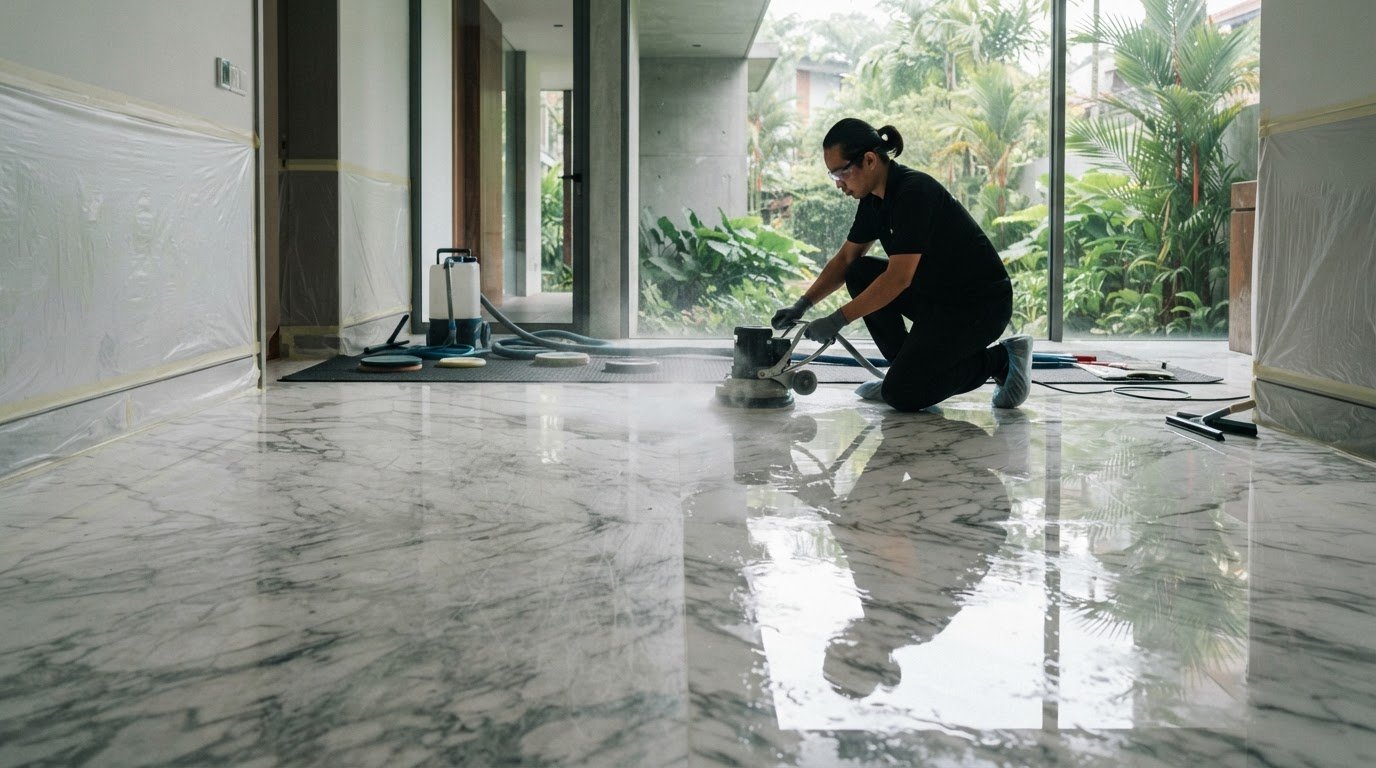
Precision begins long before heavy machinery powers on. Technicians mask perimeter baseboards, fixed cabinetry, and adjoining flooring with heavy-gauge protective barriers to prevent slurry contact. Next, specialized pH-neutral degreasers strip away old wax buildup, embedded oils, and soap residues. Industrial wet extractors continuously remove standing suspension fluid. This careful water containment guarantees an entirely dustless environment, preserving your indoor air quality throughout the operation.
Progressive Diamond Honing: Erasing Scratches and Etches
Eliminating physical damage relies on heavy rotary machines fitted with resin-bonded diamond abrasive discs. Honing follows a rigorous grit progression that levels high spots and erases scratches step by step:
- Coarse grits (50 to 100 grit): Cut through stubborn lippage, flatten irregular tile edges, and remove severe chemical burns.
- Medium grits (200 to 400 grit): Smooth out grinding marks left by coarse cutting, transitioning the stone into a smooth, honed matte texture.
- Fine grits (800 to 1500 grit): Tighten the stone pores, producing an elegant satin sheen as natural specular reflection begins to emerge.
Final Polishing, Buffing, and Densification
The transformation culminates at the ultra-fine stage. Technicians deploy micro-fine diamond discs reaching 3000 grit, followed by specialized polishing compounds rich in potassium oxalate. Driven by high-speed weighted rotary machines, these compounds trigger a controlled thermochemical reaction on the calcium carbonate surface. The reaction hardens the top mineral layer into a dense, wear-resistant finish. Technicians conclude with a detailed optical inspection across corner transitions and wide spans, ensuring a uniform, mirror-like clarity from wall to wall.

Professional Diamond Polishing vs. DIY Waxing and Buffing Compounds
Faced with fading luster, many property owners reach for off-the-shelf polishing kits or synthetic liquid waxes. While a quick bottle of retail acrylic promises instant shine, it fundamentally misunderstands stone physics. Restoring dull marble floors requires re-establishing an optically flat mineral surface, not encasing the stone under a layer of liquid plastic. Mechanical intervention treats the root cause of dullness, ensuring your natural stone breathes, reflects, and performs exactly as intended.
The Pitfalls of Topical Wax Coatings and Temporary Fixes
Consumer waxes create an impermeable barrier that suffocates natural stone. Moisture vapor naturally migrating through the concrete slab becomes trapped beneath this synthetic film, triggering white cloudy patches and yellow oxidation over time. Many retail restoration powders also contain acidic chemical blends; if you leave them on the floor seconds too long, they create fresh chemical burns instead of shine. Additionally, soft acrylic films scuff easily under shoe soles, harbor ground-in dirt, and turn walkways dangerously slick. Stripping away that degraded wax later requires aggressive chemical strippers that further compromise the underlying calcite.
The Lasting Value and Durability of Mechanical Polishing
Mechanical diamond honing delivers lasting structural correction rather than a fragile cosmetic film. Rotating diamond abrasives shave away micro-ridges and scratch valleys, leaving an authentic, mirror-smooth stone plane. Without sticky topical residues, dust and grime have no surface film to cling to, which makes routine maintenance substantially faster. The stone remains cool, slip-resistant, and chemically stable. Investing in mechanical diamond restoration eliminates the endless cycle of applying, stripping, and reapplying temporary waxes, reducing long-term floor care costs while keeping the finish pristine.
Entrusting your stone to an established professional cleaning company singapore ensures that every square foot receives calibrated rotary grinding tailored to its exact mineral hardness. When you're ready to revive your floors permanently, reach out to book our specialized marble floor polishing service and experience the timeless clarity of masterfully finished natural stone.
Preserving Your Restored Marble: Long-Term Sealing and Daily Care
Completing mechanical diamond restoration returns your stone to peak optical clarity. Protecting that investment requires establishing thoughtful daily habits and an effective barrier against future chemical contact. While restoring dull marble floors resolves years of built-up abrasions and acid burns, sound aftercare ensures you won't need corrective grinding again anytime soon. By pairing sub-surface sealing with gentle cleaning protocols, you keep the crystal matrix luminous and resilient.
The Role of Penetrating Impregnators vs. Film-Forming Sealers
Never protect polished marble with topical, film-forming sealers. Instead, apply a breathable penetrating impregnator. These sub-surface treatments sink deep into the stone's microscopic capillaries without leaving a plastic layer across the polished plane. The carrier solvent evaporates, leaving behind active hydrophobic and oleophobic fluoro-polymers that dramatically slow liquid absorption:
- Vapor transmission: Sub-surface sealers let interior slab moisture escape freely, preventing the milky efflorescence caused by trapped humidity.
- Stain resistance: Coffee, culinary oils, and water bead on the surface rather than soaking directly into open pores.
- The water droplet test: Place a few drops of clean water across high-traffic spots. If the water beads tightly after ten minutes, your seal is robust. If the stone darkens, it's time for a fresh impregnator application.
Establishing an Effective Daily and Weekly Cleaning Protocol
Routine care centers on removing dry abrasives before foot traffic grinds them down. Sweep floors daily using a dedicated, clean microfiber dust mop. Avoid traditional bristle brooms, which drag fine grit across the calcite and produce fresh micro-scratches. Place heavy-duty walk-off mats at all exterior doorways to capture grit and coarse particles at the threshold.
For weekly washing, adopt a two-bucket damp mopping method. Fill one bucket with warm water mixed with a dedicated, pH-neutral stone cleaner and the second with pure water for rinsing your mop head. This prevents redistributing dirty wash water back into delicate tile crevices. Completely avoid conventional cleaning agents, including:
- Bleach, ammonia, or multi-surface disinfectant sprays.
- Acidic limescale, grout, or toilet bowl solutions.
- Abrasive scouring powders or rough nylon scrubbing pads.
Whenever accidental spills occur, blot them immediately with a soft cloth rather than wiping, which spreads liquid over a wider area. These deliberate maintenance habits keep your natural marble flawless, preserving high-definition reflections for years after restoring dull marble floors.
Revitalize Your Marble Floors with Lasting Clarity
A cloudy, scratched stone floor doesn't signal the end of your investment. Because natural calcite responds exceptionally well to precision diamond resurfacing, restoring dull marble floors through systematic honing permanently erases micro-abrasions and acid etching at their source. Bypassing temporary synthetic waxes in favor of authentic mechanical restoration ensures your interior regains its genuine architectural radiance.
Athena Team Cleaning brings specialized technical expertise in diamond stone honing and polishing directly to your property. Our team utilizes systematic, dustless wet-grinding methods that safeguard surrounding furnishings and woodwork, upholding rigorous care standards that re-establish natural optical clarity without superficial coatings. When you're ready to elevate your living or working environment, restore the luminous, mirror finish of your natural stone with Athena Team Cleaning and enjoy the lasting peace of mind that comes with masterfully preserved stone.
Frequently Asked Questions
Why do marble floors turn dull even when mopped every day?
Marble floors turn dull because routine mopping only cleans surface dirt without correcting physical micro-abrasions. Daily footfall drags uncaptured silica dust across the delicate calcium carbonate surface, creating millions of tiny scratches that scatter light. Standard domestic detergents often carry improper pH balances, leaving behind an insoluble film or mildly etching the stone over time. Without mechanical resurfacing, mopping simply redistributes residue across an increasingly rough mineral plane.
Can dull marble floors be completely restored without removing the tiles?
Yes, dull marble floors can achieve a factory-grade mirror finish entirely in place without costly tile replacement. Systematic mechanical grinding with industrial rotary machines shears off only a few microns of damaged stone, leveling surface scratches and etch marks. As long as your subfloor is structurally stable and tiles remain firmly bonded, restoring dull marble floors in situ renews full optical clarity at a fraction of the disruption and expense of total removal.
How long does a professional marble floor polishing restoration last?
A professionally restored marble floor typically retains its brilliant polish for two to five years, depending on traffic density and maintenance discipline. Residential hallways and foyers with proper walk-off mats and daily microfiber dust mopping often maintain their reflection even longer. Scheduling light maintenance honing every two or three years prevents deep abrasion cycles, keeping the stone pristine without requiring aggressive coarse grinding down the road.
What is the main difference between marble polishing and floor waxing?
Marble polishing is a permanent mechanical resurfacing process, while waxing merely layers a temporary liquid plastic over existing damage. Polishing utilizes industrial diamond abrasives to smooth the physical stone crystals into an optically flat, reflective plane that breathes naturally. Conversely, synthetic waxes create a soft, non-breathable coating that traps moisture, discolors into a yellow haze, and scuffs quickly under foot traffic, ultimately requiring harsh chemical stripping.
Does professional diamond restoration create heavy dust inside the property?
Professional diamond restoration produces zero airborne dust because technicians utilize specialized wet-grinding protocols. Water is continuously introduced to the rotating diamond pads, transforming abraded stone particles into a manageable, contained slurry. Heavy-duty wet extractors vacuum this suspension fluid instantly from the floor plane. This sealed wet method completely protects adjacent interior living spaces, HVAC ventilation systems, and surrounding furniture from invasive, powdery stone dust.
How soon can we walk on the marble floors after restoration?
You can typically walk across the restored floor in clean stocking feet within two to four hours after technicians finish. Full chemical curing of penetrating impregnators generally takes 24 to 48 hours. During this initial curing window, keep wet spills, culinary oils, and street footwear off the surface. After this brief settling period, normal residential foot traffic can resume safely across the newly hardened stone.
Can deep etch marks and liquid stains be removed from marble?
Yes, both deep chemical etches and organic liquid stains are fully treatable with the proper technical protocol. Etching is a surface void that diamond grinding planes smooth, which makes restoring dull marble floors highly effective for acid damage. Deep liquid discoloration that has soaked into porous capillaries can be drawn out using dedicated poultice extraction pastes before technicians begin the final honing and sealing process.
Frequently Asked Questions
Why do marble floors turn dull even when mopped every day?
Can dull marble floors be completely restored without removing the tiles?
How long does a professional marble floor polishing restoration last?
What is the main difference between marble polishing and floor waxing?
Does professional diamond restoration create heavy dust inside the property?
How soon can we walk on the marble floors after restoration?
Can deep etch marks and liquid stains be removed from marble?
Related articles