

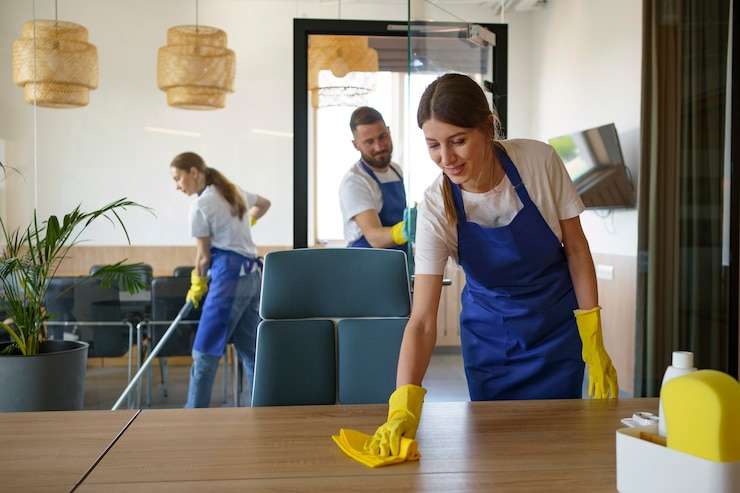
How do you clean an office daily in Singapore? Work through six zones in a fixed order every morning: workstations, high-touch surfaces, floors, pantry, restrooms, and glass partitions. In a typical 1,000 sq ft Singapore office, a trained cleaner completes this full routine in 60–90 minutes. The stakes are higher here than in most countries — Singapore's year-round humidity averages 80–85%, which means bacteria multiply faster on unwiped surfaces and mould can take hold in carpet fibres within 48 hours of moisture exposure.
This guide covers the exact daily routine, the products that work in Singapore's climate, a cost comparison between professional and in-house cleaning, and a written SOP checklist you can hand to any cleaner starting tomorrow. For a broader look at what daily professional cleaning does for your team, see our article on how office cleaning services keep your Singapore workplace safe and healthy.
The six-zone daily office cleaning routine
Break the office into six zones and clean them in the same sequence every day. Consistency matters because it prevents zones from being skipped when time is short. Most Singapore offices — whether a 400 sq ft HDB shophouse unit in Toa Payoh or a full floor in a Raffles Place tower — share the same core zones: workstations, high-touch surfaces, floors, pantry, restrooms, and glass partitions. Fix the order and your cleaner builds muscle memory that keeps the standard consistent even on a rushed morning.
Start at workstations and work outward. Wipe each desk surface, monitor bezel, keyboard tray, and phone handset with a microfiber cloth dampened with a neutral disinfectant. A 70% isopropyl alcohol solution or a diluted quaternary ammonium compound (QAC) works well on plastic and laminate. Avoid bleach on desk surfaces — it degrades the finish and the fumes linger in air-conditioned rooms. Finish with glass last so no airborne disinfectant spray settles on clean panes after wiping them.
Zone-by-zone timing guide for a 1,000 sq ft office
Zone 1, Workstations: 20 minutes. Zone 2, High-touch surfaces: 10 minutes. Zone 3, Floors (vacuum then mop): 20 minutes. Zone 4, Pantry: 15 minutes. Zone 5, Restrooms: 15 minutes. Zone 6, Glass partitions and ledges: 10 minutes. Total: 90 minutes. Scale proportionally — a 500 sq ft co-working unit takes around 45 minutes; a 3,000 sq ft open-plan floor needs 2.5 to 3 hours. Carpeted offices take roughly 20% longer than tiled or vinyl-floored spaces because vacuuming is slower than mopping. For a full breakdown of carpet care frequency, see our guide on how often to clean carpets in Singapore.
High-touch surfaces that spread illness fastest in Singapore offices
HealthHub Singapore notes that respiratory infections like the common cold and influenza spread primarily through contact with contaminated surfaces. In a typical office, the highest-risk surfaces are door handles, lift call buttons, light switches, shared keyboards, pantry fridge handles, and water cooler dispensers. These are touched dozens to hundreds of times a day but are often skipped during basic cleaning rounds because they do not look dirty.
Disinfect every high-touch point daily using a QAC wipe or a spray-and-wipe method. Contact time is where many offices go wrong: most commercial disinfectants need 30–60 seconds of wet contact on the surface to kill 99.9% of bacteria. Spray, wait, then wipe — do not spray and immediately wipe dry. That single habit difference separates offices that see two or three sick-day clusters per quarter from those with one or fewer.
Shared office equipment is another blind spot. Printers, scanners, and photocopier control panels are among the most-touched and least-cleaned surfaces in any Singapore office. Add them to the daily high-touch checklist even when they look clean. A small laminated reminder label near each machine prompting staff to wipe the panel after use reduces the burden between professional cleaning visits and builds a shared hygiene culture that a written SOP alone cannot create.
Pantry and restroom hygiene that meets NEA standards
The NEA's public cleanliness framework sets clear expectations for commercial premises, including documentation requirements and penalties for persistent unhygienic conditions. Daily pantry tasks that satisfy these standards: wipe all countertops and the sink basin, clean the exterior of the microwave and refrigerator, empty the bin and replace the liner, and check that no food is left uncovered on surfaces. Food residue in Singapore's heat attracts cockroaches within 24–48 hours — a genuine risk in older HDB shophouse offices where gaps in skirting boards give pests a route in.
Restroom protocols are non-negotiable for any office that receives client visits. Clean and disinfect toilet bowls, seats, and cisterns every day. Wipe all sink basins and faucets. Disinfect door handles on both sides — the inside handle carries more contamination because people touch it immediately after using the toilet before reaching the sink. Check and restock soap dispensers and toilet paper daily so staff are never left without supplies mid-afternoon, which is when restroom traffic typically peaks.
Odour control in singapore's humidity
Singapore's ambient humidity means pantries and restrooms need active odour management beyond surface cleaning alone. Run the exhaust fan continuously during office hours. Place an activated charcoal odour absorber near the bin — it lasts 4–6 weeks before replacement and works without chemical fragrance that some staff find irritating. For pantry bins, use bin bags with baking soda strips. These are small, low-cost steps that prevent the stale-air smell that clients notice the moment they step off the lift — an impression that is difficult to recover from regardless of how the meeting goes.
How singapore's climate shapes your daily cleaning approach
Singapore sits at 1.3 degrees north of the equator with year-round temperatures between 25°C and 33°C and average relative humidity of 80–85%. That combination accelerates mould growth, dust-mite reproduction, and bacterial colonisation on surfaces compared with temperate climates. A surface left unwiped for 48 hours in a Singapore office typically carries a higher bacterial load than the same surface in a London or Sydney office over the same period — the moisture acts as a growth medium that dry air would suppress.
This climate reality means some tasks that are weekly routines in cooler countries must be daily in Singapore. Wiping window ledges is one example: in a dry climate they stay clean for several days; here, condensation from air-conditioning settles dust onto ledges overnight. Entrance mats are another: during the Northeast Monsoon (November to January) and Southwest Monsoon (May to September), tracked-in moisture and mud from afternoon downpours can saturate entrance mats within two days if they are not vacuumed and spot-cleaned as part of the daily routine.
Air-conditioning shapes the cleaning requirement in a less visible way. Singapore offices run aircon 8–12 hours a day. Cold evaporator coils collect condensation, and when filters are clogged, the unit recirculates dust and mould spores across every desk in the room. While aircon servicing is a separate quarterly task, the cleaning crew should wipe air-return grilles weekly and flag visible mould on vent covers to building management immediately. The US EPA's mould cleanup guidance confirms that visible mould on HVAC components requires professional remediation — not just a surface wipe with a cloth.
Professional daily office cleaning vs. in-house cleaners: costs compared
The choice between a professional cleaning company and an in-house cleaner turns on office size, budget, and the cost of HR overhead. A professional cleaning company supplies trained staff, brings all equipment and chemicals, manages MOM work-pass compliance, and automatically sends a replacement when your regular cleaner is absent. An in-house cleaner gives you more scheduling flexibility, but you absorb the full HR cost: foreign worker levy (if applicable), CPF contributions, annual leave, medical leave, and uniforms.
For offices below 500 sq ft — common among startup teams in HDB shophouses or co-working hubs — a part-time cleaner three to five mornings per week is usually enough, costing $200–$400 per month through a cleaning company. Medium offices of 500–2,000 sq ft typically need a daily cleaner for 60–150 minutes, costing $350–$900 per month on a professional contract. Above 2,000 sq ft, a full-time in-house cleaner often becomes cost-competitive once you account for the management overhead a contract involves. Current pricing benchmarks are at our page on the cost of office cleaning services in Singapore.
One factor many office managers overlook is product quality. Professional companies use commercial-grade microfiber cloths rated for 300-plus washes, pH-neutral multi-surface disinfectants, and colour-coded cloths per zone — red for restrooms, blue for general surfaces — to prevent cross-contamination. Consumer-grade products from supermarkets fall short in high-footfall commercial environments. Consistent product quality and trained technique are among the primary benefits of hiring a cleaning company for your Singapore office.
Building a daily cleaning SOP your office will actually follow
A written Standard Operating Procedure is what separates offices that stay clean from those that gradually drift back to a baseline of dusty desks and sticky pantry counters. The SOP does not need to be complex: a single A4 sheet listing each zone, the tasks within it, the product to use, and a checkbox for daily sign-off. Post it inside the cleaning cupboard door. Date and initial each completed sheet and keep one month's worth in a binder — this gives you an audit trail if a hygiene complaint arises from staff or building management, and it satisfies the documentation requirements some commercial leases in Singapore include.
Train every cleaner — in-house or outsourced — on the SOP before they start. Cover four things: correct dilution ratios for disinfectants (over-diluting makes them ineffective; over-concentrating wastes product and irritates skin); the colour-coding system for cloths; proper disposal of waste containing food or biological matter; and the escalation path if they find a pest, a leak, or visible mould. Singapore's NEA requires commercial premises to maintain pest management records, so connecting the cleaning SOP to your pest contractor's quarterly visit schedule makes compliance straightforward rather than a separate administrative burden.
Review the SOP every quarter. As headcount grows, new zones appear — a second pantry, a nursing room, a server room with no-liquid rules near equipment racks. As better products arrive on the market, swap in improved options. A static SOP written two years ago is almost certainly missing something the office has since added. For a full framework on selecting and managing a professional cleaning partner, see our complete guide to choosing office cleaning services in Singapore.
Comparison at a glance
| Office size | Typical staff count | Daily clean time | Professional cost per month (SGD) | In-house cost per month (SGD) |
|---|---|---|---|---|
| Under 500 sq ft | 1–5 | 30–45 min | $200–$400 | $500–$900 |
| 500–1,000 sq ft | 6–12 | 60–90 min | $350–$600 | $900–$1,400 |
| 1,000–2,000 sq ft | 13–25 | 90–150 min | $500–$900 | $1,200–$1,800 |
| 2,000–5,000 sq ft | 26–60 | 2.5–4 hrs | $800–$1,500 | $1,800–$2,800 |
| Over 5,000 sq ft | 60+ | 4–7 hrs | $1,500–$3,000+ | $2,800–$4,500+ |
Frequently asked questions
How long does daily office cleaning take in Singapore?
For a typical Singapore office of 500–1,000 sq ft, a trained cleaner completes the full daily routine — workstations, high-touch surfaces, floors, pantry, and restrooms — in 60–90 minutes. Larger offices of 2,000–3,000 sq ft take 2.5–3 hours. Carpeted floors add roughly 20% to the overall time compared with tiled or vinyl surfaces because vacuuming is slower than mopping. Offices with multiple pantry stations or more than one restroom will also run longer than these baseline estimates.
What cleaning products are safe to use in a Singapore office every day?
The safest daily-use products are pH-neutral multi-surface disinfectants and 70% isopropyl alcohol wipes. Avoid strong bleach on work surfaces — it degrades laminate finishes and the fumes can irritate staff in enclosed, air-conditioned rooms. For floors, a neutral floor cleaner diluted per the manufacturer's ratio is sufficient; undiluted product leaves residue that attracts more dust. If reducing chemical exposure matters for your team, enzyme-based cleaners break down organic matter without harsh fumes and perform well in Singapore's humid conditions. Greener options are covered in our guide on eco-friendly office cleaning in Singapore.
How often should office carpets be professionally cleaned in Singapore?
High-traffic areas — corridors, meeting rooms, and reception zones — need vacuuming daily as part of the standard cleaning routine. Steam cleaning should happen every 3–6 months in Singapore, more often than in temperate climates because humidity causes moisture and dust to bind in carpet fibres, creating conditions for dust mites and mould. If you notice a musty smell from carpeted areas after a wet day, schedule a steam clean sooner rather than waiting for the next scheduled service. Our full frequency guide is at how often to clean carpets in Singapore.
Can a small HDB office manage daily cleaning without a professional company?
Yes — many small offices with five or fewer staff manage daily cleaning through a part-time cleaner or a staff rota. The requirements are: a commercial vacuum, colour-coded microfiber cloths, a neutral disinfectant, and a written checklist so nothing is skipped. Where in-house cleaning typically falls short is consistent disinfection of high-touch points and proper restroom technique — these are the areas that benefit most from trained professional staff. Once headcount grows past 10, the daily workload usually justifies outsourcing, and the cost is often less than most managers expect.
What does a professional daily office cleaning service cost in Singapore?
Prices vary by office size and how many days per week you need service. A small office under 500 sq ft cleaned five mornings per week typically costs $200–$400 per month. A medium office of 1,000–2,000 sq ft runs $500–$900 per month for daily service. These figures reflect market rates as of 2026; CBD locations and upper floors without lift access for equipment sometimes carry a small surcharge. Get at least three written quotes before committing to a contract. Full pricing benchmarks are on our page covering the cost of office cleaning services in Singapore.