

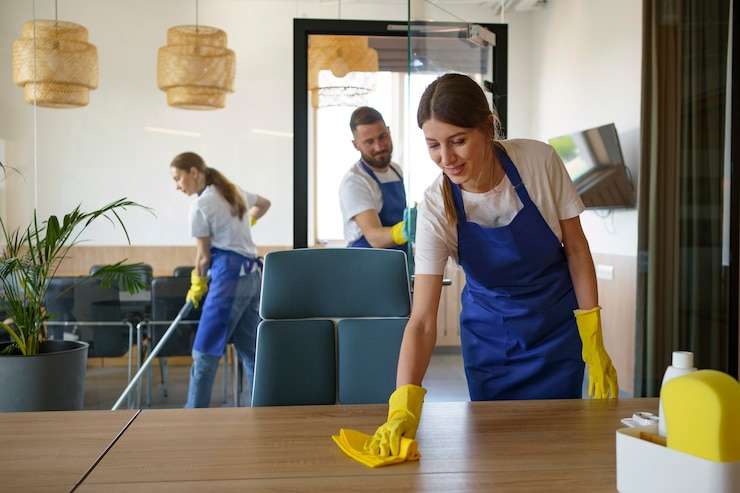
Knowing how to clean your office desk in Singapore properly comes down to two habits: a 2-minute daily wipe with a disinfectant and microfibre cloth, and a 20–30 minute weekly deep-clean covering your keyboard, screen, and cables. In Singapore's climate — average relative humidity of 80–90% year-round — bacteria multiply on surfaces far faster than in temperate countries, turning a neglected desk into a genuine health risk. HealthHub Singapore lists surface hygiene as one of the top preventive measures against common infectious illness spread in shared spaces.
Whether you work from a home office in a Tampines HDB flat or an open-plan space in Raffles Place, the same core routine applies. The main variable is how often the desk is shared: a hot desk used by multiple people needs disinfecting before and after every session, while a private home-office desk runs on a weekly deep-clean cycle with quick daily touch-ups in between.
Why singapore's climate makes desk bacteria a real health issue
The humidity factor
Singapore sits at roughly 1.3°N latitude with average relative humidity between 80% and 90% year-round. The NEA's public cleanliness guidance identifies high ambient humidity as a primary driver of rapid microbial growth on indoor surfaces. At these humidity levels, moisture settles on cool surfaces — including your desk — and bacteria can double in number roughly every 20 minutes when even small amounts of organic matter, such as food crumbs or skin cells, are present. This is not a theoretical risk; it is the reason a desk that looks perfectly clean on Monday morning can carry a meaningful bacterial load by Wednesday afternoon.
Air-conditioned offices compound the problem. AC units cycle humid outdoor air through the space, and the resulting temperature differential encourages condensation on surfaces close to vents. Mould spores — identified by the US EPA's indoor air quality guidance as a leading cause of respiratory irritation — can begin colonising porous desk materials like untreated wood or fabric cable tidies within 24–48 hours of exposure. This matters especially in newer BTO flats where rooms are compact and ventilation is limited.
What actually lives on your desk right now
A University of Arizona study by microbiologist Dr Charles Gerba found that the average office desk carries around 400 times more bacteria per square inch than a toilet seat. Repeated hygiene audits across shared offices in the UK and Australia have consistently placed keyboards and mouse surfaces among the top ten germiest contact points in any workplace. Singapore's ambient humidity extends bacterial survival time on surfaces — meaning the risk compounds with every hour a desk goes uncleaned.
The main species found on office desks — Staphylococcus (spread by hand contact), E. coli (linked to eating at the desk), and Pseudomonas (thrives in moist conditions) — can persist on hard surfaces for up to 72 hours. In a shared office where a sick colleague uses a hot desk, that 72-hour window means the contamination chain runs through two full working days without intervention. How office cleaning services in Singapore keep workplaces safe and healthy explains how systematic sanitisation breaks that chain at the organisational level.
Supplies you need and what they cost in Singapore
Using the wrong product on the wrong surface causes permanent damage — bleach on a lacquered wood desk strips the finish, and standard antibacterial wipes ruin anti-glare screen coatings. Before starting, gather the right materials. Everything below is available at FairPrice, Guardian, Watsons, Challenger, or on Lazada and Shopee.
- Microfibre cloths ($5–$12 for a pack of 5): Essential for screens and sealed surfaces. Buy two sets — one for screens, one for hard surfaces — and wash them weekly. Paper towels scratch surfaces over time and should be avoided.
- Disinfectant spray or wipes ($8–$25 per bottle/pack): Look for at least 70% isopropyl alcohol (IPA) or a quaternary ammonium compound. Dettol Multi-Purpose Disinfectant Spray, Zoono Z71 Surface Microbe Shield, and Cif Multi-Surface Spray are all widely stocked. Always spray onto the cloth, not directly onto the desk surface or near electronics.
- Compressed air canister ($8–$15 at Challenger or Sim Lim Square): The only practical way to clear debris from keyboard gaps without removing keycaps. One can handles roughly 4–6 thorough keyboard cleans.
- Screen-safe cleaning solution ($10–$20 for a kit with cloth): Standard disinfectant degrades anti-glare coatings with repeated use. Use a product specifically labelled screen-safe — the Logitech or 3M screen cleaning kits are reliable options at IT stores in Sim Lim or online.
- Cotton swabs ($2–$4 for a box): For cleaning between keyboard keys, USB ports, and tight cable-channel corners after removing bulk debris with compressed air.
Total setup cost for a first-time kit runs roughly $33–$76 SGD. Monthly running costs — replacing wipes and an occasional compressed air canister — typically stay below $15/month for a single-person home office. For a shared office with 10 or more workstations, budget $30–$60/month in supplies on top of any professional cleaning contract.
Step-by-step: how to clean your office desk in Singapore
Step 1 — clear and declutter
Remove everything from the desk: monitors (or shift them back), keyboard, mouse, notebooks, cups, stationery. Throw away rubbish immediately — used tissues, food wrappers, and old receipts are bacteria reservoirs. Wipe each item down before returning it to the desk, not after placing it back. Most people lose time at this step by cleaning around objects rather than removing them, which means the surface underneath never gets properly disinfected.
Step 2 — dust, then disinfect (always in this order)
Use a dry microfibre cloth to dust the desk surface, monitor bezels, and any shelving above the desk. Dusting after disinfecting is a common mistake — you end up spraying dust particles back onto a wet surface. Once dusted, spray your disinfectant onto the cloth and wipe all hard surfaces in overlapping strokes. Pay extra attention to the mouse pad area, wrist rest, and any surface within 30 cm of where your hands rest during a typical session.
Step 3 — keyboard and mouse
Tilt the keyboard upside-down over a bin and tap the back firmly — the debris that falls out is usually more substantial than expected. Use compressed air in short bursts between the keys. Follow with a cotton swab dipped in 70% IPA around each keycap edge. Wipe the mouse body, scroll wheel, and underside with an IPA wipe. Leave both to air-dry for 5 minutes before reconnecting power — alcohol evaporates quickly, but you want the surface fully dry before use.
Step 4 — screen
Apply 2–3 pumps of screen-safe solution to a clean microfibre cloth — never directly to the screen panel. Wipe in gentle circular motions from the centre outward. One pass clears fingerprints; a second dry-cloth pass removes any streaks. Tissue, paper towels, and newspaper all scratch anti-glare coatings with repeated contact and should never be used on display surfaces.
Step 5 — cables and underdesk
Wipe exposed cable runs with a slightly damp cloth. If you have a cable tray or basket under the desk, vacuum it or use compressed air — these spots accumulate dust at a rate that affects air quality in a small enclosed home office. The US EPA's indoor air quality guidance identifies settled dust as one of the top contributors to poor indoor air quality, and underdesk cable bundles are among the most consistently overlooked dust traps in any workspace.
How often to clean each part of your desk
Frequency depends on how intensively the desk is used and whether it is shared. The table below covers typical Singapore scenarios. The baseline rule is straightforward: more users means more cleaning. A shared hot desk in a co-working space in one-north or Tanjong Pagar needs disinfecting before and after every session — not just for self-protection, but as a courtesy to the next user.
Keyboards are the most neglected item and often the most contaminated. Repeated hygiene audits across shared offices in Western countries consistently place keyboards among the top germiest surfaces in any workplace, and Singapore's humidity extends the survival time of bacteria already present on the surface. A weekly keyboard clean is the minimum; twice weekly if you eat at your desk. This is one area where the benefits of hiring a cleaning company for your Singapore office are tangible — professional teams clean keyboard surfaces far more thoroughly than most DIY routines, using compressed air systems and specialist wipes unavailable in consumer retail.
Screen cleaning is lower-priority from a hygiene standpoint but matters for eyestrain and visual comfort. A visibly smudged monitor requires more visual effort to read, which contributes to end-of-day headaches. Clean screens once a week or whenever fingerprints are visible — whichever comes first. Phone handsets and headsets, if present on the desk, should be wiped daily since they contact the skin near the mouth and eyes directly.
When to bring in a professional office cleaning team
DIY cleaning covers daily hygiene, but certain situations call for professional service. If you or a colleague has been ill with a respiratory or gastrointestinal infection, a professional disinfection using hospital-grade electrostatic sprayers is far more reliable than home-grade spray-and-wipe. Post-illness professional cleaning matters especially in Singapore's open-plan offices, where workstations are typically 1–2 metres apart and cross-contamination risk is high.
NEA's public cleanliness standards require commercial premises to maintain a defined hygiene standard. For businesses, a documented professional cleaning schedule helps demonstrate compliance during inspections — particularly relevant for offices in the food, healthcare, and education sectors. Before committing to a contract, read the complete guide to choosing office cleaning services in Singapore, since coverage and pricing vary widely between providers.
Professional teams bring tools unavailable at a consumer level: HEPA-filter vacuums for allergen removal, electrostatic sprayers that coat the undersides of shelves and backs of monitors with a uniform film of disinfectant, and hospital-grade solutions rated to eliminate 99.9% of common pathogens. For a full picture of what each tier covers, see the cost of office cleaning services in Singapore — a single-session desk disinfection runs $80–$150 in 2026, while a bi-weekly contract for a 10–15 person SME office typically falls in the $400–$600/month range. There is also a measurable business case: office cleaning services in Singapore are associated with higher workplace productivity, with surveys linking professionally maintained offices to lower absenteeism and higher self-rated focus scores among staff.
Keeping your desk clean between professional visits
Professional cleaning does the heavy lifting every few weeks, but the gap between visits is where daily habits determine whether your desk stays genuinely hygienic or just looks tidy. The single most impactful change is eliminating food at the desk. Food crumbs are the primary fuel source for bacterial growth and attract ants — a persistent problem in Singapore, particularly in lower-floor HDB units near green corridors. If eating at your desk is unavoidable, wipe the surface down immediately after using an antibacterial cloth. Keeping a pack of wipes in a desk drawer removes any friction from that habit.
Cable management also matters more than most people realise. Tangled cables trap dust and slow air circulation, which in Singapore's humidity means surfaces between cable bundles stay damp longer. A simple velcro cable tie ($5–$10 at Daiso or Don Don Donki) groups cables neatly and makes it possible to wipe the full desk surface in one continuous pass — a small change that cuts weekly cleaning time roughly in half.
Think beyond the desk surface itself. How often you clean carpets in Singapore directly affects air quality above your desk — dust from uncleaned office carpets resettles on every horizontal surface in the room. Office chairs with fabric seats and backs also hold dust mites and should be vacuumed monthly. A spotless desk in a dusty room is only half the job.
Comparison at a glance
| Method | Recommended frequency | Time per session | Approx cost (SGD) | Best for |
|---|---|---|---|---|
| Daily surface wipe (DIY) | Daily | 2–3 min | <$5/month in supplies | All desk users — minimum baseline |
| Weekly deep clean (DIY) | Weekly | 20–30 min | $10–$20/month in supplies | Private home office, single user |
| Professional one-off disinfection | Post-illness or quarterly | 1–2 hours | $80–$150 per session | Shared desks, post-sick leave, BTO home offices |
| Bi-monthly professional clean | Every 2 months | 1–2 hours | $200–$400 per visit | SME offices, 5–10 workstations |
| Regular cleaning contract (weekly) | Weekly, ongoing | Varies by office size | $300–$800/month | Open-plan offices, 10+ staff, compliance-sensitive sectors |
Frequently asked questions
What disinfectant products are safe to use on an office desk in Singapore?
Products containing at least 70% isopropyl alcohol (IPA) or a quaternary ammonium compound are safe for most hard desk surfaces including laminate, glass, and metal. Dettol Multi-Purpose Disinfectant Spray, Zoono Z71 Surface Microbe Shield, and Cif Multi-Surface Spray are widely available at FairPrice and Guardian. Avoid bleach solutions on lacquered or painted wood — they strip the finish over time. For screens and keyboard surfaces, use IPA-based wipes rather than water-based cleaners, since water can seep under keycaps or behind screen edges and cause lasting damage.
How often should I clean my office desk in Singapore compared to offices in other countries?
More often. Singapore's 80–90% year-round humidity means surfaces stay moist longer and bacteria multiply faster than in a temperate climate. Most international hygiene guides recommend a weekly deep clean for private desks, but in Singapore a daily 2–3 minute wipe with disinfectant is a sensible addition to that routine. In a shared or hot-desk environment, wipe the surface, keyboard, and mouse before each session regardless of what the previous user did. This is higher-frequency than recommendations designed for drier climates, but it reflects Singapore's actual conditions.
Can I use the same antibacterial wipes on my desk and on my laptop screen?
No. Standard antibacterial wipes — including Dettol and Clorox wipes — contain compounds that degrade anti-glare screen coatings with repeated use. Use them on your desk surface, mouse body, keyboard casing, and monitor bezel, but not on the screen panel itself. For the screen, use a microfibre cloth with a purpose-made screen cleaner, or a dry microfibre cloth for light dust removal. The same applies to phone screens and tablet displays used at the same workstation.
How much does professional desk and workstation cleaning cost in Singapore?
A single-session professional desk disinfection typically costs $80–$150 in 2026, depending on the number of workstations and the depth of service required. Some providers price on a per-desk basis at $20–$40/desk for larger offices. A bi-weekly cleaning contract for a 10–15 person SME office in Singapore typically runs $400–$600/month, usually covering all workstations, shared surfaces, and common areas. For a full cost breakdown by service type and office size, see cost of office cleaning services in Singapore.
Does eating at my desk make it notably dirtier in singapore's climate?
Yes, substantially. Even crumbs not visible to the naked eye provide enough organic matter to sustain bacterial colonies, and Singapore's humidity accelerates that growth considerably. HealthHub Singapore recommends minimising food contact with shared surfaces as one of its core workplace hygiene practices. If eating at your desk is unavoidable, wipe the surface immediately after with an antibacterial cloth — a habit that takes under a minute and notably extends the effective life of your weekly deep clean.
Sources
Related Athena cleaning services in Singapore
- how office cleaning services singapore keep workplace safe healthy
- benefits of hiring cleaning company singapore office
- complete guide choosing office cleaning services singapore
- cost of office cleaning services singapore
- boosting productivity how office cleaning services in singapore can make a difference