

The fastest way to declutter your office desk in Singapore is to clear the surface completely, sort everything into three piles — keep, store, and discard — deep-clean the bare desk, and put back only what you use every day. Knowing how to do this efficiently matters in Singapore's context: compact offices, up to 85% indoor relative humidity, and document compliance requirements all make desk organisation more than a cosmetic task.
Whether you work in a Marina Bay Financial Centre open-plan floor, a one-room co-working booth at Tanjong Pagar, or a HDB bedroom doubling as a home office, this guide covers the complete process — from the initial clear-out to the habits that stop the desk sliding back into chaos. Run it once this week, and about five minutes of daily attention is all you need after that.
Why a cluttered desk costs you more in Singapore offices
Office space in Singapore's Central Business District averages S$10–S$14 per square foot per month, based on Knight Frank's 2025 commercial market data. That's not a figure that rewards using prime desk surface as a filing cabinet. Every square foot buried under old printouts, cables, and unused stationery is space you're paying rent on without any productive return.
Visual clutter competes for the brain's attention and reduces sustained concentration — a relationship well-documented in occupational health research and reflected in resources like HealthHub Singapore's healthy living guidance. For Singapore workers managing tight project timelines and back-to-back video calls, that hidden drag adds up across the week in ways that are hard to attribute but real in their effect on output quality.
There is also a hygiene dimension specific to our climate. Singapore's indoor relative humidity sits between 70% and 85%, even in air-conditioned offices. NEA public cleanliness guidance flags damp, cluttered surfaces as prime environments for dust mite colonies and mould growth. A desk piled with papers is a moisture trap — each page holds humidity, restricts airflow, and creates a slow build-up of allergens that affects respiratory health over months of continuous exposure.
What to prepare before the clear-out
A proper desk declutter for an average Singapore office worker takes 90 minutes to three hours, depending on how long clutter has been accumulating. Block that time in your calendar before you begin — interrupted sessions almost never get completed, and a half-finished declutter leaves your staging area in worse shape than the desk was to start with.
Gather these before you touch anything: two microfiber cloths (one damp, one dry), a surface-safe disinfectant spray such as Dettol Multi-Purpose Cleaner, three boxes or bags labelled Keep, Store, and Discard, a roll of sticky labels or a label maker, and a bin bag. If your desk has a hutch or overhead shelves, clear a nearby table or floor area to use as a staging surface while you sort items.
Before touching the desk, take a photograph of it in its current state. People consistently underestimate how much is on their desk until they look at it in a flat image rather than three-dimensionally in person. The photo also serves as a before-and-after reference later — that contrast is a useful reminder of why the daily reset habit matters once you've done the work. In corporate environments it can also document workstation condition for facilities records.
The step-by-step process to declutter your office desk
Step 1 — clear everything off the surface
Move every object off the desk: monitor, keyboard, mouse, phone, cables, papers, stationery, food items, and personal belongings. Place everything on the staging area. Do not sort as you go — decision fatigue during removal slows the process and leads to poorly considered choices. The goal is a completely bare desk surface within 15 minutes.
Step 2 — deep-clean the bare surface
With the desk empty, clean it thoroughly — something you cannot do when it is covered. Wipe the surface with the damp microfiber cloth, apply disinfectant spray, and follow with the dry cloth. Get into the edges and back panel. Clean inside each drawer, wipe the drawer slides, and disinfect the handles. Check the underside of the desk surface for sticky tape residue and the back panel for mould spotting — both are common on Singapore office desks that have not been cleaned in six months or more.
If you find mould on the surface, treat it before returning any items. A diluted bleach solution (1 part bleach, 10 parts water), applied and left for 10 minutes, handles surface mould on non-porous laminates. For porous surfaces or patches larger than 30cm, the US EPA indoor air quality guidance recommends professional assessment rather than DIY removal.
Step 3 — sort every item into three categories
Go through everything on the staging area. For each item, make one decision: Keep (used daily on the desk), Store (used occasionally, belongs in a drawer or cabinet), or Discard. Be strict — anything not touched in the past month belongs in Store at best, not on the primary surface. For paper documents, apply PDPA requirements before discarding: anything containing client names, NRIC numbers, or financial data must go through cross-cut shredding, not the general bin. Most Singapore corporate offices have a confidential waste bin managed by the facilities contractor. For a home office, a personal shredder runs S$30–S$80 at Popular or Challenger and pays for itself in compliance peace of mind after a single clear-out.
Step 4 — return only what earns its place
Return items to the desk in priority order. The primary zone — the space within arm's reach of your seated position — should hold only what you use multiple times per day: screen, keyboard, mouse, phone, one notebook, and one pen. Everything else goes into drawers, a shelf, or a cabinet. When you are done, the desk should have clear surface space to the left and right of the screen — if it doesn't, something is still on the desk that belongs in storage.
Storage solutions for singapore's compact offices
Once the desk is clear, keeping it that way requires storage infrastructure that actually fits Singapore's office conditions. In most HDB home offices and smaller commercial units, storage has not been designed around the desk, so items default to sitting on it. A few targeted purchases remove that excuse entirely.
A monitor riser with a drawer shelf underneath provides vertical lift for the screen and a flat storage tier at the same time. IKEA's ELLOVEN model costs around S$50 and suits compact Singapore home office desks well. Pair it with a desktop drawer unit — IKEA's ALEX drawer unit at S$130–S$180 depending on depth fits under most standard desks and gets everything off the primary surface with proper compartmentalisation.
For cables, self-adhesive trunking fixed to the underside of the desk keeps power and USB cables off the surface entirely. Bunnings and Shopee both carry cable trunking for S$10–S$25 per metre, and the visual difference after cable management is larger than most people expect before they try it. A label maker (S$25–S$60 at Challenger) applied to drawer fronts eliminates the habit of leaving frequently-needed items on the desk because you forget which drawer holds what.
The table below compares four common desk organisation approaches by cost, time, and suitability for Singapore's humidity — use it to decide which fits your workspace before investing in storage products.
How singapore's humidity changes your organisation strategy
Most international desk organisation guides ignore humidity entirely. For Singapore offices — particularly HDB home offices where air-conditioning runs on a timer rather than continuously — humidity is a practical constraint that shapes what you store and how you store it.
Paper absorbs moisture. A stack of printouts left on a desk in a room where air-conditioning has been off overnight can develop a musty smell within 48 hours, and visible mould spotting within a week if the papers are against a surface with poor airflow. The fix is to get paper off the desk and into enclosed storage with ventilation gaps: a proper filing cabinet protects paper better than an open shelf for this reason, because it limits humidity exposure without sealing moisture inside.
For items stored inside desk drawers, silica gel desiccant packets are inexpensive insurance. A 10-pack costs around S$5–S$8 at Daiso. Place one packet in each drawer and replace it every three months — most packets change colour when saturated, so the timing is easy to track. This matters especially for MDF and particleboard desks, which can warp and develop surface mould when drawer contents stay damp repeatedly over time.
The same humidity logic applies to flooring and how often you should clean carpets in a Singapore office — floor-level dust and moisture accumulation compound each other, and a clean floor around a clean desk is part of the same overall workspace health system rather than a separate concern.
Building habits that keep the desk clear long-term
The declutter process gives you a clean desk once. Habits are what keep it that way. Without a short daily routine, most desks return to their previous state within two to three weeks — not because people are careless, but because there is no designated home for items that land on the desk during the day, so they accumulate by default.
The most effective habit is a five-minute end-of-day reset. Before leaving your desk or closing your laptop, return every item to its designated place, dispose of waste, and wipe the surface with a dry cloth. Five minutes is the right scope — fast enough to feel trivial, thorough enough to prevent small accumulations from becoming large ones. This is where most of the ongoing productivity benefits of a consistently clean office environment are captured, not in the quarterly clear-out.
Add a 10-minute audit on Friday afternoon for anything the daily reset missed: papers that built up in the inbox tray, cables that migrated to the surface, stationery that drifted from its drawer. Many Singapore facilities managers run a building-wide tidying push in January and July — aligning your personal desk declutter with those dates gives you a consistent external anchor and means the office around you is organised at the same time you are.
When to bring in professional office cleaning help
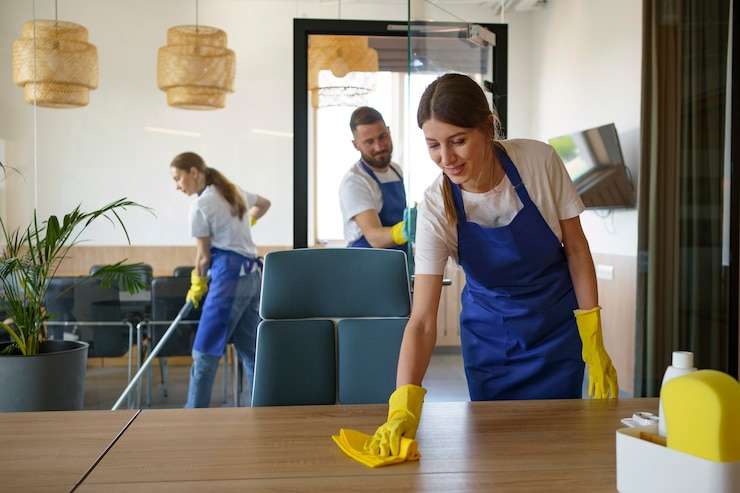
Decluttering your desk is personal work — only you know which items to keep and which to discard. The deeper cleaning that follows, and the ongoing maintenance of chairs, carpets, partition panels, and air-conditioning filters, is often better handled by a professional team. This is especially true in commercial offices where individual responsibility ends at the workstation surface and the rest falls to facilities management.
In Singapore, professional office cleaning contracts typically cover daily surface cleaning, waste removal, and common area maintenance. Deep cleaning of individual workstations — keyboards, monitor screens, chair upholstery, and cable areas — is usually priced separately and scheduled quarterly or on request. If your office has not had a workstation deep clean in six months, requesting one is worth it. Our complete guide to choosing office cleaning services in Singapore covers what to look for in a contract and how to evaluate competing providers before signing.
For HDB home offices, a quarterly professional clean of the room — desk surface, chair, shelves, and floor — runs around S$80–S$150 for a standard bedroom-sized space, depending on the provider and the scope requested. Most providers offer a one-off rate for clients who do not want a recurring contract. The cost of office cleaning services in Singapore varies notably by job type and frequency, so it is worth understanding the pricing structure before committing. If you are still weighing in-house versus outsourced cleaning, the benefits of hiring a cleaning company for a Singapore office lay out the productivity and hygiene case clearly — for many businesses, the numbers favour outsourcing even at modest cleaning frequencies.
Comparison at a glance
| Approach | Best suited for | Setup cost (SGD) | Time to implement | Humidity risk |
|---|---|---|---|---|
| Clear desktop — all items in closed drawers or cabinets | HDB home offices, compact co-working desks | S$0–S$50 | 1–2 hours | Low — closed storage limits moisture exposure to paper |
| Zone-based system — primary, secondary, and tertiary desk zones | Corporate open-plan offices | S$50–S$150 | 2–4 hours | Medium — paper left in secondary zone absorbs ambient humidity |
| Digital-first — scan documents, cross-cut shred originals | Admin-heavy or PDPA-compliance roles | S$100–S$300 (scanner cost) | 4–8 hours initial setup | Very low — minimal paper remains on or near desk |
| Professional organising service — on-site organiser sets up system | Long-term accumulation, shared office areas | S$200–S$500 per session | Half-day on-site | Low — organiser sets up correctly sealed and ventilated storage |
Frequently asked questions
How long does it take to properly declutter an office desk in Singapore?
For a desk with months of accumulated clutter, expect 90 minutes to three hours for the initial clear-out, sort, and reorganisation including surface cleaning and storage setup. If you are doing a quarterly maintenance session on a desk that is already broadly tidy, 30 to 45 minutes is more realistic. The most common mistake is starting without blocking enough calendar time — an interrupted session almost never gets completed, and a half-finished declutter leaves your staging area in a worse state than the desk was before you started.
What should I do with old documents when decluttering my desk in Singapore?
Sort documents into three groups: archive (transfer to a filing cabinet or scan to digital storage), shred (anything containing personal data covered by the PDPA — client names, NRIC numbers, financial records, employment details), and recycle (non-sensitive waste paper). Putting PDPA-covered documents in a general bin is a compliance breach — cross-cut shredding is the minimum acceptable disposal standard. Most Singapore corporate offices have a confidential waste bin managed by a facilities contractor. For a home office, a personal shredder costs S$30–S$80 at Popular or Challenger and handles the problem permanently.
How often should I do a full desk declutter?
A full clear-everything-off declutter works well quarterly — four times per year — with a five-minute daily reset and a 10-minute weekly tidy in between. The quarterly session handles items that have crept back: stationery that has accumulated, outdated reference materials, and cables that migrated to the surface. Aligning it with your workplace's building-wide cleaning schedule is the most practical approach. Many Singapore facilities managers push a major clean in January and July, which gives you a natural anchor point without needing to track the date separately.
Does singapore's humidity affect which desk storage products I should buy?
Yes, meaningfully. In Singapore's climate — indoor humidity of 70–85% even in air-conditioned spaces — fully open wire mesh trays and uncovered paper trays expose contents to ambient moisture, which leads to musty smells and mould within weeks on paper and cardboard items. Closed drawer units with small ventilation gaps are the right balance: they protect contents from humidity without trapping moisture inside a sealed container. Add silica gel desiccant packets to each drawer (around S$5–S$8 for a 10-pack at Daiso, replaced every three months). Avoid unsealed MDF storage products — they swell and distort in Singapore's humidity over 12 to 18 months of regular use.
Is there a quick method to declutter my desk if I only have 30 minutes?
Yes — use the minimum viable desk approach. Set a timer and spend the first 10 minutes moving everything off the desk into a labelled box. In the next 10 minutes, return only five items: screen, keyboard, mouse, phone, and one notebook. In the final 10 minutes, move the box somewhere accessible but off the desk entirely. The desk is immediately usable. Over the following week, deal with the box item by item — giving each thing a proper home rather than rushing all decisions at once. This avoids the common outcome where a rushed declutter simply shifts clutter from the desk surface to a pile on the floor beside it.
Sources
- HealthHub Singapore's healthy living guidance
- NEA public cleanliness guidance
- US EPA indoor air quality guidance