
Benefits of Professional Office Cleaning: 2026 Guide
In this article
- Key Takeaways
- Table of Contents
- Beyond Aesthetics: How Commercial Cleanliness Directly Influences Operational Performance
- Measurable Health Gains: Mitigating Sick Leave and Pathogen Transmission
- Economic Realities: In-House Ad-Hoc Chores vs. Contracted Cleaning Services
- Capital Asset Protection: Extending the Lifespan of Commercial Interiors
- Structuring an Effective Commercial Maintenance Strategy for Long-Term Value
- Transform Your Workplace Into a Resilient Commercial Asset
- Frequently Asked Questions
What if the greatest drain on your workforce's focus isn't meeting fatigue, but the physical condition of the workplace itself? For business leaders evaluating facility operations, the true benefits of professional office cleaning extend far beyond surface shine. You already recognize the daily friction: cluttered shared spaces that chip away at morale, seasonal illnesses that circulate rapidly through open-plan desks, and the quiet resentment that sparks when talented employees are asked to handle chore rotations.
Your team deserves a healthy space that fuels clear concentration, just as your brand deserves an immaculate environment that commands immediate respect from visiting clients. In this 2026 guide, you'll discover how scheduled commercial care elevates workforce productivity, protects corporate capital assets, and establishes a hygienic, high-performance working environment. Here is your operational roadmap to reducing avoidable absenteeism, extending interior finish lifespans, and turning routine maintenance into a measurable business advantage.
Key Takeaways
- Explore the core operational benefits of professional office cleaning, moving beyond surface appearances to enhance focus and reduce daily cognitive fatigue.
- Uncover how structured sanitization protocols curb transmission across high-touch germ vectors to mitigate costly sick leave.
- Compare the hidden operational expenses of internal chore rotations against contracted services to protect staff morale and billable hours.
- Learn how targeted flooring and fixture care shields corporate capital assets from premature wear and costly leasehold dilapidations.
- Master a step-by-step facility audit framework to establish traffic-based zoning and an optimal commercial maintenance schedule.
Beyond Aesthetics: How Commercial Cleanliness Directly Influences Operational Performance
A tidy desk looks appealing, but commercial hygiene runs deeper than visual presentation. One of the foundational benefits of professional office cleaning is how it transforms the physical workspace into a strategic driver of workplace efficiency. Unaddressed dust reservoirs, grimy conference electronics, and cluttered pantries place a continuous background tax on mental focus, draining executive bandwidth long before mid-afternoon arrives.
Defining Systematic Commercial Cleaning Standards
Superficial tidying merely rearranges surface dust. By contrast, contracting established commercial cleaning services introduces rigorous checklists, calibrated chemistry, and institutional accountability to your facility. Professional crews follow methodical workflows designed around operational continuity, ensuring deep sanitization happens without interrupting daily business operations. Setting these structured maintenance baselines eliminates hygiene bottlenecks during peak quarters, allowing operations to scale smoothly without facility decay.
The Cognitive and Morale Impact of Workspace Order
The human brain struggles to ignore chaotic surroundings. Physical clutter and neglected communal areas continually compete for neural attention, subtly increasing daily stress and accelerating cognitive fatigue. When leadership invests in dependable, high-standard facility upkeep, it sends an unambiguous message to the entire team: their comfort, health, and focus matter.
Realizing the operational benefits of professional office cleaning is often most visible across core communal zones:
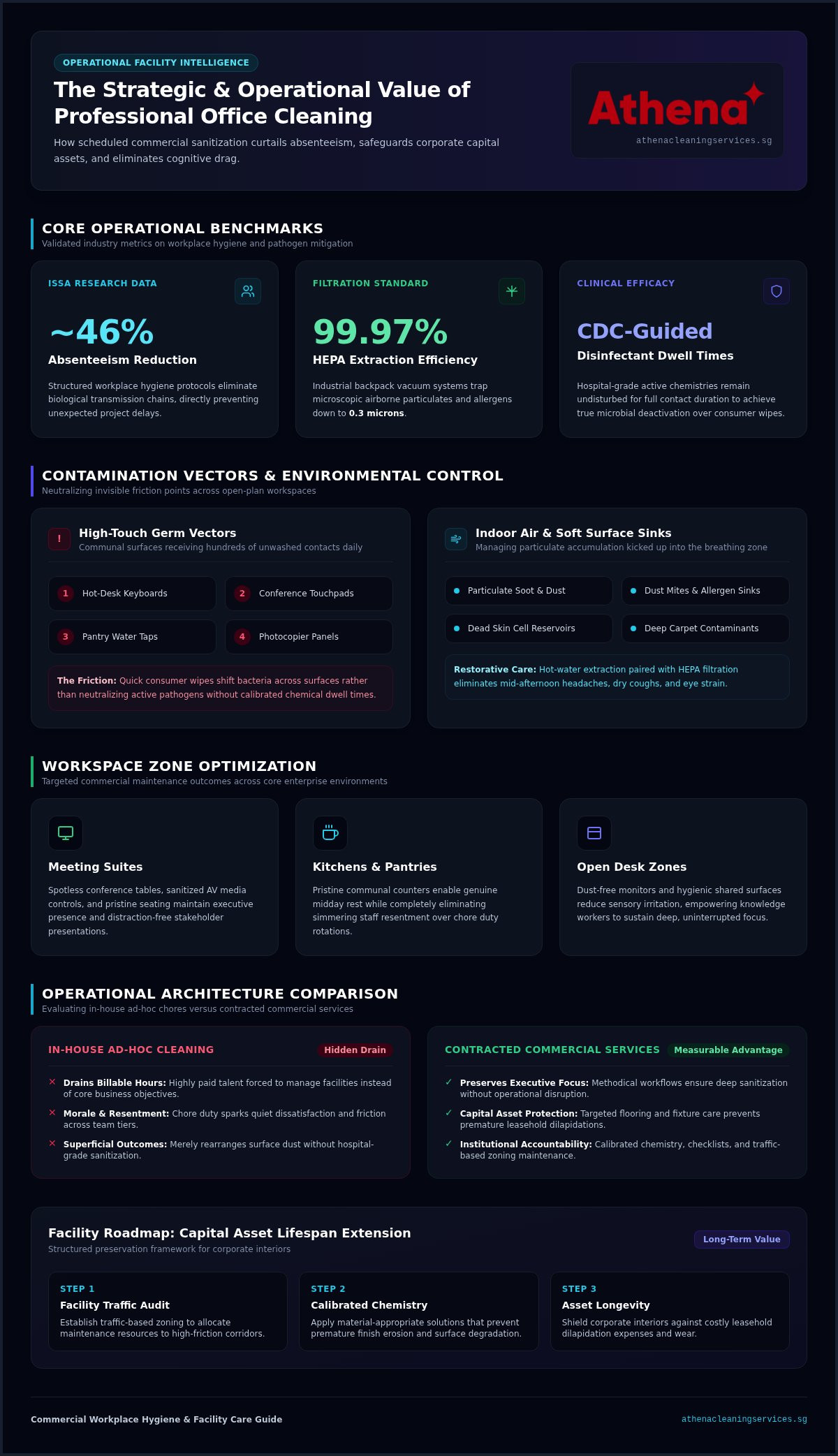
- Meeting suites: Spotless conference tables, sanitized media controls, and pristine seating keep stakeholder presentations sharp and distraction-free.
- Kitchens and pantries: Pristine communal counters foster genuine midday rest while eliminating simmering workplace resentment over chore duty.
- Open desk zones: Dust-free monitors and hygienic shared surfaces reduce sensory irritation, helping knowledge workers sustain deep, uninterrupted concentration.
Measurable Health Gains: Mitigating Sick Leave and Pathogen Transmission
Unplanned sick leave drains operational momentum faster than almost any other internal factor. When key staff call out unexpectedly, team deadlines slip and project coverage falters. Data from the International Sanitary Supply Association (ISSA) indicates that targeted workplace hygiene protocols can reduce absenteeism by roughly 46%. Unlocking the measurable health benefits of professional office cleaning means moving past basic visual upkeep and dismantling the biological transmission chains that turn modern open-plan desks into viral runways.
Controlling High-Touch Vectors in Shared Corporate Spaces
Shared infrastructure creates silent contamination loops. Hot-desk keyboards, conference room touchpads, pantry water taps, and photocopier panels receive hundreds of unwashed touches every day. Quick swipes with consumer wipes simply shift bacteria across surfaces rather than neutralizing them, because proper microbial deactivation requires strictly monitored disinfectant dwell times. By adhering to authoritative CDC facility cleaning and disinfection guidance, trained commercial personnel allow active antimicrobial chemistries to sit undisturbed for their full contact duration. Cross-contamination mitigation is the systematic application of hospital-grade sanitizing solutions to neutralize pathogens across communal contact points before they can spread between occupants. Eliminating these reservoirs protects individual wellness across seasonal illness peaks.
Indoor Air Quality, Ventilation, and Allergen Management
Workplace illness isn't limited to communicable viruses. Indoor carpets and soft upholstery act as massive sinks for dead skin cells, particulate soot, pollen, and dust mites. Foot traffic constantly kicks these microscopic reservoirs back up into the breathing zone, triggering eye strain, dry coughs, and mid-afternoon headaches that suppress daily stamina.
- High-filtration extraction: Industrial backpack vacuums fitted with verified HEPA filters trap airborne particulate matter down to 0.3 microns at 99.97% efficiency.
- Deep restorative sanitation: Routine hot-water extraction flushes deeply embedded micro-contaminants out of fabric weaves before they degrade room ventilation.
Partnering with a nationwide specialist for scheduled commercial sanitization and routine office cleaning safeguards your team from chronic airborne irritants, helping everyone breathe easier and perform at their peak.
Economic Realities: In-House Ad-Hoc Chores vs. Contracted Cleaning Services
Assigning office chores to salaried team members looks like an easy budget hack on paper. In practice, it's an expensive misallocation of skilled payroll that quietly erodes workplace culture. Evaluating the true financial benefits of professional office cleaning requires analyzing hidden labor economics, administrative drag, and preventable compliance liabilities.
The Hidden Operational Cost of Employee Chore Rosters
When software engineers, account executives, or project managers pause high-value workflows to scrub breakroom sinks and empty central recycling bins, you're paying premium hourly wages for basic facility tasks. Small interruptions destroy concentration. Beyond lost billable time, informal cleaning rotations breed subtle resentment across teams. Conscientious employees feel burdened when less diligent colleagues dodge communal responsibilities, leading to friction that damages office culture. Outsourcing these duties restores complete operational focus, allowing your staff to direct their full energy toward the complex projects they were hired to drive.
The comparative economic reality becomes immediately clear:
- In-house chores: Diverts expensive payroll, creates social tension, and risks asset damage through amateur chemical use.
- Contracted maintenance: Converts unpredictable chore disruption into an efficient, predictable operating expense backed by industrial equipment.
Equipment Investment, Chemical Safety, and Compliance
Managing commercial sanitation in-house also demands continuous capital expense. Commercial backpack vacuums, microfiber laundering cycles, and specialized floor restoration equipment require substantial upfront expenditure, ongoing maintenance, and secure square footage for storage.
Untrained staff members face real safety risks when handling concentrated sanitizers and solvents. Misreading labels, mixing incompatible products, or neglecting ventilation can release harmful volatile organic compounds (VOCs). As highlighted in the EPA's office indoor air quality guide, inappropriate chemical usage degrades indoor air and often triggers respiratory discomfort or eye strain across enclosed suites. Commercial contractors remove these risks entirely by deploying trained technicians equipped with certified solutions, calibrated dilution stations, and robust safety protocols. To explore how to evaluate vendor standards across these compliance areas, review our comprehensive professional cleaning company Singapore guide.
Capital Asset Protection: Extending the Lifespan of Commercial Interiors
Every commercial workspace represents a major capital investment. From executive boardrooms to expansive open floors, fixtures and surfaces suffer relentless wear under daily foot traffic. One of the most overlooked financial benefits of professional office cleaning is its ability to extend asset replacement timelines, shielding balance sheets from premature capital depreciation and painful lease-end restoration charges.
Preserving High-Traffic Carpeting and Ergonomic Upholstery
Daily foot traffic deposits fine silica, sand, and outdoor grit deep into commercial carpet piles. When left untouched, these sharp micro-particles act like microscopic blades, severing synthetic carpet strands with every step. Routine surface vacuuming only collects surface dust, leaving dense particulate matter compacted at the backing level. Deep low-moisture encapsulation and routine hot water extraction lift these abrasive cutting agents before permanent wear paths emerge. Routine deep maintenance can effectively double commercial carpet lifecycle, extending usable life from 5 to 7 years up to 10 to 15 years.
The same restorative logic applies to office task chairs and executive boardroom furnishings:
- Oils and perspiration: Body chemistry binds with ambient dust, causing fibers to stiffen, discolor, and tear prematurely.
- Targeted fabric extraction: Deep commercial fabric extraction lifts embedded grime, restores texture, and protects ergonomic office seating from early retirement.
- Maintenance cadence: Scheduling deep extraction every three to six months keeps fabrics resilient against high-friction wear.
Specialized Care for Executive Marble and Parquet Flooring
Hard floor surfaces demand equally disciplined preservation. Unprotected natural marble easily dulls and etches when abrasive debris grinds across its surface. Without regular diamond polishing and pH-neutral maintenance, natural stone loses its signature clarity, requiring disruptive and costly resurfacing down the road. Hardwood parquet presents similar vulnerabilities, where tracked-in moisture and stripped protective coats lead to cupping or severe timber rot.
Commercial building maintenance programs integrate routine parquet buffing, specialized sealing, and precision marble floor polishing. This systematic asset care keeps high-profile reception lobbies gleaming while ensuring your corporate tenancy leaves surfaces in pristine, deposit-securing condition. To protect your corporate furnishings and architectural finishes from avoidable wear, schedule a comprehensive commercial building maintenance evaluation with our national team today.
Structuring an Effective Commercial Maintenance Strategy for Long-Term Value
Maximizing the benefits of professional office cleaning requires more than generic, blanket task lists. A successful facility plan balances daily sanitization with proactive asset preservation. By structuring services around practical workspace utilization rather than arbitrary schedules, operations teams eliminate wasted effort while keeping high-traffic zones consistently immaculate.
Auditing Traffic Zones and Service Frequencies
Building an efficient facility strategy starts with auditing how your team and visitors move through the building. Office areas face wildly different wear rates and pathogen loads, meaning uniform cleaning frequencies are rarely cost-effective. Use this three-step framework to establish an optimal maintenance cadence:
- Step 1: Map zone foot traffic and hygiene risks. Divide your floor plan into distinct activity zones: high-exposure areas (main reception, shared washrooms, and cafeteria pantries), medium-traffic collaborative zones (conference rooms and open hot-desking rows), and low-turnover executive suites or records rooms.
- Step 2: Assign daily, weekly, and monthly tasks. High-exposure zones require daily disinfectant contact on all vector points and routine floor care. Reserve weekly workflows for thorough edge vacuuming and interior glass polishing, while scheduling monthly details for high-dust surfaces and baseboards.
- Step 3: Establish quarterly specialized preservation. Protect your capital investments by booking scheduled deep fabric extraction, pressure washing for building entrances, and protective floor buffing before grit cuts through base finishes.
Partnering with Athena Team Cleaning for Complete Facility Care
Execution determines the success of your facility strategy. Aligning cleaning operations with off-peak hours preserves commercial continuity, allowing your workforce to focus entirely on daily deliverables without vacuum noise or chemical scents disrupting meetings. Working with a single-source provider streamlines oversight and ensures consistent accountability across your entire portfolio.
Athena Team Cleaning serves as a dedicated nationwide maintenance partner, delivering comprehensive capability across scheduled commercial office cleaning, hospital-grade sanitization services, and deep carpet care. Rather than coordinating multiple vendors, your facility benefits from unified expertise that also covers specialized marble floor polishing, parquet floor restoration, and commercial building maintenance. Discover how a tailored operational agreement with Athena Team Cleaning elevates workplace standards, protects your corporate interior assets, and delivers the full, measurable benefits of professional office cleaning nationwide.
Transform Your Workplace Into a Resilient Commercial Asset
Treating facility hygiene as an operational priority rather than an afterthought unlocks lasting commercial value. As explored throughout this guide, the real benefits of professional office cleaning reach far beyond surface shine. Replacing ad-hoc internal chores with disciplined commercial sanitization shields your team from preventable illness, preserves daily focus, and protects high-value interior finishes from premature replacement.
A pristine work environment elevates daily morale and commands immediate confidence from visiting clients. Delivering nationwide capability that spans routine office upkeep, deep carpet care, and specialized parquet and marble floor polishing, Athena Team Cleaning brings precision and non-disruptive scheduling to your facilities. It's time to give your team the spotless workspace they deserve. Elevate your workplace with Athena Team Cleaning today and establish a cleaner, healthier, and more productive corporate standard.
Frequently Asked Questions
How often should a commercial office space undergo professional cleaning?
Most commercial workspaces require daily janitorial upkeep combined with scheduled periodic deep care. High-traffic communal areas like restrooms, pantries, and shared workstations need daily attention to maintain hygiene baselines. Low-occupancy zones or private suites can follow two-to-three-day cycles, while restorative services like carpet extraction and floor buffing are best scheduled quarterly. Calibrating frequency to headcount and foot traffic maximizes the operational benefits of professional office cleaning.
What is the difference between regular daily cleaning and commercial deep sanitization?
Daily cleaning focuses on surface maintenance, such as emptying trash bins, wiping desks, and vacuuming visible debris. Commercial deep sanitization targets microbial pathogens at an institutional level. Technicians utilize hospital-grade antimicrobials, enforcing precise chemical dwell times to neutralize viruses on high-touch vectors. Deep sanitization also incorporates specialized extraction machinery to clean air ducts, upholstery, and carpets, eliminating hidden microscopic contamination that routine wiping misses entirely.
Can professional office cleaning help reduce annual employee sick leave?
Structured commercial sanitization significantly curtails the spread of communicable workplace illnesses. Shared contact points like door levers, conference call touchscreens, and water dispensers harbor active bacteria that standard dusting leaves behind. By neutralizing biological transmission paths and improving indoor air quality with HEPA filtration, dedicated cleaning protocols prevent widespread outbreak cycles. Protecting team health directly reduces unplanned absenteeism and keeps active client deliverables on schedule.
Does commercial carpet cleaning disrupt everyday business operations?
Commercial carpet cleaning doesn't disrupt daily operations when scheduled around your facility's operational hours. Dedicated providers tailor service windows to evenings or weekends, allowing extraction and rapid drying to finish before staff arrive. Modern low-moisture encapsulation methods also dry in just a few hours. This seamless scheduling ensures carpets receive deep restorative treatment without noisy machinery or damp flooring interfering with your team's productive workflow.
Why is hiring an external cleaning provider better than assigning chores to staff?
Outsourcing avoids wasting expensive professional payroll on manual tasks that cause employee friction. Asking skilled knowledge workers to wipe appliances and empty waste bins generates resentment and fragments deep concentration. External teams bring industrial-grade equipment, specialized sanitization expertise, and complete compliance accountability. Investing in dedicated commercial maintenance protects staff morale, sharpens company focus, and delivers the full productivity benefits of professional office cleaning.
What specialized maintenance do natural stone and marble office floors require?
Natural marble and stone surfaces require pH-neutral cleansers, routine diamond-pad buffing, and periodic deep sealing. Standard acidic or abrasive floor soaps dissolve the stone's calcium structure, causing etching, dull patches, and permanent surface stains. Professional marble floor polishing restores crystalline reflectivity while removing abrasive micro-grit tracked in from outside. Routine resealing creates an invisible barrier against moisture penetration, preserving high-end corporate finishes and protecting leasehold investments.
How do professional cleaners prevent cross-contamination between restrooms and office desks?
Professional technicians prevent cross-contamination by using strict color-coded microfiber systems and zoned equipment protocols. Red or yellow cloths and mop heads are strictly reserved for sanitary facilities, while blue or green tools are dedicated exclusively to general office desks and pantry surfaces. Commercial crews also change disposable protective gear between zones and utilize separate chemical dispensing systems. This disciplined separation guarantees restroom pathogens are never transferred to workstation surfaces.
Frequently Asked Questions
How often should a commercial office space undergo professional cleaning?
What is the difference between regular daily cleaning and commercial deep sanitization?
Can professional office cleaning help reduce annual employee sick leave?
Does commercial carpet cleaning disrupt everyday business operations?
Why is hiring an external cleaning provider better than assigning chores to staff?
What specialized maintenance do natural stone and marble office floors require?
How do professional cleaners prevent cross-contamination between restrooms and office desks?
Related articles