
Hiring cleaning service vs full time helper: Which fits your household
In this article
- Key Takeaways
- Table of Contents
- Cleaning agency reliability and cleaner availability
- Household size and dual-income work schedules
- Security and cleaner verification
- Cleaning frequency and job scope
- Flexibility and privacy
- Athena Team Cleaning: Office Cleaning
- Choose the support that fits your next step
- Frequently Asked Questions
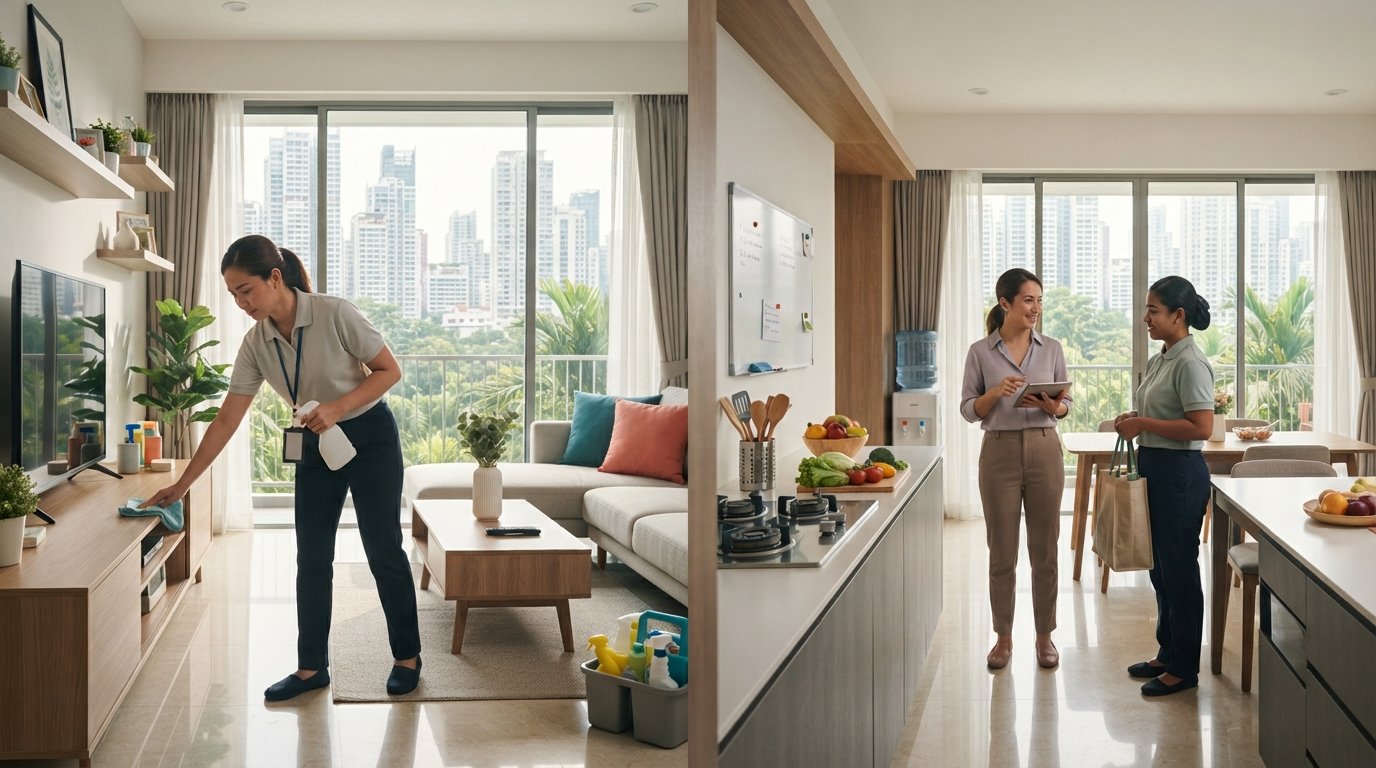
A full-time helper isn’t automatically the better fit. The choice between hiring a cleaning service and a full-time helper depends on whether you need focused cleaning visits or ongoing household support. In Singapore, part-time cleaning is generally arranged in advance for agreed hours and selected tasks, while a full-time domestic helper is a live-in Migrant Domestic Worker who supports the household.
Both options can make home life easier, but they suit different routines. If your main need is regular cleaning, scheduled visits may be enough; if your household needs help with a wider range of daily responsibilities, a full-time helper may fit better. The right decision also depends on how much flexibility you need, your expectations around reliability and security, and how comfortable you are sharing your home. This guide compares cleaning needs, household routines, privacy, and practical considerations to help you choose an arrangement that works for your home.
Key Takeaways
- Choose scheduled cleaning visits when your main need is focused household cleaning, and plan ahead to support reliable availability.
- Consider how your household’s size, daily routines, and need for broader ongoing support affect the right arrangement.
- Build security into your decision by paying attention to access, trust, and how comfortable you feel having someone in your home.
- List the cleaning tasks and frequency you need, then distinguish them from wider household responsibilities such as childcare or cooking.
- Weigh the privacy trade-off: a live-in helper needs space in your home, while scheduled cleaning visits keep support time-limited.
Cleaning agency reliability and cleaner availability
Scheduled cleaning provides support for agreed tasks; a live-in helper offers broader household assistance, subject to rest days.
Cleaning Agency Reliability
A cleaning service schedules visits around agreed times and tasks, making clear arrangements central to reliability. Confirm the visit time, task list, and access instructions before the appointment. For recurring cleaning, booking a regular slot and planning ahead can support consistency. A live-in arrangement is different: support is part of the household routine, not a booked cleaning visit.
Part-Time Cleaner Consistency
Cleaning visits are booked in advance for agreed hours and selected tasks. They may be one-time, weekly, fortnightly, or monthly, so choose a pattern that matches your routine. Booking ahead helps you secure a time that suits your household. By contrast, a full-time helper lives in the home, but still has mandatory rest days.
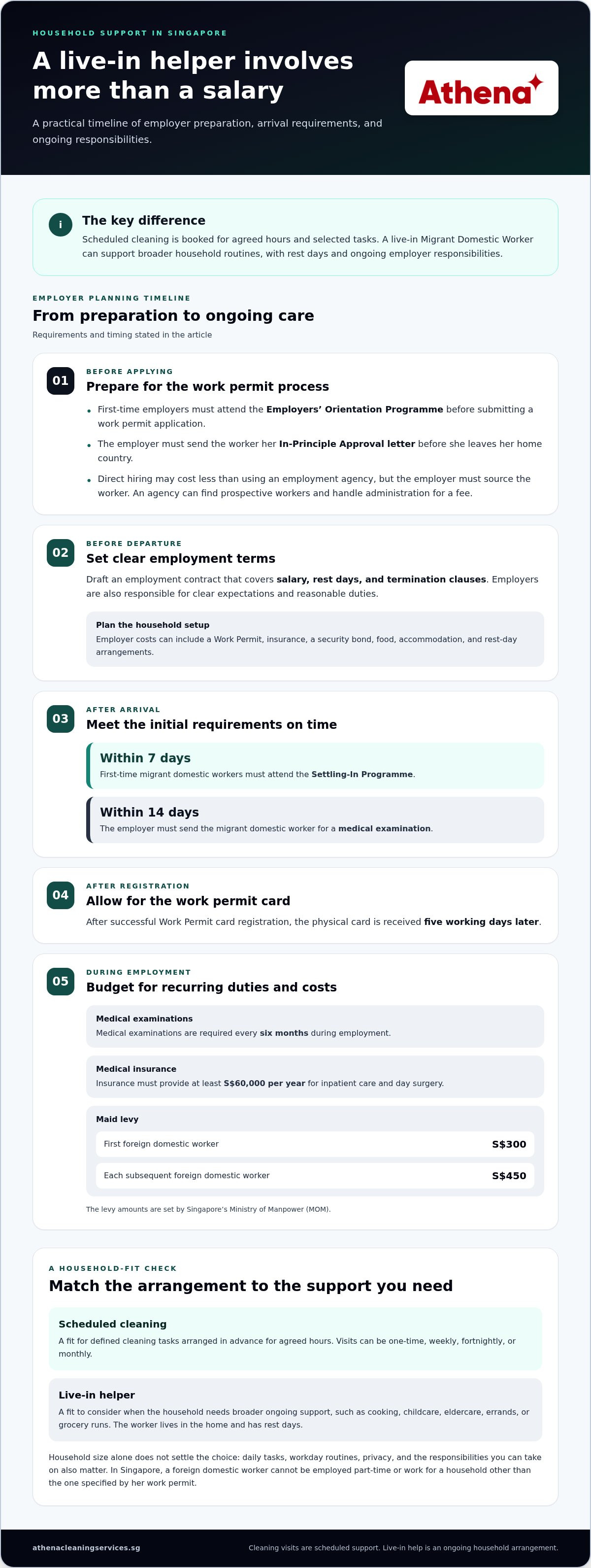
For foreign domestic workers, employment involves ongoing responsibilities, not just salary. The Ministry of Manpower (MOM), Singapore, sets the maid levy at S$300 for the first foreign domestic worker and S$450 for each subsequent foreign domestic worker. Other household costs can include accommodation, food, insurance, and rest-day arrangements.
Medical requirements also shape the employer’s responsibilities. According to the Ministry of Manpower (MOM), Singapore, employers must send a migrant domestic worker for a medical examination within 14 days of her arrival. The Ministry of Manpower (MOM), Singapore, also requires migrant domestic workers to undergo mandatory medical examinations every six months during employment. Medical insurance must provide at least S$60,000 per year for inpatient care and day surgery, according to the Ministry of Manpower (MOM), Singapore.
Availability depends on the arrangement you choose. Cleaning visits are scheduled for agreed hours, so they suit households that can plan tasks around appointments. Full-time helpers live in and may support daily household routines, but their rest days mean they are not continuously available. In Singapore, foreign domestic workers cannot be employed part-time or work for a household other than the one specified by their work permit.
| Option | Availability | Scheduling | Best fit |
|---|---|---|---|
| Agency-arranged cleaning | Booked cleaner | Agreed appointment | Planned cleaning tasks |
| Part-time cleaner | Limited to agreed hours | One-time or recurring visits | Regular, defined cleaning |
| Live-in helper | Household support, with rest days | Integrated into home routines | Broader ongoing assistance |
Choose scheduled cleaning if defined tasks and advance bookings suit your routine; choose a live-in helper when broader household support justifies the responsibilities and costs.
Full-time maids in Singapore are described as working most days of the week or on demand. Planning ahead and booking early can reduce the risk of a part-time maid being unavailable at a desired time.
Household size and dual-income work schedules
Household size matters less than the number of daily tasks and who can handle them. In Singapore, compare a planned cleaning visit with the broader support a live-in domestic helper can provide.
Employer costs include salary and levy, plus items such as a Work Permit, insurance, a security bond, food, accommodation, and rest-day arrangements. Employers also take responsibility for employment administration, reasonable duties, and clear expectations.
Match support to household routines
In a dual-income household, list the tasks that pile up while everyone is at work. A household needing regular floor and bathroom cleaning may manage with scheduled visits. One that also needs cooking, childcare, eldercare, errands, or grocery runs may value broader domestic support.
Household size alone doesn’t settle the choice. A smaller home with young children or an older relative can have more daily care needs than a larger home with independent occupants. Write down recurring tasks, who currently handles each one, and which need attention on workdays. This list helps reveal whether you need consistent cleaning or support woven into daily routines.
Prepare for the work permit process
Hiring a migrant domestic worker involves preparation before arrival. First-time employers must attend the Employers’ Orientation Programme before submitting a work permit application. The employer must also send the worker her In-Principle Approval letter before she leaves her home country.
After arrival, the Ministry of Manpower (MOM), Singapore, requires employers to send first-time migrant domestic workers to the Settling-In Programme within seven days of arrival. Employers must also draft an employment contract covering salary, rest days, and termination clauses. These steps call for time and clear planning, beyond coordinating cleaning appointments.
Direct hiring can cost less than using an employment agency, but the employer must source the worker. An agency can handle administrative work and find prospective workers for a fee. After successful Work Permit card registration, the physical card is received five working days later. Include each stage in your household’s preparation timeline.
Build a routine for consistency and safety
For cleaning, consistency comes from a stable task list and a repeatable schedule. A household might include kitchen surfaces, bathroom cleaning, and floors in each visit, then reserve occasional deeper tasks for a separate plan. For a domestic helper, agree on reasonable duties and rest arrangements. Clear priorities help prevent cleaning from competing with care responsibilities.
Before either arrangement begins, write down access instructions, household priorities, and what to do if an accident occurs. For example, identify whom to contact if a spill damages an appliance or a key is misplaced. If you need recurring cleaning rather than broader household support, consider a scheduled cleaning arrangement that fits your household routine.
Security and cleaner verification
For cleaning visits, the main risks include accidental damage or loss, so choose an insured service. For a domestic helper, employer protections include medical and personal accident insurance, alongside clear employment arrangements.
Before booking a cleaner, establish who will enter your home and what the visit covers. Write down access instructions, rooms to clean, and any fragile items, such as a glass cabinet or a loose appliance cord. Secure valuables and explain how to report damage or a misplaced key. A written task list gives everyone a clear reference.
Ask whether the cleaning service is insured against accidental damage or loss during cleaning. This can help protect you if an incident occurs, but documenting the home’s condition is still useful. For example, note an existing chip on a countertop before the first appointment. Keep the booking details and report any new damage promptly.
Verification differs for a foreign domestic worker. Licensed employment agencies in Singapore can find prospective migrant domestic workers, vet their qualifications, and handle administrative work for a fee. An employer who hires directly must source the worker. In either arrangement, review identity and employment documents, agree on duties, and record salary and rest-day terms in a written contract.
Insurance is another part of the employer’s responsibility. The Ministry of Manpower (MOM), Singapore, requires medical insurance of at least S$60,000 per year for inpatient care and day surgery. Medical insurance must provide at least S$60,000 per year for inpatient care and day surgery; under the described coverage, accidental death or permanent disability must occur within 12 months of the accident.
Don’t treat household access as an informal detail. Decide which rooms the cleaner or domestic worker may enter, where keys are kept, and how visitors should be handled. For a live-in helper, discuss privacy boundaries and duties such as cooking or laundry before work begins. These steps reduce confusion about personal spaces and daily responsibilities.
Use a simple routine for recurring cleaning: confirm the appointment, share any changed instructions, and record completed tasks. If a cleaner reports a spill or broken item, take photos and note when it happened. For a domestic worker, keep employment documents and insurance records together so key information is accessible if an incident needs attention.
Choose the arrangement that matches the level of access and responsibility you’re comfortable managing. A scheduled cleaner has time-limited access for defined tasks; a live-in domestic worker requires an ongoing employment relationship, insurance, and household arrangements. Clear records, agreed boundaries, and suitable insurance make either choice more secure.
Cleaning frequency and job scope
Start by separating cleaning from the wider work that keeps a household running. In Singapore, scheduled cleaning may suit homes that mainly need cleaning once or twice a week. A live-in domestic helper may also support cooking, laundry, childcare, eldercare, errands, or grocery runs. The better fit depends on which tasks recur and how much time they take.
A monthly estimate for part-time cleaning assumes approximately 3 to 4 hours of work per week. Use that as a practical scope check, not a promise that every task fits. A visit focused on floors, bathrooms, and kitchen surfaces differs from one that also includes windows, dishes, laundry, and appliance cleaning. Additional tasks may cost extra, so prioritise them clearly.
Household responsibilities can expand quickly. Parents with children may need regular floor cleaning and help keeping shared spaces orderly, while a household caring for an older relative may need support beyond cleaning. A domestic helper’s possible duties can include cleaning alongside cooking, childcare, eldercare, errands, and grocery runs. These responsibilities call for a broader employment arrangement than a defined cleaning visit.
Build a task list before deciding. Group jobs by how often they need attention, then identify which require a cleaner’s time and which involve ongoing household support:
- Routine cleaning: floors, bathrooms, kitchen surfaces, and dusting.
- Occasional cleaning: windows, appliances, and other less frequent jobs.
- Daily household support: cooking, laundry, childcare, eldercare, or errands.
This breakdown makes the scope visible. It also helps employers avoid treating every domestic responsibility as part of a cleaning visit.
For work that fits a scheduled visit of 3 to 4 hours, paying for 24/7 availability may not make sense. Compare the time needed for cleaning with the value of having someone support other daily routines. A household that needs only targeted cleaning can keep the arrangement task-focused; one with recurring care or household duties should weigh those needs separately.
Also consider how the scope changes through the year. A move may call for end-of-tenancy cleaning, while a seasonal reset may require spring cleaning. These are defined projects, unlike recurring domestic work. Write down the rooms, surfaces, and priorities for each project, then compare them with the ongoing tasks your household needs to manage.
Finally, compare the complete job scope with the monthly salary and other responsibilities involved in employing a domestic helper. A cleaning visit is centered on agreed cleaning tasks; a full-time helper may take on broader household duties. Choose a cleaning service for focused cleaning needs, and consider a helper when your household requires ongoing support beyond cleaning.
Flexibility and privacy
A scheduled cleaner provides time-limited support, while a live-in helper becomes part of the household’s daily environment. In Singapore, compare how each arrangement affects your routines, personal space, and ability to change plans.
Part-time cleaning can be booked as a one-time session, weekly, fortnightly, or monthly. That structure suits households whose needs vary, such as arranging a focused clean before guests visit or maintaining a recurring routine. Since visits are agreed in advance and limited to set hours, cleaning tasks need to fit the booking.
This arrangement can also keep home life more private between visits. A household can schedule cleaning while family members are out or choose a time when someone is present. Decide which rooms are included, how the cleaner enters, and where personal items should remain untouched. Clear instructions help protect boundaries during each visit.
A live-in helper offers a different kind of convenience: support can be integrated into household routines rather than confined to a cleaning appointment. However, the arrangement requires accommodation, such as a room or designated space. It also means sharing common areas and agreeing on privacy expectations for both the household and the helper.
Rest arrangements matter too. Live-in domestic helpers have mandatory rest days, so employers shouldn’t assume continuous availability. Consider what happens to household routines on those days. A family that depends on daily assistance may need to plan tasks around the helper’s rest, while a household needing occasional cleaning can schedule visits around its own calendar.
Before choosing, write down the boundaries that matter most. Include which areas are private, which household members may give instructions, and how schedule changes should be communicated. For a live-in arrangement, also discuss the helper’s personal space and agreed responsibilities. For scheduled cleaning, record entry instructions and the rooms to be cleaned.
- Choose scheduled visits if you prefer defined cleaning hours and privacy between appointments.
- Consider live-in support if your routine needs broader household help and you can provide accommodation.
- Plan rest days if daily routines rely on a helper’s presence.
Flexibility isn’t simply about adding more hours. It’s about matching support to the household calendar while respecting everyone’s space. If defined cleaning visits suit your home, arrange scheduled cleaning around the routines and privacy boundaries that matter to you.
Take time to revisit the choice if your household needs change. Keep the decision practical: ask whether a booking can fit the tasks you expect, or whether support needs to extend across household routines. A live-in domestic helper requires accommodation, such as a room or designated space. Make sure that space can be included in the home plan before choosing this arrangement.
You can also compare what each option asks of household members. For scheduled visits, agree on priorities and communicate any changes before the appointment. For live-in support, discuss boundaries and responsibilities before routines are settled. If either arrangement no longer fits, reconsider the schedule or support setup rather than letting expectations remain unclear. Aim for an arrangement that preserves privacy while giving your household the help it needs.
Athena Team Cleaning: Office Cleaning
Athena Team Cleaning provides Office Cleaning for workplaces that need professional cleaning rather than ongoing household support. If your priority is cleaning, not cooking, childcare, or other daily personal assistance, a cleaning service may be the more relevant fit. Building Maintenance, Carpet and Rug Cleaning, and Sanitization Services also address specific workplace upkeep needs.
For example, arrange Office Cleaning to maintain shared work areas, or choose Carpet and Rug Cleaning when floor coverings need focused care. These services are distinct from hiring a live-in helper, whose role may include broader household responsibilities. Match the service to the space and cleaning needs you want addressed.
For workplace cleaning support, visit athenacleaningservices.sg to contact Athena Team Cleaning.
Choose the support that fits your next step
The decision about hiring a cleaning service versus a full-time helper becomes clearer when you focus on what you want to change in your routine. Identify the tasks you want handled, the level of support your household needs, and how much privacy you want to preserve. Then choose an arrangement that fits those priorities, rather than paying for responsibilities you don’t need.
If your need is for a workplace rather than household support, Athena Team Cleaning offers Office Cleaning, Building Maintenance, and Carpet and Rug Cleaning. These services address specific cleaning and upkeep needs in professional spaces, not the broader personal responsibilities of a live-in helper.
Take the next step with a clear scope in mind. Contact Athena Team Cleaning to discuss cleaning support for your workplace. A considered choice can make your environment easier to maintain and leave you with more room to focus on what matters.
Frequently Asked Questions
What are the pros and cons of a cleaning service versus a live-in domestic helper?
For households comparing hiring a cleaning service vs a full-time helper, the main trade-off is focused cleaning versus broader household support. A cleaning service handles agreed tasks during booked visits, but doesn’t cover other daily responsibilities. A live-in domestic helper may take on a wider range of household work, though the arrangement requires accommodation and employment administration. If your main pressure is accumulated cleaning, scheduled service may fit; recurring daily tasks point toward broader support.
How should I compare cleaning frequency and household needs to choose between a cleaner and a full-time helper?
For the hiring-cleaning-service-versus-full-time-helper decision, map one typical week: list cleaning jobs, how often they return, and who handles other tasks. If cleaning takes roughly 3 to 4 hours weekly, scheduled visits may suit a home focused on floors, bathrooms, or kitchen surfaces. If cooking, childcare, eldercare, or errands also need regular support, weigh those responsibilities separately. The range of work, rather than household size alone, should guide your choice.
Frequently Asked Questions
What are the pros and cons of a cleaning service versus a live-in domestic helper?
How should I compare cleaning frequency and household needs to choose between a cleaner and a full-time helper?
Related articles