

Decluttering guide for Singapore HDB and condo homes: a room-by-room plan
In this article
- Why declutter before a deep clean in Singapore
- How to plan your decluttering before you touch a single room
- The room-by-room order that avoids double work
- Where your decluttered items actually go in Singapore
- HDB, BTO and condo homes need slightly different plans
- What it costs, and when to call a professional
- Comparison at a glance
- Frequently asked questions
- Sources
- Related Athena cleaning services in Singapore
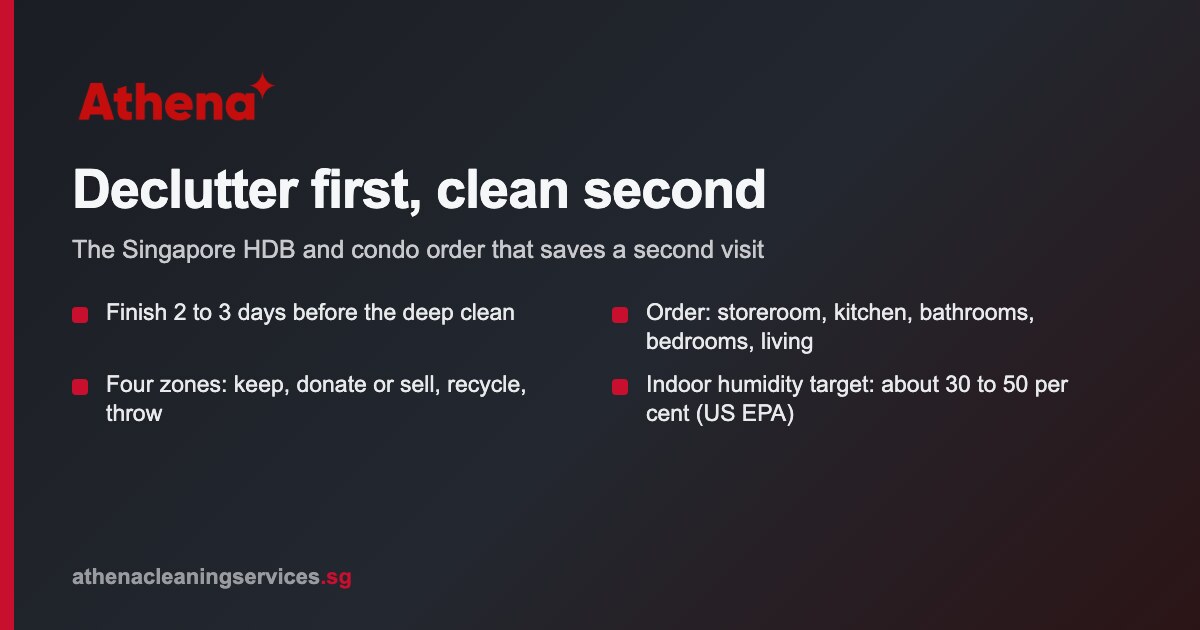
This decluttering guide for Singapore HDB and condo homes comes down to one rule: clear the home in a fixed order, storeroom first and living room last, sorting everything into keep, donate or sell, recycle and throw. Finish two to three days before any deep clean, and book bulky item collection early so nothing sits in the corridor. A 3-room or 4-room HDB flat usually takes one focused weekend. A larger condo, or a home that has gone unsorted for years, takes two.
Below you will find the exact order, where each type of item goes in Singapore, what disposal and cleaning typically cost in 2026, and when it makes sense to hand the job to a team.
Why declutter before a deep clean in Singapore
Cleaners can only clean what they can reach. A shelf stacked with boxes, a sofa buried under laundry and a wardrobe packed to the door all stop the work halfway. Decluttering first means the hours you pay for go into grout, fans, cabinets and floors instead of shifting your belongings from one corner to another.
Singapore adds a second reason. Outdoor relative humidity here sits around 70 to 90 per cent for most of the year, and a flat with closed windows and an air-conditioner running holds moisture in every packed corner. The US EPA advises keeping indoor humidity roughly between 30 and 50 per cent and fixing moisture problems quickly, because mould grows wherever damp air meets a surface that never gets wiped (EPA mould cleanup guidance). Boxes pushed against an exterior wall, clothes crammed into a wardrobe and cartons stacked on a bathroom floor are the usual starting points.
What you find when you clear properly
Moving things out is also a free inspection. People regularly turn up a damp patch behind a storage cabinet, a stained ceiling corner below a neighbour's bathroom, or droppings behind the rice container. Catching these early costs a wipe-down or a call to the town council or management office. Catching them after another six months of stacking costs a repaint.
- More surface cleaned: skirting boards, window tracks and the tops of wardrobes become reachable.
- Better airflow: air moves behind furniture that is no longer wedged against the wall.
- Faster cleaning: a crew spends its time on dirt, not on lifting your belongings.
How to plan your decluttering before you touch a single room
Most decluttering stalls because people start in the bedroom with the sentimental stuff and run out of energy by lunch, which a short plan avoids. Pick your date for the deep clean first, then count back three days. That is your finish line for decluttering, and it leaves a buffer for bulky item pick-ups, which are rarely same-day.
Set up four zones near the door
Lay out four labelled boxes or bags: keep, donate or sell, recycle, and throw. Keep them near the front door so every trip out of a room ends in the right pile. A fifth pile for "decide later" tends to become a second storeroom, so give yourself one rule: anything in it after the weekend goes in the donate bag.
Use a one-year test, with exceptions
If you have not used an item in twelve months and it carries no sentimental value, it can go. Seasonal items such as a Chinese New Year tray set, a Christmas tree or a portable fan for the haze season earn an exception. Spare parts for appliances you no longer own do not.
Give each home size a realistic window
- Studio or 2-room: one day.
- 3-room or 4-room HDB: a full weekend, with a second evening for disposal runs.
- 5-room, executive flat or 3-bedroom condo: two weekends, or one weekend with extra hands.
- Landed home: plan for the garage and the car porch as separate rooms.
These are typical working times for a household doing the job themselves. Add a day if elderly parents' belongings are involved, because those decisions are slower for good reason.
The room-by-room order that avoids double work
Work from the room that holds the most forgotten items to the room people see most. This way the early rooms give you free floor space and the later rooms never get re-cluttered by overflow.
1. storeroom or household shelter
Start here. In many HDB flats and condos the storeroom or household shelter has become the place where unfinished decisions live. Empty it fully onto the floor of the nearest room, sort, and put back only what you will use. Keep the door and any ventilation openings clear, and do not leave paint, solvents or other flammables stacked inside. The household shelter is built as a protective space, so treat it as one rather than as extra shelving for the overflow.
2. kitchen
Check expiry dates on every tin, sauce and packet. Throw out stale dry goods, duplicate utensils, plastic containers without lids and the free takeaway sets that have not been used in a year. Pull everything off the counters, because grease collects fastest where appliances sit permanently. Clear the space under the sink so the pipes and cabinet base can be wiped and checked for slow leaks.
3. bathrooms
Remove half-empty toiletries, worn mats, rusted razors and cracked soap dishes. Clear the floor completely, since stacked buckets and bottles trap water against the tiles and grout. If you have an exhaust fan, check that nothing blocks it.
4. bedrooms and wardrobes
Do one wardrobe or one drawer unit at a time, not the whole room at once. Pull everything out, wipe the inside, then put back only what you have worn in the past year. Under-bed storage deserves its own pass: boxes stored there trap dust, and the mattress above rarely gets aired. If you are planning a mattress clean as part of the same job, our mattress cleaning guide singapore explains what to expect and how long the mattress needs to dry.
5. living and dining areas
Paper, cables, toys, decor and shoe overflow come last. Sort paper into shred, recycle and file. Bundle cables by device, and throw the ones you cannot name. Clear the floor and the coffee table so upholstery and flooring can be cleaned properly. Owners with a leather sofa can read our 5 expert tips for leather sofa cleaning in singapore before the clean, since leather needs different handling from fabric.
6. final sweep
Clear the floors, wardrobe tops, window ledges and the ground beside the main door. Bag the last items and move them to the disposal area or a designated corner. Then vacuum or sweep so the cleaning crew starts on a clear surface.
Where your decluttered items actually go in Singapore
The slowest part of decluttering in Singapore is rarely the sorting. It is the lorry, the bulky pick-up slot or the recycling bin that fills up on Sunday night. Plan the exits before you lift the first box.
Items fall into a few streams. Clothes, books, toys and working household goods go to charity shops or a marketplace listing. Paper, cardboard, metal, glass and plastic go in the blue recycling bins found in HDB estates and most condos. Electronics are different. Singapore's regulated e-waste scheme makes producers fund collection, so retailers and collection points take old appliances back. Large furniture goes through your town council or management office, or a private removal service.
The NEA public cleanliness guidance is clear that discarded items should not be left in common areas, and in HDB blocks a corridor full of bags is also a safety issue. Use the table below to choose the right exit for each pile.
What does each disposal route cost and how long does it take?
The costs below are typical ranges for 2026 and depend on volume, floor level and lift access, so treat them as a planning guide and confirm with the provider.
HDB, BTO and condo homes need slightly different plans
The method stays the same, but the logistics change with the building.
HDB resale and BTO
In an HDB block, large items must usually be booked through the town council or the managing agent, and lifts that stop at selected floors can complicate moving a wardrobe. Check the lift landing and time your pick-up for a weekday when the corridor is quieter. Newer BTO flats often have no spare space for stored overflow, so declutter hard before move-in rather than after. If you have just collected the keys, do the sorting only after the renovation dust is gone, and read our post renovation cleaning singapore 2026 guide for the order in which contractors, cleaners and movers should arrive.
Condo
Condos add management rules. Many require a booking for the service lift, a deposit for large moves, and set hours for noisy work or heavy removal. Ask the management office before you hire a removal lorry, because a team turned away at the gate costs you the slot and the fee. Condos usually have a dedicated bin centre or bulky item corner, but the policy differs from one development to the next.
Landed homes
Landed homes have the most to clear and the most freedom. Garages, store sheds and the roof terrace collect years of items, and a private removal service is usually the practical choice. Pay attention to outdoor storage: cartons left under a porch in the humid season soften quickly and become pest habitat.
Newly furnished or renovated homes
If you are decluttering because new furniture is arriving, ventilate well. New wood panels, cabinetry and some carpets can release formaldehyde, which the US EPA describes as a common indoor air pollutant that is most noticeable in newer, less ventilated spaces (EPA facts about formaldehyde). Open windows when you can, and avoid packing new items into sealed cupboards straight away.
What it costs, and when to call a professional
Doing the sorting yourself costs time rather than money. The cash costs are the exits and the clean that follows. Typical 2026 ranges in Singapore: a private junk removal lorry load at around S$80 to S$300 depending on volume and access; a mover or helper by the hour, often S$25 to S$50 per person per hour; and a one-time deep clean for an HDB flat, which commonly falls between S$280 and S$600 depending on size and condition, with condos and landed homes costing more. Prices before GST are common in quotes, so confirm whether GST is included.
Decluttering and cleaning are separate jobs, and most cleaning companies do not remove your belongings. Be wary of any quote that bundles disposal into a cleaning price without listing it, and compare at least two written quotes. Get the terms in writing, as the Consumers Association of Singapore (CASE) advises in its guidance on service providers.
Signs it is time to hire help
- You cannot see the floor in more than two rooms.
- There is visible mould, a musty smell or evidence of pests behind stored items.
- You are clearing the home of a family member and the volume or the emotions are too heavy to do alone.
- You have a hand-over, a tenancy end or a move-in date within a week.
In these cases, a team can sort and bag while a second crew cleans. After a hoarded or very damp home is cleared, the surfaces underneath usually need a proper wash and sometimes a disinfecting pass. For homes where the carpet has also been buried, our guide to choosing carpet cleaning service singapore explains how to pick a provider and what questions to ask.
For general health advice on keeping a home clean and dry, HealthHub from Singapore's Ministry of Health is a reliable starting point. Athena's team can handle the cleaning once the decluttering is done, so you arrive at a home that is ready to live in.
Comparison at a glance
| Route | Best for | Typical cost | Lead time |
|---|---|---|---|
| Town council or management office bulky pick-up | Wardrobes, mattresses, sofas, large furniture | Often free for a limited number of pick-ups a year, then about S$20 to S$60 per item | 2 to 14 days by appointment |
| Private junk removal lorry | Whole-room clear-outs, renovation leftovers | About S$80 to S$300 per load | Same day to 3 days |
| Karang guni | Metal, old newspapers, small appliances | Free, sometimes pays a small amount for scrap | Whenever they pass or by call |
| Blue recycling bin | Paper, cardboard, clean plastic, glass, cans | Free | Immediate |
| E-waste collection point or retailer take-back | Phones, laptops, fridges, TVs, batteries | Free at most points | Immediate to 1 week for large appliances |
| Charity shop or donation drive | Clean clothes, books, toys, working household goods | Free, delivery sometimes at your cost | Same day to 1 week |
| Online marketplace resale | Furniture, electronics and branded items in good condition | Free, you carry delivery or pick-up | 1 to 4 weeks to sell |
Frequently asked questions
How long should I declutter before a deep clean?
Finish two to three days before the cleaners arrive. That gives you time to book bulky item collection, clear bags from the corridor and sweep the floors. Starting any later leaves piles that block the cleaners, and starting too early lets the clutter grow back.
What is the best order to declutter an HDB flat?
Begin with the storeroom or household shelter, then the kitchen, bathrooms, bedrooms and wardrobes, and finally the living and dining areas. Clearing the storeroom first gives you floor space to sort the rest, and finishing with the living room means guests and family see the result straight away.
Where can I throw away bulky furniture in Singapore?
HDB residents can book a bulky item pick-up through their town council, and condo residents ask the management office. Many town councils offer a limited number of free pick-ups a year by appointment. If you need it gone quickly, a private junk removal lorry is the alternative, typically around S$80 to S$300 per load depending on volume and access.
Do I need to declutter before hiring a cleaning company?
Yes. Cleaners work around your belongings, so every box on the floor and every packed shelf means areas left uncleaned. A clear home gets a more thorough result in the same time, and you can see any damp or mould problem that was hidden behind stored items.
How do I dispose of old electronics and appliances in Singapore?
Use an e-waste collection point or return the item to a retailer when buying a replacement. Singapore's regulated e-waste scheme makes producers fund the collection and recycling. Do not leave old appliances in the common corridor or put them in the general rubbish chute.
Does humidity make clutter worse in a Singapore home?
It does. Singapore's high humidity means stored cloth, paper and cardboard absorb moisture, and packed corners stay damp for longer. This is the usual setting for mould and musty smells, which is why clearing space around walls and inside wardrobes matters even in a home that looks tidy.
Sources
Related Athena cleaning services in Singapore
Related articles