
Haze aircon care guide: what Singapore homes should do
In this article
- How to run your aircon when the haze sets in
- Filters: when to check, rinse and leave alone
- Does haze mean you need a chemical wash?
- Humidity, mould and the smell after haze
- Clearing settled dust around the home
- Booking a service without being upsold
- Comparison at a glance
- Frequently asked questions
- Sources
- Related Athena cleaning services in Singapore
The short haze aircon care guide for Singapore homes: keep windows and doors shut, run the aircon on recirculate, check the filters every one to two weeks, rinse them only if they are washable and visibly dusty, and skip the chemical wash unless the unit smells, drips or cools poorly. Haze alone does not mean your aircon is dirty inside.
Most Singapore flats run the aircon 8 to 12 hours a day when the air outside turns unhealthy, so the filters take the load first. Below you get the exact checks to do, what each service costs in SGD, how to stop mould after a humid, hazy week, and how to spot an upsell. It suits HDB, BTO and condo owners alike.
How to run your aircon when the haze sets in
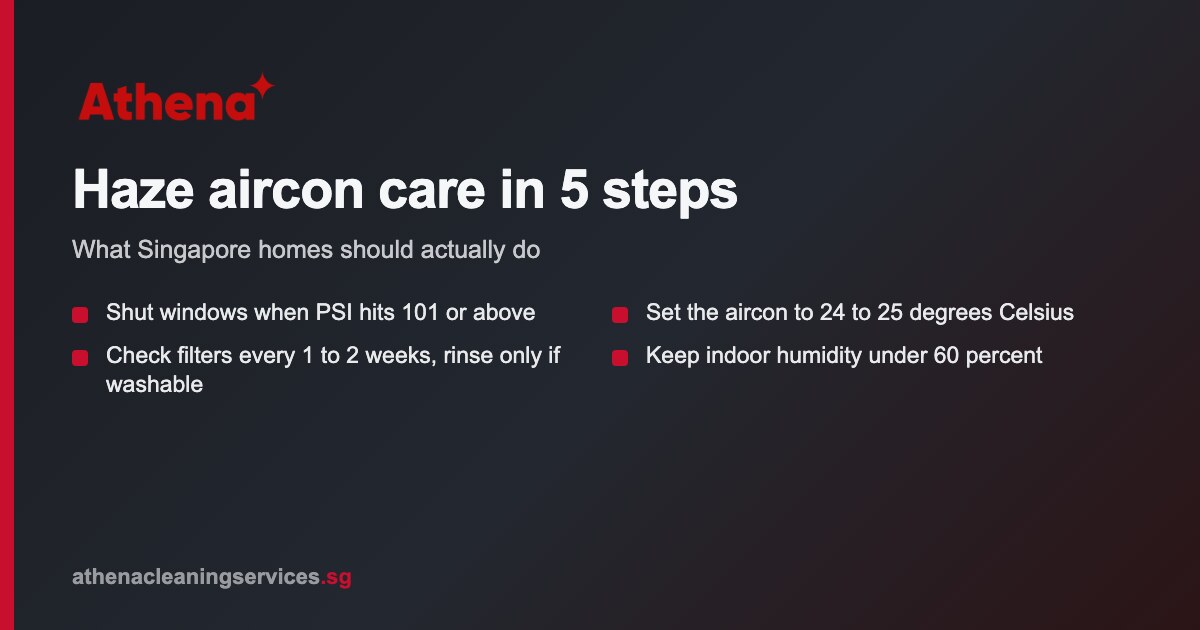
When NEA's PSI reading climbs into the unhealthy band (101 to 200), the first job is to stop outdoor air coming in. Close windows, balcony doors and any bathroom or kitchen windows that open to the outside. HealthHub gives the same basic advice: keep outdoor air out while it is bad, and ventilate again once readings improve. Check the PSI on the NEA site before you reopen anything, and look at the update time, since the reading changes hourly.
A standard split-type aircon in an HDB bedroom or condo living room only recirculates the air already in the room. It does not pull in outdoor air, so it will not bring haze inside. The exceptions are ducted or fresh-air systems, which some newer condos and landed homes have. If yours has a fresh-air intake, check the manual for the control that closes it. Do not cover vents or open the unit to find it. If you cannot tell, ask the manufacturer or your servicing company.
Settings that help during a haze week
- Set the temperature to 24 to 25 degrees Celsius. Going lower makes the compressor work harder and does not clean the air.
- Use a steady fan speed rather than constantly switching between auto and turbo.
- Keep the door to the room shut, and put a rolled towel along the bottom gap if your HDB door does not seal well.
- Do not expect the aircon to remove haze particles. It cools the room, nothing more.
Filters: when to check, rinse and leave alone
The filter is the only part most owners should touch. Take a look every one to two weeks during a haze spell. A typical manufacturer instruction for washable mesh filters is to clean them about every two weeks under heavy use, so that is a sensible rhythm to follow when the air is dirty. Check your own model's manual first, because some units have auto-cleaning filters that should not be pulled out and rinsed under the tap.
Switch the unit off at the wall or isolator before opening the front panel. Slide the filter out, and hold it up to a light. If you can see a grey film or fluffy dust, rinse it in lukewarm water with a drop of mild dish soap, rinse again, and let it dry fully in the shade before refitting. In a humid flat, that usually means 1 to 2 hours in an airy spot. A damp filter put back in the unit is how musty smells start.
When to stop and call someone
If the filter will not slide out, if the frame is cracked, or if you need a ladder taller than your comfort level, leave it. A fall from a stool while holding a wet filter is a bigger risk than a dusty one. Also leave it alone if the filter is a special type, such as the electrostatic or photocatalytic inserts found on some premium models. These can be damaged by washing.
Do not spray the evaporator coil behind the filter with household cleaners. The fins bend easily, and chemical residue drips into the drain pan and the room. That part is for a trained technician.
Does haze mean you need a chemical wash?
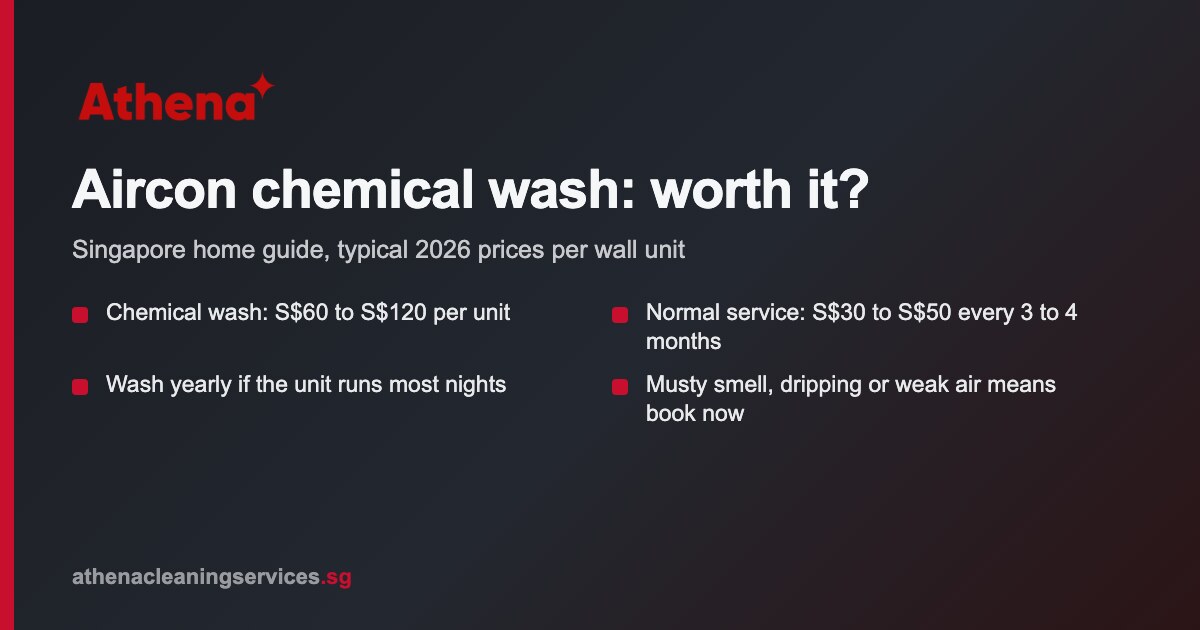
No. A chemical wash is for a unit that has a problem: a sour or mouldy smell, water dripping from the indoor unit, weak airflow even with clean filters, or black specks blowing out of the vents. A few hazy days with a dirty filter do not produce those symptoms. A rinsed filter and a routine service are usually enough.
Singapore households commonly book a general service every three to four months for a unit that runs daily, and a chemical wash once a year or when a symptom appears. These are typical provider recommendations, not rules, so go by how your own unit behaves. If you serviced it in the last three months and it cools well, the end of the haze is not a reason to book again.
Typical costs and what each option covers
The table below shows typical 2026 prices for a wall-mounted split unit in Singapore. Prices drop per unit when you book several units in one visit, and ceiling cassette or ducted units cost more.
Humidity, mould and the smell after haze
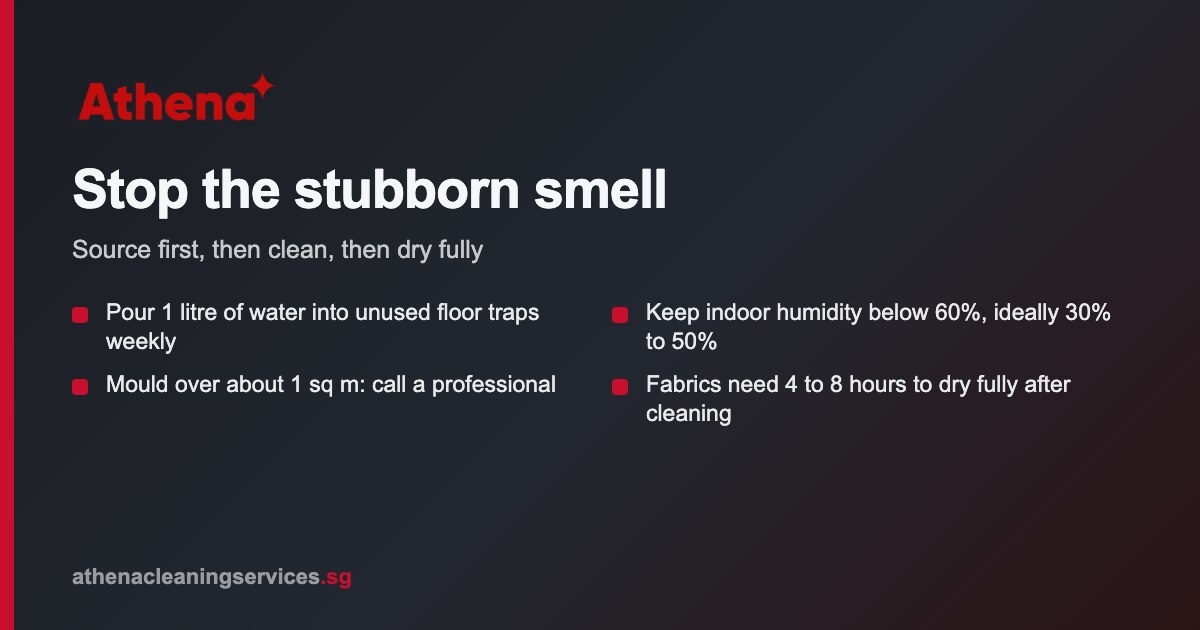
Haze and humidity often arrive together. Singapore's relative humidity usually sits between 70 and 90 percent, and a closed-up flat running the aircon all day can still hold moisture in curtains, bedding and the unit's own drain pan. The US EPA advises keeping indoor humidity below 60 percent to discourage mould growth. If your room feels clammy even with the aircon on, use the dry mode for an hour or two or add a small dehumidifier.
The classic bad-aircon smell is damp, sour and a bit like old socks. It means moisture is sitting on the coil or in the drain tray. A cleaned filter sometimes fixes it in a day. If the smell is still there after two days of clean filters, book a chemical wash. Do not mask it with sprays.
Turn off the aircon the right way
When you switch off for the day, set the fan-only mode for 10 to 15 minutes first if your remote has it. This dries the coil so moisture does not sit overnight. Many new units do this automatically, so check the manual before adding a step.
Wash bedding on a hot cycle and give the mattress an airing once the haze lifts. Our mattress cleaning guide for Singapore covers how to deal with dust and damp in bedding, which collect more of both after a long closed-window spell.
Clearing settled dust around the home
Haze particles do not stay in the air. They settle on window sills, floors, balcony ledges and soft furnishings. HealthHub recommends wet methods, such as damp wiping and mopping, because dry sweeping and feather dusters push fine dust back into the air. Wipe the aircon's outer casing and the louvres with a damp microfibre cloth, and leave everything inside the unit to a technician.
Start high and work down: shelves, then furniture, then floors. Hard floors are easy. Our vinyl floor care tips for Singapore explain what to use so you do not dull the surface. Rugs and fabric sofas hold more dust, and a proper extraction clean does better than a vacuum alone. See the guide to choosing a carpet cleaning service in Singapore if your rug has taken the brunt of it.
If your home is still under works
A recently renovated BTO or resale flat has a lot of fine construction dust, and haze makes it worse. Finish the deep clean before you judge how dirty your aircon is, since renovation dust clogs filters fast. The post renovation cleaning Singapore 2026 guide sets out the order to clean in. If someone in the home has allergies, the allergen removal methods for mattress cleaning in Singapore are worth a read as well.
Booking a service without being upsold
Haze weeks bring a rush of promotions, and some of them push chemical overhauls or gas top-ups that the unit does not need. Poor cooling does not automatically mean low refrigerant. Dirty filters, a blocked coil, a failing fan or a faulty thermistor can cause the same complaint. A good technician explains what they found before starting extra work and quotes the price in writing.
Ask three things before you book: is the quote per unit, what does the service include (filter, coil, drain, outdoor unit), and do they test the unit after the clean. Ask for the price of any extra work before the technician starts. The Consumers Association of Singapore (CASE) advises consumers to get itemised quotes and keep receipts, which also helps if you need to raise a dispute.
A quick haze checklist
- Windows and doors shut while PSI is unhealthy; reopen when it improves.
- Filters checked every one to two weeks; rinsed only if washable and dusty.
- Surfaces wiped damp, not swept dry.
- Humidity under 60 percent; dry mode if the room feels sticky.
- Service booked only if there is a smell, a drip, weak airflow or the regular date is due.
Comparison at a glance
| Option | Typical cost (SGD) | Time needed | Best for |
|---|---|---|---|
| Rinse washable filter yourself | Free to S$5 for soap | 15 minutes plus 1 to 2 hours drying | Visible dust during haze, unit otherwise cooling well |
| General service | S$30 to S$60 per unit | 30 to 45 minutes | Routine upkeep every 3 to 4 months |
| Chemical wash | S$70 to S$130 per unit | 1 to 1.5 hours | Musty smell, light dripping, weak airflow |
| Chemical overhaul | S$130 to S$220 per unit | 2 to 3 hours | Heavy buildup, black specks, long gap since last clean |
| Diagnostic visit | S$40 to S$80, often credited to repair | 30 to 60 minutes | Not cooling, error code, noise or leaking |
| Gas top-up (after leak check) | S$60 to S$130 | 30 to 60 minutes | Confirmed low refrigerant only |
Frequently asked questions
Should I service my aircon after the haze clears in Singapore?
Not by default. If the unit cools normally, has no smell and your last service was within the past three to four months, there is no need to book an extra visit. Wipe the casing, rinse the filters if they are dusty and keep to your regular schedule.
How often should I clean aircon filters during haze?
Check them every one to two weeks while the air stays unhealthy, and rinse only washable filters that look dusty. Always follow your model's manual, as auto-cleaning and special-coated filters should not be washed under the tap.
Is it safe to run the aircon all day during haze?
Yes, for a standard split unit it is. It recirculates indoor air and does not draw in outdoor air, so it will not bring haze in as long as your windows stay shut. Expect filters to collect dust faster, and check them more often.
Does an aircon remove haze particles from the room?
No. An aircon cools and dehumidifies, and its filter catches some larger dust, but it is not designed to clear fine haze particles. A portable HEPA air purifier, typically S$150 to S$500 in Singapore, does that job better. Pair it with damp wiping to remove settled dust.
How much does an aircon chemical wash cost in Singapore?
A typical chemical wash costs S$70 to S$130 per wall-mounted unit in 2026, and a full chemical overhaul runs S$130 to S$220. Multi-unit bookings often get a lower rate per unit. Ask for an itemised quote before the technician starts.
Sources
Related Athena cleaning services in Singapore
Related articles