
How often should offices be cleaned in Singapore? A schedule by area
In this article
- The short schedule most Singapore offices follow
- What needs cleaning every day
- What needs cleaning every week
- Deep cleaning: carpets, upholstery, vents and floors
- How headcount and office type change the schedule
- Humidity, mould and why Singapore offices need more attention
- Costs, contracts and doing it in-house
- Comparison at a glance
- Frequently asked questions
- Sources
- Related Athena cleaning services in Singapore
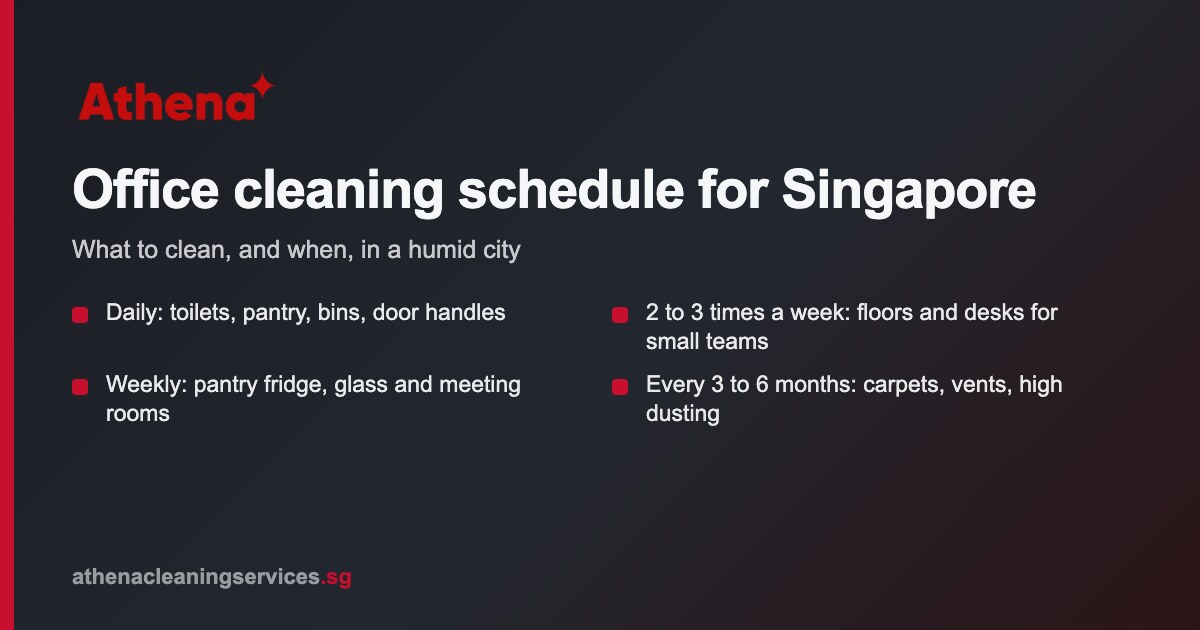
How often should offices be cleaned in Singapore? For most workplaces, toilets, pantries, bins and door handles need cleaning every working day. Floors, desks and meeting rooms need a proper clean at least once a week. Carpets, upholstered chairs, vents and high surfaces need a deep clean every three to six months. Small teams of five to ten can often run on two or three visits a week, while offices with 30 or more staff usually need a cleaner on site every day.
The right number depends on headcount, footfall and how humid your building runs. Below is a schedule by area, what each visit should cover, and typical costs in SGD so you can plan a budget before asking for quotes.
The short schedule most Singapore offices follow
Cleaning frequency comes down to one question: how many hands touch the surface each day? A pantry tap used by 40 people needs attention far more often than a boardroom table used twice a week. Sorting your office into three tiers keeps the plan simple and stops you paying for work you do not need.
Tier 1: every working day
Toilets, pantry counters, sinks, bins, door handles, lift buttons, reception counters and shared microwaves. These are high-touch and high-moisture areas. In Singapore's heat, food waste in a pantry bin turns within hours, and a toilet that skips a day shows it by the afternoon.
Tier 2: once or twice a week
Vacuuming and mopping of open-plan floors, desk wiping, glass partitions, meeting rooms, skirting and the inside of pantry fridges. Most offices land on two or three visits a week, and busy ones go daily.
Tier 3: every few months
Carpet shampooing, fabric chair and sofa cleaning, aircon vent and grille dusting, high dusting, window interiors and hard floor polishing. These jobs are scheduled rather than reactive, so they are easy to book in advance and quote as fixed items.
If you are unsure where your office sits, start one tier higher than you think, then trim after a month. It is easier to cut a visit that proved unnecessary than to recover from a pantry that got ahead of you.
What needs cleaning every day
Daily cleaning is about hygiene, not appearance. Shared surfaces carry the germs that pass between colleagues, and the HealthHub healthy living resources from Singapore's Ministry of Health stress regular hand hygiene and clean shared spaces as basic protection against common infections.
Toilets and pantries
Toilets need bowls, seats, basins, taps, floors and dispensers cleaned and restocked daily. Pantries need counters, sinks, coffee machine surrounds and the microwave wiped down, and bins emptied. In a 20-person office the pantry is often the dirtiest room by Wednesday if it is left alone.
Bins, handles and entrances
Empty general bins daily, and food bins before they attract ants and cockroaches, which are a constant issue in Singapore's warm climate. Wipe door handles, lift buttons, turnstile readers and the reception counter, because visitors touch them without thinking. The NEA public cleanliness guidance sets the standard Singapore expects for shared premises, and a clean toilet and clear bins are what inspectors and visitors notice first.
Daily work usually takes one cleaner between one and three hours for a 1,000 to 2,500 sq ft office. Many firms run it before opening or after closing so staff are never working around a mop bucket.
What needs cleaning every week
Weekly cleaning deals with dust and floor grime that build up quietly. Open-plan floors need vacuuming or mopping at least once a week, and twice for offices with heavy footfall, a ground-floor entrance or staff who walk in from rain-soaked streets. Wet shoes drag grit onto tiles, and grit wears the finish on vinyl and carpet faster than anything else.
Desks, partitions and meeting rooms
Wipe desks, monitors stands, phones and shared keyboards weekly, or daily if you hot-desk. Clean glass partitions and meeting room tables, and reset chairs. Fingerprints on glass are the first thing a client sees when they arrive for a pitch.
Pantry fridge and appliances
Clear out the shared fridge every week. Expired lunches and open drinks are the source of most pantry smells. Wipe the inside, the shelves and the door seals, which collect mould in humid weather.
A checklist signed after each visit keeps this honest. Ask your cleaner or contractor for a written list of what was done, so the office manager can spot a skipped task in seconds rather than finding out when someone complains.
Deep cleaning: carpets, upholstery, vents and floors
Deep cleaning is the work routine visits cannot reach. Plan it as a calendar, not an emergency, and you will spend less overall.
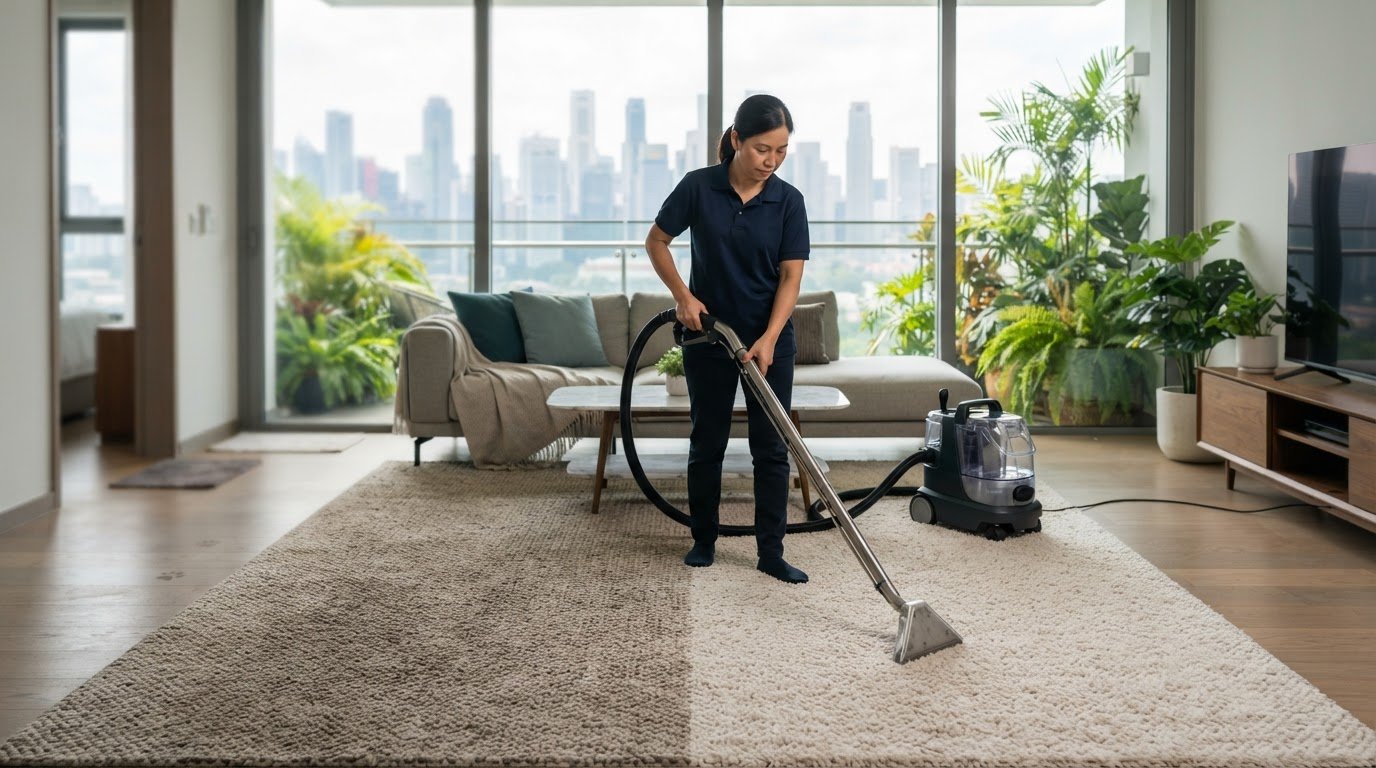
Carpets and fabric chairs
In Singapore's humid air they hold damp longer than in drier countries, so a deep clean every three to six months is a sensible range for a busy office. Fabric chairs in meeting rooms and reception can usually go every six months. Our guides on how often to clean carpets in Singapore and how often to schedule carpet cleaning for a healthier space go into drying times and method choice.
Aircon vents and high dusting
Dust settles on ceiling vents, grilles, light fittings and the tops of partitions. The US EPA guidance on improving your indoor environment lists regular cleaning and controlling moisture among the basic steps for better indoor air, and an air-conditioned Singapore office recirculates the same air all day. Dust vents and high surfaces every three to six months, and have the aircon units themselves serviced on their own schedule.
Hard floors and stone
Reception lobbies with marble or granite lose their shine to foot traffic. Polishing once or twice a year restores it, and it is cheaper than replacing damaged stone. See our notes on how to maintain marble floors with professional polishing in Singapore for what the job involves.
After a renovation or office move, book a one-time deep clean before staff return. Builders leave fine cement dust that settles on everything, and our 5 essential steps for effective post renovation cleaning in Singapore shows the order professionals work in.
How headcount and office type change the schedule
A fixed rule across all offices does not hold. Headcount, opening hours and the type of business all move the schedule.
Small offices of 5 to 10 people
A small team in a shophouse unit or a 600 to 1,000 sq ft rental can usually manage with two or three visits a week, plus a daily self-service routine: staff wipe the pantry counter and bag their own rubbish. Toilets should still be done daily if they are shared with other tenants and nobody else owns the job.
Mid-size offices of 20 to 50 people
Daily cleaning is the safe default. Toilets, pantry and bins are used heavily, and a missed day shows. Add a weekly floor and desk service and quarterly carpet work.
Large or high-footfall sites
Clinics, tuition centres, co-working spaces, retail-facing offices and showrooms need cleaning during opening hours as well as after. A day cleaner who stays on site for toilets and touchpoints is common in these places, and it protects the impression visitors form in the first minute.
Hot-desking and shared equipment
Where nobody owns a desk, nobody wipes it. If your team rotates, move desk and keyboard wiping from weekly to daily, and keep sanitising wipes at every bank of desks for use between cleans.
Industries with extra hygiene obligations, such as dental or medical clinics, follow their own regulator rules on top of this. Treat the schedule here as a base, and ask your licensing body what it adds.
Humidity, mould and why Singapore offices need more attention
Singapore's relative humidity regularly sits above 80 percent, and that changes how offices behave. Damp builds up behind furniture, under carpets, along window frames and inside poorly ventilated storerooms. Mould needs moisture and organic material, and an office has plenty of both in the form of paper, fabric and dust.
The US EPA mould cleanup guidance says the way to control mould is to control moisture, and that small patches should be cleaned promptly while large or recurring growth needs professional help. For an office, that means three habits. Check storerooms, the back of bookshelves and the corners of the ceiling quarterly. Wipe condensation from window frames and pantry walls weekly. Run the aircon and dehumidifier on a schedule rather than only when staff are in, particularly over long weekends and public holidays when a closed office traps damp air.
Signs the schedule is too light
Musty smells on Monday morning, black spots on ceiling tiles or grout, sticky floors near the pantry, and staff complaining of sneezing or itchy eyes are all signs that cleaning has fallen behind. Tiles and grout in toilets are the usual first sign, and our guide on choosing a bathroom cleaner for tiles, grout and fixtures in Singapore covers the products that work in this climate.
When a problem is bigger than surface mould, such as water staining that returns after cleaning, find the leak first. Cleaning treats the symptom, and the building manager or landlord handles the cause.
Costs, contracts and doing it in-house
Prices below are typical Singapore ranges before GST in 2026, based on office size, access and how often the cleaner comes. Final quotes depend on a site visit.
A recurring contract is almost always cheaper per visit than ad-hoc booking, because the provider can plan routes and staff ahead. A small office on a few visits a week typically pays from around S$350 to S$700 a month, while larger or daily contracts for 2,000 sq ft and up are priced by hours and headcount and often run well above S$1,000 a month. One-time deep cleans for offices usually fall between S$400 and S$1,200 depending on floor area and carpet.
When in-house cleaning works
A very small office with a handful of staff and light use can manage with a shared rota and a monthly professional visit. It breaks down quickly when the rota depends on goodwill. If cleaning is nobody's job, it becomes everybody's complaint.
What to check in a contract
Ask for a written scope with the tasks and frequency per area, the hours on site, who supplies consumables, and how missed visits are handled. Check that the provider is an NEA-licensed cleaning business with trained, MOM-registered staff, and confirm it carries public liability insurance. The Consumers Association of Singapore is the place to check your rights if a service falls short of what was agreed.
Start with a three-month term and review after the first month. A contract that survives a review at 30 days tends to hold up for the year.
Comparison at a glance
| Area or task | Recommended frequency | Why it matters in Singapore |
|---|---|---|
| Toilets and washrooms | Daily (twice daily for 30+ staff) | High moisture and heavy use; odours and grout mould build fast in humid weather |
| Pantry counters, sinks and bins | Daily | Food waste attracts ants and cockroaches within hours in warm conditions |
| Door handles, lift buttons, reception | Daily | Most-touched shared surfaces for staff and visitors |
| Floors (vacuum and mop) | 2 to 3 times a week; daily for high footfall | Wet shoes bring in grit and moisture during rainy periods |
| Desks, partitions and meeting rooms | Weekly; daily if hot-desking | Shared equipment spreads germs between users |
| Pantry fridge | Weekly | Expired food and damp door seals encourage smells and mould |
| Carpets and fabric chairs | Every 3 to 6 months | Fabric holds humidity and dust longer than in drier climates |
| Aircon vents and high dusting | Every 3 to 6 months | Recirculated air spreads dust through the office |
| Marble or hard floor polishing | Once or twice a year | Restores shine and protects stone from foot traffic wear |
| Post-renovation or move-in deep clean | Once, before staff return | Removes fine construction dust from every surface |
Frequently asked questions
How often should a small office in Singapore be cleaned?
A small office of 5 to 10 people usually does well with two or three professional visits a week, plus simple daily habits such as staff wiping the pantry and taking out food waste. Toilets should still be cleaned every working day if you share them with other tenants. Review after a month and add or drop a visit based on what you see.
How often should offices be cleaned in HDB shophouses or older buildings?
Older shophouse and walk-up units tend to hold more dust and damp than newer towers, so lean towards the higher end of any range. Check storerooms and corners for mould each quarter and keep a dehumidifier running when the space is empty. Floors and pantry areas usually need cleaning more often than the same footprint in a modern Grade A building.
Do offices need daily cleaning?
Toilets, pantries, bins and shared touchpoints do, in almost every office. Floors, desks and meeting rooms can usually move to two or three times a week for smaller teams. Offices with 30 or more people, public visitors or hot-desking generally need a cleaner on site every day.
Should I clean the office myself or hire a professional company?
A very small office with light use can handle daily wiping in-house and book a professional for the monthly and quarterly jobs. Once you reach around 15 to 20 staff, a contract is usually cheaper than the lost time and the arguments over who does the toilets. Choose an NEA-licensed provider with insured, trained staff and a written checklist.
Sources
- HealthHub healthy living resources
- NEA public cleanliness guidance
- US EPA guidance on improving your indoor environment
- US EPA mould cleanup guidance
- Consumers Association of Singapore
Related Athena cleaning services in Singapore
Looking for help? See our house cleaning service in Singapore.
Related articles