

Insured and Bonded Cleaning Company Singapore: A 2026 Buyer’s Guide

In this article
- Key Takeaways
- Table of Contents
- What does “insured and bonded cleaning company Singapore” mean?
- How to verify a cleaning company’s insurance and bond claims
- How to compare insured cleaning companies beyond the paperwork
- What should you do if a cleaner causes damage or something goes missing?
- Choosing a cleaning company in Singapore: questions to ask before booking
- Choose with confidence before you book
- Frequently Asked Questions
What happens if a cleaner damages a surface, gets injured on the job, or something goes missing? Searching for an “insured and bonded cleaning company singapore” may feel reassuring, but the label alone doesn’t tell you what’s covered, who can make a claim, or where exclusions apply.
It’s sensible to want clear accountability before welcoming unfamiliar staff into your home or workplace. Insurance and bonding aren’t interchangeable, and a provider’s claim is useful only when the supporting documents match the work and risks involved.
This 2026 buyer’s guide explains what to request, including policy or bond documents, coverage scope, limits, exclusions, and validity dates. You’ll also learn how to check a provider’s business details, compare service scope and staff practices, and clarify responsibility for damage or loss before booking. Use the checklist to assess any cleaning provider, including Athena Team Cleaning, without assuming coverage that hasn’t been confirmed. The right questions can help you set clearer expectations before work begins.
Key Takeaways
- Assess an “insured and bonded cleaning company singapore” by checking whether its documents match the company you’re hiring and the work required.
- Request and review current policy or bond documents, including coverage scope, exclusions, limits, and validity dates.
- Compare providers on more than paperwork: consider service fit, written scope, communication, scheduling, and follow-up.
- If damage or loss occurs, prioritise safety, record relevant facts, notify the provider, and keep correspondence.
- Use a pre-booking checklist to clarify responsibilities and expectations before confirming a cleaning arrangement.
What does “insured and bonded cleaning company Singapore” mean?
Before allowing a cleaning team into your home or workplace, you want more than reassuring words on a website. You want to know what happens if a worker is injured, property is damaged, or something goes missing. The phrase insured and bonded cleaning company singapore sounds like a complete safeguard, but these terms refer to different arrangements. Their meaning depends on the documents and contract.
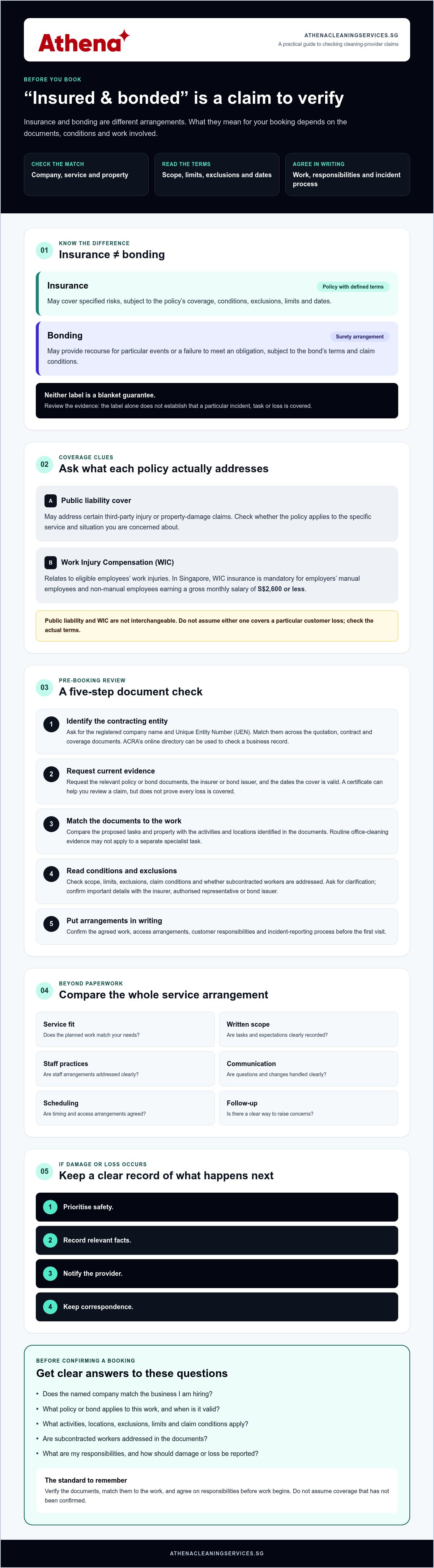
Insurance is a policy with defined coverage and conditions. Bonding generally refers to a surety arrangement that may respond to specified losses or a failure to meet an obligation. Neither label automatically covers every incident, task, or type of loss. Review the evidence, not just the claim.
At a glance
- Insurance: A policy that may cover specified risks, subject to its terms, exclusions, limits, and dates.
- Bonding: A surety arrangement that may provide recourse for particular events or contractual failures, subject to its conditions.
Ask for the relevant documents and confirm what they cover before booking.
What may cleaning-company insurance cover?
Policies differ. Public liability cover may address certain third-party injury or property damage claims, while Work Injury Compensation insurance relates to eligible employees’ work injuries. These are not interchangeable, and neither should be assumed to cover a particular customer loss. In Singapore, WIC insurance is mandatory for employers’ manual employees and non-manual employees earning a gross monthly salary of S$2,600 or less.
Check the named insured, covered activities, exclusions, limits, and policy dates. Ask whether the policy applies to the specific service and scenario you’re concerned about, such as damage during floor polishing. For important details, confirm directly with the insurer or an authorised representative.
What does bonded mean when hiring cleaners?
In general, a surety bond involves the cleaning company, the client, and a surety provider. The bond’s purpose and claim conditions depend on its terms. The label alone doesn’t establish which person or loss is protected. For a plain-language overview of the arrangement, see this explanation of a surety bond.
Ask who or what the bond protects, which events qualify, what evidence a claim requires, and how to submit one. A bond is not the same as insurance or a blanket guarantee that every complaint will be compensated. Verify the document, issuer, scope, exclusions, limits, and validity dates before treating “bonded” as meaningful protection.
How to verify a cleaning company’s insurance and bond claims
Before confirming a booking, check that the documents relate to the company, work, and property involved. This five-step review can help you assess an insured and bonded cleaning company singapore without relying on a website badge or verbal assurance.
- 1. Identify the contracting entity. Ask for the company’s registered name and Unique Entity Number (UEN). Check that these details match the business named in the quotation, contract, and coverage documents. You can use ACRA’s online directory to check the business record.
- 2. Request current evidence. Ask for relevant policy or bond documents, the insurer or bond issuer, and the dates the cover is valid. A certificate can help you review a claim, but it doesn’t prove that every possible loss is covered.
- 3. Match the documents to the work. Compare the proposed tasks and property with the activities and locations identified in the documents. For example, don’t assume that evidence for routine office cleaning also applies to a separate specialist task.
- 4. Read the conditions. Check exclusions, limits, claim conditions, and whether subcontracted workers are addressed. Ask the provider to explain anything unclear. Confirm important details directly with the insurer or authorised representative, or the bond issuer.
- 5. Get the arrangements in writing. Confirm the agreed work, access arrangements, customer responsibilities, and the process for reporting an incident before the first visit.
Which documents and details should you request?
Ask for the policy or bond evidence relevant to your booking, including its issuer, effective dates, scope, exclusions, limits, and claims process. Check that the named company matches the entity you’re hiring, and ask whether the stated terms include the specific cleaning activity and any subcontracted staff. If the company provides only a certificate, treat it as a starting point for verification, not a promise that a claim will be accepted.
Questions to ask before the first cleaning visit
Find out who will supervise the work, how staff access to your home or workplace is managed, and whom you should contact if something goes wrong. Ask how incidents are recorded, investigated, and escalated. Keep the agreed tasks and access instructions in writing so both sides have a clear reference.
If a service-related disagreement remains unresolved, the Singapore Courts explain the process for filing a claim with the Small Claims Tribunals. If you’re considering a booking, you can also review Athena Team Cleaning’s services, clarify the scope that fits your needs, and request a quote. Ask directly about any relevant insurance or bonding rather than assuming it has been confirmed.
How to compare insured cleaning companies beyond the paperwork
Documents help you assess a provider’s stated coverage, but they don’t tell you whether the service suits your space or whether expectations are clear. Compare providers against the same practical criteria, and look for specific written answers rather than broad claims such as “premium” or “fully covered.” You can also read more about professional residential and commercial cleaning solutions to better understand common service offerings and standards.
| Area | What to compare | Useful question |
|---|---|---|
| Documentation | Whether evidence is current and matches the contracting entity and proposed work | Can you clarify which activities and incidents these documents address? |
| Service scope | Tasks, areas, exclusions, and any special requirements in the written description | Which rooms or surfaces are included, and what is excluded? |
| Communication | Clarity of replies and a named contact for questions or concerns | Who should I contact if the agreed work needs clarification? |
| Scheduling | Whether proposed visit times and access arrangements fit your needs | How will timing or access changes be confirmed? |
| Follow-up | How completion, feedback, and incident reports are handled | How are concerns recorded and followed up? |
Use the same questions with each provider. An insured and bonded cleaning company singapore is not automatically the best fit. Insurance or bonding alone doesn’t establish cleaning quality, suitability, or how clearly the service will be delivered. For a wider framework on evaluating service standards and reliability, read this professional cleaning company buyer’s guide.
What matters for residential and commercial cleaning?
For a home, confirm which rooms are included, how staff access the property, and how to flag fragile belongings or areas that need special care. For a workplace, clarify the agreed operating hours, restricted areas, access responsibilities, and how completed work will be reported. In either setting, check that the written scope matches the specific service you’re considering, such as upholstery cleaning or office cleaning; professional firms like Deepclean Services illustrate how transparent scope definitions and specialized care protocols should look in practice.
Signals that deserve a follow-up question
Pause and ask for specifics if a provider says “fully covered” without explaining the terms, if documents name a different business, or if validity dates are unclear. A provider should be able to explain relevant exclusions and how incidents are reported. If the answers remain vague, you may not have enough information to compare the offer confidently.
What should you do if a cleaner causes damage or something goes missing?
Discovering damage or a missing item can be upsetting. Take a measured approach: protect people first, preserve accurate information, then contact the cleaning provider through its stated incident process. Even if a company describes itself as insured or bonded, that doesn’t mean a claim will automatically be accepted. The relevant policy or bond terms, evidence, and circumstances matter.
- Prioritise safety. If there’s an immediate hazard, keep people away from it and take reasonable steps to prevent further harm.
- Record what you observe. Note the date, the affected area, the service booked, and when you first noticed the issue. Take clear photographs where appropriate.
- Notify the provider promptly. Use its stated reporting channel and ask what information or documents it needs.
- Keep a record. Save the booking details, receipts, messages, photographs, and notes of calls or other conversations.
- Follow up on the coverage process. Ask which policy or bond process may apply, who handles the next step, and what requirements or timelines are stated in the documents.
How to report an incident clearly
Stick to facts you can verify. For example, describe the surface and location of visible damage, or identify the item you noticed was missing and when you last saw it. Avoid guessing how the incident happened or assigning responsibility before the circumstances are reviewed. Send your account in writing where possible, and keep a copy. Follow the provider’s documented process, but ask for clarification if the reporting steps aren’t clear.
How to follow up on a coverage response
If the provider says a policy or bond may be relevant, ask for the named insurer or issuer and the applicable claim contact. Contact that issuer to clarify the terms, exclusions, evidence needed, and submission process. Keep a dated log of responses and copies of correspondence. The insurer or issuer can explain its own requirements. For advice about your specific circumstances, consult a qualified adviser.
If a service dispute remains unresolved, Singapore Courts provide information about filing a claim through the Small Claims Tribunals. Review the official guidance to understand the process and whether it may fit your situation.
Before booking, you can discuss your cleaning requirements with Athena Team Cleaning and clarify the proposed scope and incident-reporting arrangements. Ask directly whether relevant insurance or bonding applies, and request details you can review.
Choosing a cleaning company in Singapore: questions to ask before booking
A confident choice comes from weighing the full arrangement, not treating an insurance or bonding claim as a substitute for clear service details. Before booking, confirm that the provider understands your requirements, documents the work, explains how to raise concerns, and provides coverage evidence you can assess.
A final checklist for selecting a provider
Use these questions to bring your comparison together. Clear answers should help you understand what the service includes and what to expect if plans or circumstances change.
- Service fit: Are the tasks and property details you discussed reflected in the written scope?
- Coverage evidence: Have you reviewed current documents relevant to the specific work, including issuer, scope, exclusions, limits, and validity dates?
- Access: Who will enter the property, how will access be managed, and are any areas restricted?
- Scheduling: Do the proposed visit arrangements suit your needs, and how will changes be communicated?
- Incident handling: Do you know whom to contact, how to report a concern, and what information may be required?
- Communication: Are key answers and responsibilities confirmed in writing before the first visit?
Use the same checklist for every provider. If you’re searching for an insured and bonded cleaning company singapore, treat those words as a prompt to verify relevant documents, not as proof that every incident or loss is covered.
How to assess Athena Team Cleaning for your needs
Athena Team Cleaning provides residential and commercial cleaning in Singapore, including office cleaning, carpet and rug cleaning, upholstery cleaning, sanitization services, and end-of-tenancy cleaning. Compare these service options with your specific requirements, then ask directly whether relevant insurance or bonding applies to the work you’re considering. If it does, request the supporting details and review the scope, exclusions, limits, issuer, and validity dates before deciding. Don’t assume Athena Team Cleaning has insurance or bonding without confirming it directly.
For additional criteria on evaluating service quality and reliability, consult this professional cleaning company buyer’s guide. Once you’ve clarified the cleaning scope and any coverage questions, you can request a cleaning quote from Athena Team Cleaning and assess whether the proposed arrangement fits your needs.
Choose with confidence before you book
A trustworthy cleaning arrangement starts with clear evidence, not reassuring labels. Before choosing an insured and bonded cleaning company singapore, check that the documents match the provider and the work you need. Then compare the written service scope, communication, access arrangements, and incident process. Coverage does not confirm cleaning quality or guarantee that a claim will be accepted.
Athena Team Cleaning provides residential and commercial cleaning in Singapore. Ask the team directly whether relevant insurance or bonding applies to the work you need, and request details you can review. You can submit an online quote request or contact the team by phone or email to clarify your requirements.
Request a cleaning quote and ask about relevant coverage. Confirm expectations before booking so you can move forward with clearer information and a cleaning plan that suits your space.
Frequently Asked Questions
Is a cleaning company in Singapore required to be insured and bonded?
No, public liability insurance and bonding are not generally mandatory for every cleaning company in Singapore. However, Work Injury Compensation insurance is mandatory for employers whose employees perform manual work, and for non-manual employees earning a gross monthly salary of S$2,600 or less. Separately, certain general cleaning businesses at commercial premises or public places need a valid NEA Cleaning Business Licence. Ask which requirements apply to the provider and work you’re considering.
What is the difference between an insured and a bonded cleaning company?
Insurance is a policy that may cover specified risks, subject to its terms, limits, and exclusions. Bonding generally refers to a surety arrangement that may provide recourse for particular losses or contractual failures, depending on the bond’s conditions. They serve different purposes and aren’t interchangeable. If you’re assessing a company described as an “insured and bonded cleaning company singapore,” ask for the relevant documents and confirm what each arrangement actually covers.
How can I check whether a cleaning company’s insurance is valid?
Request current documentation and check the named insured, insurer, effective dates, covered activities, exclusions, limits, and claim conditions. Confirm that the company named on the policy matches the entity that will contract with you, and that the proposed cleaning work fits the stated scope. If a date or term is unclear, contact the insurer or an authorised representative directly. A certificate is useful evidence to review, but it doesn’t establish that every loss is covered.
Does a bonded cleaning company guarantee that stolen or damaged items will be reimbursed?
No. A bond doesn’t guarantee reimbursement for every theft, damage incident, or complaint. Eligibility depends on the specific bond wording, qualifying events, evidence, exclusions, and claim process. Ask who or what the bond protects, which circumstances may qualify, and how to submit a claim. For damaged property, also ask whether a relevant insurance policy applies. Contact the bond issuer or insurer to confirm requirements for your particular situation.
What should I ask a cleaning company before letting its staff into my property?
Confirm which tasks and areas are included, who will attend, how access will be managed, and how to flag restricted areas or fragile belongings. Ask who supervises the work, how incidents are reported, and whom to contact with concerns. Request written confirmation of the service scope, scheduling, access arrangements, and your responsibilities. If the company refers to insurance or a bond, ask for current supporting documents and details relevant to the work.
Are all cleaning services covered by the same insurance policy?
No. A policy may define particular activities, locations, workers, exclusions, and limits, so don’t assume cover for one cleaning task extends to another. For instance, ask whether the documents apply to the specific service you plan to book, such as office cleaning, upholstery cleaning, or floor polishing. Confirm whether subcontracted workers are addressed too. If the wording is unclear, ask the insurer or an authorised representative to explain the relevant terms.
What should I do if a cleaning company cannot provide proof of coverage?
Ask the provider to explain what coverage it claims to hold and whether it can supply current documents relevant to your booking. If it can’t clarify the claim, avoid relying on verbal assurances. Consider pausing the booking while you compare other providers. You can still assess the written service scope, access arrangements, and incident process, but don’t assume coverage exists. For a specific concern, seek confirmation from the purported issuer or independent professional advice.
Frequently Asked Questions
What may cleaning-company insurance cover?
What does bonded mean when hiring cleaners?
Which documents and details should you request?
What matters for residential and commercial cleaning?
Is a cleaning company in Singapore required to be insured and bonded?
What is the difference between an insured and a bonded cleaning company?
How can I check whether a cleaning company’s insurance is valid?
Does a bonded cleaning company guarantee that stolen or damaged items will be reimbursed?
What should I ask a cleaning company before letting its staff into my property?
Are all cleaning services covered by the same insurance policy?
What should I do if a cleaning company cannot provide proof of coverage?
Related articles