
NEA Office Cleaning Guidelines: Singapore Guide 2026

In this article
- Key Takeaways
- Table of Contents
- What Do NEA Guidelines for Office Cleaning Actually Cover?
- Which Official Guidance Should Office Managers Check?
- How to Build an NEA-Informed Office Cleaning Checklist
- How to Put the Cleaning Plan Into Practice and Keep Records
- How Professional Office Cleaning Supports a Consistent Routine
- Turn Your Office Cleaning Plan Into a Consistent Routine
- Frequently Asked Questions
What makes an office cleaning plan useful is not a one-size-fits-all checklist, but a routine built around the guidance that applies to your workplace. For office managers, the NEA guidelines for office cleaning can be difficult to interpret: some materials provide practical recommendations, while legal duties depend on the setting and circumstances.
Managers need to know what applies, how to set task intervals and whether the checklist covers shared desks, frequently touched surfaces and other easily missed areas. One cleaning frequency will not suit every office. Separate applicable requirements from good hygiene practice, then document a routine your team can follow and review.
This guide explains how to use NEA pictorial guides for office spaces and common areas alongside its guidance for cleaning and disinfecting non-healthcare premises exposed to infectious diseases. You’ll learn how to plan tasks around your workplace, record completion and distinguish routine cleaning from sanitizing or disinfection. It also explains how professional office cleaning can support a consistent routine.
Key Takeaways
- Interpret the NEA guidelines for office cleaning without treating every recommendation as a universal legal requirement.
- Identify which official guidance is relevant to your workplace and check that the sources are current.
- Build a practical checklist covering shared touchpoints, workstations, washrooms, pantry areas, floors and waste.
- Track task completion, follow up on missed work and review recurring issues with a simple record system.
- Use professional office cleaning and sanitization to support a consistent routine while keeping workplace accountability with the organisation.
What Do NEA Guidelines for Office Cleaning Actually Cover?
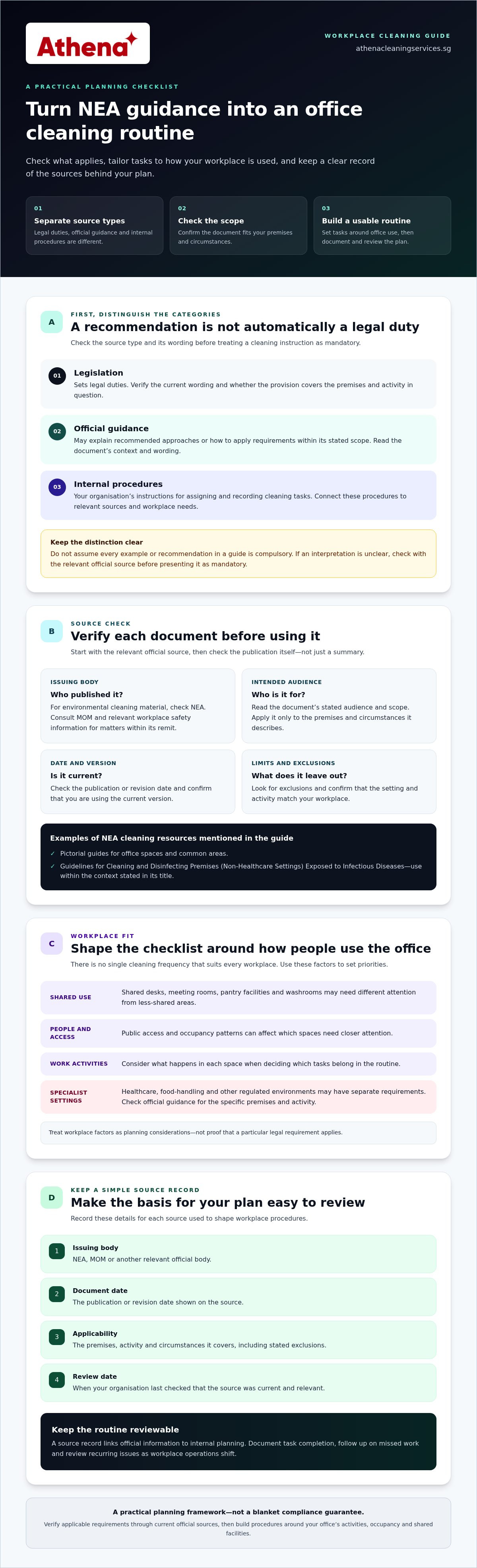
Official guidance and general cleaning advice are not the same. A recommendation to pay attention to shared surfaces may be sensible practice, but that alone does not make it a legal requirement for every office. To apply the NEA guidelines for office cleaning accurately, check the source, document type and scope, including whether it applies to your premises and circumstances.
The National Environment Agency (NEA) publishes cleaning resources, including pictorial guides for office spaces and common areas. It has also published Guidelines for Cleaning and Disinfecting Premises (Non-Healthcare Settings) Exposed to Infectious Diseases, which addresses the context stated in its title. For background on the agency, see this National Environment Agency (NEA) Singapore overview. For cleaning instructions, use the relevant NEA publication and check its current version.
Guidelines, legal duties, and workplace procedures are not interchangeable
Legislation sets legal duties. An agency’s explanatory or practical guidance is a different type of material. Official guidance can explain recommended approaches or how to apply requirements within its stated scope, so its wording and context matter. Internal procedures are the organisation’s own instructions for assigning and recording cleaning tasks.
Keep these categories distinct. Before treating a statement as mandatory, check whether it appears in legislation or an applicable official requirement. Do not assume every example or recommendation in a guide is compulsory. When turning guidance into workplace procedures, record the source type and relevant scope. If a legal provision may apply, verify its current wording and relevance through the responsible official source.
Which offices may need closer attention?
Cleaning priorities depend on how people use the workplace. A busy office with shared desks, meeting rooms, pantry facilities or washrooms may need a different task plan from a small office with fewer shared areas. Public access, work activities and occupancy patterns can also affect which spaces need closer attention. Use these factors to plan tasks, not to assume one cleaning frequency applies to every workplace.
Distinguish ordinary office areas from specialist settings. Healthcare, food-handling and other regulated environments may have separate requirements that do not automatically apply to a standard office. Check official guidance for the specific activity and premises, including relevant NEA material and Ministry of Manpower information on workplace safety matters within its remit.
This is a planning framework, not a blanket compliance guarantee. Use applicable official sources to establish what is required, then build practical procedures around your office’s activities, occupancy and shared facilities. That gives managers a clear basis for the checklist and records covered next.
Which Official Guidance Should Office Managers Check?
Start with the National Environment Agency (NEA) for environmental cleaning materials. Its NEA Environmental Cleaning Guidelines page links to publications for different cleaning contexts, including non-healthcare premises exposed to infectious diseases. Read the linked document, not just a summary, and apply it only to the audience and circumstances it describes. This keeps decisions about the NEA guidelines for office cleaning grounded in relevant, current sources.
No single official document automatically answers every question for every workplace. The premises, activities and current rules can all affect which guidance is relevant. For workplace safety matters, consult the Ministry of Manpower (MOM) and relevant workplace safety information. Do not assume environmental hygiene guidance and workplace safety legislation set identical cleaning duties for every office.
How to verify whether an NEA document applies
Before using a publication to shape a procedure, check its intended audience, scope, publication or revision date, and any exclusions. Read the wording closely: does it set out a legal requirement, offer advisory guidance or describe an operational practice? These categories are not interchangeable. If the setting or interpretation is unclear, seek clarification through the relevant official channel before presenting a point as mandatory.
Apply the same care to references to legislation, including the Environmental Public Health Act or workplace safety legislation. Verify the current text and confirm that the provision covers the premises and activity in question. A law’s title alone does not establish a specific cleaning obligation for an ordinary office.
Keep a simple source record
A compact source record makes decisions easier to review when guidance changes or office operations shift. For each source, note:
- Issuing body: NEA, MOM or another relevant official body.
- Document date: The publication or revision date shown on the source.
- Applicability: The premises, activity and circumstances it covers, including stated exclusions.
- Review date: When your organisation last checked that the source was current and relevant.
This record does not replace legal advice or confirm compliance. It creates a clear link between official information and internal planning. Once you have identified the relevant sources, Athena Team Cleaning’s professional office cleaning can support a consistent workplace routine alongside your organisation’s own oversight.
How to Build an NEA-Informed Office Cleaning Checklist
A practical checklist turns relevant guidance into specific tasks, assigned responsibilities and a review process. Use it to organise cleaning at your office, not as proof that every legal requirement has been met. NEA pictorial guides can help clarify cleaning steps for office spaces and common areas. Adapt the plan to your layout and activities.
In brief: assess each space, prioritise tasks, assign responsibilities, record completion and review the plan.
Prioritise spaces and cleaning tasks
Walk through the office and note how each area is used, who shares it and which surfaces are touched often. Rank tasks according to use and workplace risk. Set intervals that fit those conditions rather than assuming one universal schedule applies.
- Shared touchpoints: List frequently used items such as door handles, switches and shared equipment.
- Workstations: State how desks and shared work surfaces should be cleaned, accounting for hot-desking and equipment use.
- Washrooms and pantry areas: Include fixtures, counters, sinks and other shared surfaces.
- Floors and waste: Specify floor care by surface type, along with waste-bin emptying and handling tasks.
For each task, identify the surface, method and any relevant product directions. Match the cleaning approach to the material and purpose, and follow the product label. Cleaning, sanitizing and disinfecting are not interchangeable terms. If the workplace plan includes a spill response or escalation process, state who should be notified and what action follows. Do not add procedures staff have not been instructed to use.
Record responsibilities, completion and review
Make the checklist workable during a normal shift. Assign each task to a role or cleaning-service schedule, and use a consistent completion record, such as a tick, initials or timestamp. Staff should be able to tell at a glance what was done and what still needs attention.
- Assign: Name the responsible role for each task and area.
- Record: Capture completion in one agreed format.
- Follow up: Note missed tasks, exceptions, corrective actions and who owns the next step.
- Review: Revisit the plan after layout or occupancy changes, repeated issues, or updated official guidance.
Keep the checklist accessible to the people who use it, and make responsibilities clear between staff and any cleaning service. Specific tasks, clear ownership and timely reviews of recurring gaps make a routine easier to carry out consistently.
How to Put the Cleaning Plan Into Practice and Keep Records
A cleaning plan works best when everyone knows who is responsible, what completion means and how to handle exceptions. A simple log helps managers follow up on missed tasks and spot recurring issues. An internal record, however, is not an official NEA form or proof of compliance.
Use a table like this to support handovers between workplace staff and a cleaning service. Set timing according to your office’s needs instead of assuming one schedule applies everywhere.
| Task | Responsible party | Planned timing | Completion record | Follow-up |
|---|---|---|---|---|
| Wipe shared meeting-room surfaces | Assigned cleaning role | As set in the office plan | Date, status and initials | Reassign if missed; note repeat gaps |
| Check pantry counters and sink | Named workplace role or cleaning schedule | Based on use and agreed routine | Task status and exception, if any | Record the action owner and outcome |
| Vacuum office floor area | Assigned cleaning role | As specified for the space | Date and completion status | Flag access issues or recurring debris |
What a useful cleaning log can capture
Keep log entries factual and concise. Record the date, area, task, status, responsible role and any exception that needs follow-up. For example, “meeting-room table not completed, room in use, assigned for next scheduled service” gives a clearer trail than “cleaning issue.” Include the corrective action and its owner so an unresolved item does not disappear between shifts.
These records support day-to-day management. They do not replace separate records that a particular law, licence or other applicable rule may require. Requirements depend on the setting and provision involved, so check the relevant official source before treating a log as a legal record or asserting a retention duty.
When to review or revise the cleaning plan
Revisit the plan when occupancy, office layout, work activities or operating hours change. Repeated complaints and missed tasks are also useful signals. Look for patterns by area, task or timing, then adjust responsibilities or the schedule where appropriate. Check for updates to applicable official guidance as part of the review.
Record the review date and the reason for any significant change. A defined cleaning scope and clear review process help support consistent implementation. For further planning considerations, read this professional office cleaning guide. To put a documented routine into practice, request a tailored office cleaning quote.
How Professional Office Cleaning Supports a Consistent Routine
A documented plan only works if its tasks are carried out consistently. Professional office cleaning can support the routine by turning workplace priorities into a defined service scope: the areas included, the tasks planned and the schedule. It supports implementation, while the organisation remains responsible for deciding which requirements apply and overseeing its procedures.
Align cleaning services with the office plan
Start with your task list. Identify the spaces and priorities that matter, from shared areas and workstations to floors and pantry spaces. Then define the service scope and timing to fit how the office operates. Flexible scheduling can align planned work with workplace activity, and a clear scope gives everyone a shared reference point.
Athena Team Cleaning provides office cleaning, building maintenance and sanitization services in Singapore. These services support a well-maintained working environment through planned cleaning and hygiene tasks suited to the office’s needs. Your organisation should continue to maintain its own procedures, review completion records and check applicable official guidance. A service provider’s involvement is not a regulatory certification, formal audit or guarantee of compliance with the NEA guidelines for office cleaning.
Prepare a clear brief and take the next step
A focused brief helps define a service around your documented plan. Include:
- Areas: List the office spaces and shared facilities to be covered.
- Priorities: Highlight high-use areas, touchpoints and tasks needing particular attention.
- Operating constraints: Note how the office is used and any practical considerations that affect cleaning.
- Preferred scheduling: Describe the timing that best fits workplace operations.
Use the brief to clarify how the planned service fits with internal responsibilities, including who reviews completed tasks and follows up on exceptions. If your routine includes sanitization, identify the areas and intended scope so this work can be considered alongside office cleaning.
With your priorities and schedule outlined, you can take the next step. Request a quote for professional office cleaning and share your workplace plan to receive a tailored quote.
Turn Your Office Cleaning Plan Into a Consistent Routine
A reliable workplace routine starts by identifying which official guidance applies, then turning relevant advice into tasks, responsibilities and records that suit your office. Keep legal requirements distinct from general recommendations, and review the plan when workplace needs or applicable guidance change.
Professional office cleaning can help put that documented scope into practice, while your organisation retains responsibility for its procedures and oversight. Office cleaning is Athena Team Cleaning’s highest-priority service. Sanitization services and flexible scheduling can also help align cleaning with workplace operations.
Ready to put your plan into practice? Request a quote for professional office cleaning and share your office’s priorities and preferred schedule. A clear plan and consistent support can help maintain a clean, well-kept workspace for your team.
Frequently Asked Questions
What are the NEA guidelines for office cleaning?
The NEA guidelines for office cleaning are official publications and resources that may provide advice for particular premises or situations. They are not one universal rulebook for every office. Check current NEA materials for their scope, date and wording. Distinguish binding requirements from advisory guidance and your organisation’s own procedures. Record the sources reviewed and the review date, then turn relevant points into a practical plan for your workplace.
Does NEA require offices to clean every day?
Do not assume one daily cleaning frequency applies to every office. Task timing should reflect how spaces are used, occupancy, workplace risks and any requirements that apply to the premises. Check current official sources before treating a particular frequency as a legal duty. A documented schedule helps staff and cleaning teams work consistently, but should not be described as an NEA requirement unless the relevant source explicitly says so.
How often should high-touch office surfaces be cleaned?
The appropriate frequency depends on how often a surface is used, the workplace environment and relevant official guidance. Identify shared touchpoints such as door handles, switches and shared equipment, then set a practical schedule staff can follow and record. Do not treat one interval as a legal rule for all offices. Review the schedule if occupancy or work patterns change, or applicable official guidance is updated.
Are NEA guidelines legally mandatory for every office?
No single answer applies to every NEA document or workplace. Some materials explain requirements, while others provide advice or apply only to particular settings. Check a document’s scope, date and exact wording before treating a statement as mandatory. To interpret a specific legal duty, use the relevant current official source or channel. A general office-cleaning checklist can guide routine planning, but it does not establish which laws apply.
What should an office cleaning checklist include?
A practical checklist names the areas, tasks, responsible roles, planned timing and method for recording completion or exceptions. Depending on the premises, it may cover shared touchpoints, workstations, washrooms, pantry areas, floors and waste handling. Match methods and products to the surface, and follow product-label directions. Review the checklist when workplace conditions change. Do not call an internal checklist an official NEA form unless you have verified that it is one.
Does hiring a cleaning company make an office NEA-compliant?
Hiring a cleaning company can support consistent delivery of agreed tasks, but the service is not a guarantee of compliance. The organisation still needs to identify applicable requirements, define the cleaning scope and review whether planned work is completed. Align the service schedule with workplace procedures and current official guidance. Treat the cleaning provider as practical implementation support, not a replacement for the organisation’s own decisions and oversight.
How should an office document its cleaning routine?
Use a clear schedule listing areas, tasks, responsible roles, planned timing and completion status. Keep entries factual, recording exceptions and follow-up actions so managers can identify missed tasks or recurring issues. Note when the plan is reviewed or changed, and why significant revisions were made. These records support internal oversight. Do not describe a particular log or retention period as legally required unless current official guidance confirms it applies to your workplace.
Frequently Asked Questions
Which offices may need closer attention?
What are the NEA guidelines for office cleaning?
Does NEA require offices to clean every day?
How often should high-touch office surfaces be cleaned?
Are NEA guidelines legally mandatory for every office?
What should an office cleaning checklist include?
Does hiring a cleaning company make an office NEA-compliant?
How should an office document its cleaning routine?
Related articles