

How to remove bad smell from carpet in Singapore homes
In this article
- Why carpets smell so quickly in Singapore
- Find the source before you treat it
- The step-by-step home method
- Pet urine, milk and food spills
- Drying a carpet in humid weather
- What professional carpet cleaning costs in Singapore
- When to stop and call a professional
- Comparison at a glance
- Frequently asked questions
- Sources
- Related Athena cleaning services in Singapore
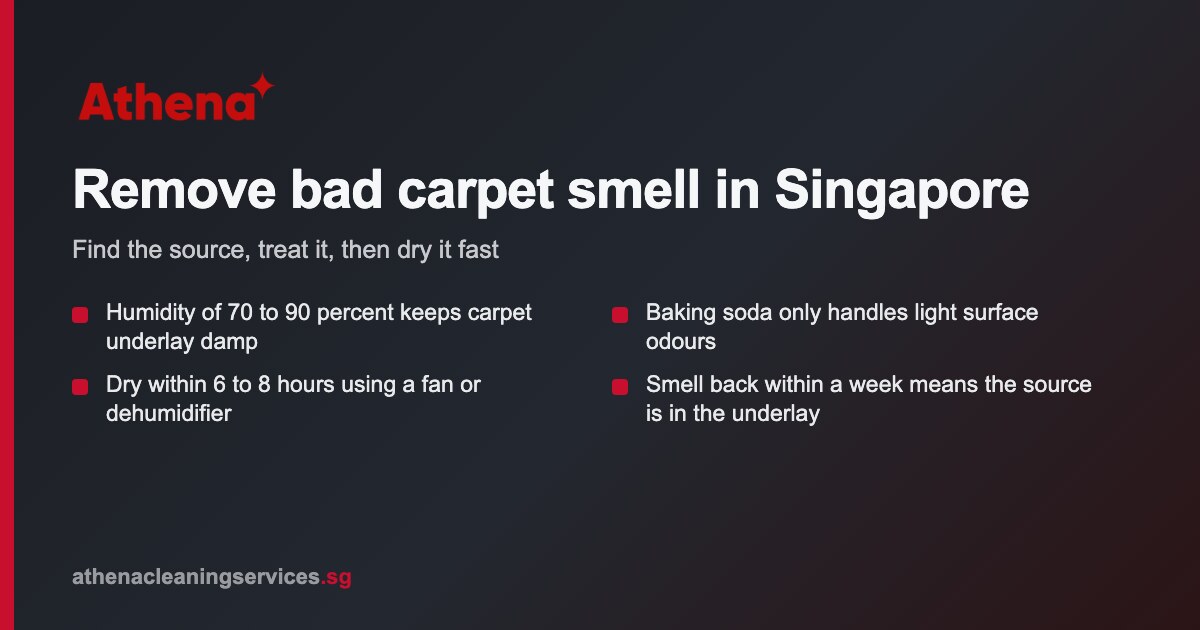
To remove bad smell from carpet in Singapore, find the source first, blot any wet spill, sprinkle baking soda, vacuum it out, then dry the carpet fully with a fan or dehumidifier. In our humid climate, the drying step decides whether the smell stays gone. If the odour is back within a week, it is sitting in the backing or underlay and needs hot water extraction.
This guide covers why carpets turn musty here, what you can do yourself this weekend, what typical professional jobs cost in SGD, and when it is time to stop scrubbing and call someone.
Why carpets smell so quickly in Singapore
Singapore sits at roughly 70 to 90 percent relative humidity most of the year, and a carpet is basically a thick sponge made of fibre, latex backing and foam underlay. Once water gets in from a spill, a mopped floor, a wet pet or a rainy-day shoe, it takes much longer to leave than it would in a dry country. The longer the pile stays damp, the more time bacteria and mould have to feed on the dirt and skin cells trapped in it.
The smell you notice is usually a mix of three things: bacteria breaking down organic residue (sour or sweaty), mildew growing in the backing (musty, like a wet towel), and old pet or food accidents that were cleaned on the surface only (sharp, ammonia-like or sweet-rotten).
Your type of home plays a part as well: HDB bedrooms with the windows shut all day, condo units left empty during a holiday, and landed ground floors near gardens all trap moist air. A carpet in an air-conditioned room dries faster than one in a closed storeroom, but aircon alone does not fully dry a soaked underlay.
Why the smell comes back after you clean
Surface cleaning removes what you can reach. If a drink or urine soaked down to the underlay, the source stays below. Each humid evening, the smell wakes up again. That is why a carpet can smell fine right after vacuuming and bad again by Friday.
Find the source before you treat it
Treating the wrong thing wastes a weekend. Kneel down and smell the carpet in several spots, and check the edges near walls and under furniture too. One strong patch points to a spill or pet accident. A smell across the whole room points to general dampness or a build-up of body oils and dust.
Quick checks you can do in five minutes
- Press a white paper towel firmly on the carpet for 20 seconds. If it comes up damp, there is moisture below the surface.
- Lift one corner of the carpet or rug and smell the backing. A musty backing means mildew.
- Switch off the lights and use a UV torch if you have one. Old pet urine glows yellow-green.
- Check the room for leaks: aircon drip trays, window seals and the wall behind furniture.
If you find visible black or green patches on the backing or on the wall behind, treat it as a mould problem rather than an odour problem. The US EPA's mould cleanup guidance notes that porous materials such as carpet that stay wet and mouldy are often better thrown out than cleaned, which is worth knowing before you spend money on a deep clean.
The step-by-step home method
This routine works for light to moderate smells on the surface: general mustiness, food crumbs, sweaty feet, a recent small spill. Set aside a dry morning if you can, so the carpet gets the full afternoon to dry.
- 1. Vacuum slowly in two directions. Use a vacuum with a brush head. Dust and grit hold odours and feed bacteria.
- 2. Blot any wet patch. Press clean cloths down, do not rub. Rubbing pushes liquid deeper into the pile.
- 3. Apply baking soda. Sprinkle a thin, even layer, about one cup for a 3 by 3 metre area. Leave it for 4 to 8 hours or overnight.
- 4. Vacuum it out. Go slowly, because baking soda clumps in damp fibres.
- 5. Spot-treat stains. Mix one part white vinegar with two parts water, test it on a hidden corner, dab and blot.
- 6. Dry the carpet fast by running a fan across the surface, open windows or run a dehumidifier. Aim for dry to the touch within 6 to 8 hours.
Baking soda only handles surface odours. It does not kill mould and it will not reach underlay that is soaked through. Try it once, wait a week, and if the smell returns, you have your answer: the source is deeper. Our DIY upholstery cleaning recipes cover more mixes that are safe for fabric.
A few things to avoid: soaking the carpet with a garden hose or heavy mopping, which makes the underlay worse; pouring bleach on coloured carpet; and using strong perfume sprays, which sit on top of the smell and turn sour once the scent fades.
Pet urine, milk and food spills
These are the hardest smells because the residue is organic, and it keeps feeding bacteria until it is physically removed. The same applies to milk from a baby bottle, spilt bubble tea and curry oil.
Pet urine
Blot first, then rinse the spot with cool water and blot again. Use an enzyme cleaner made for pet accidents, which breaks down uric acid crystals. Soak the area according to the label, then blot dry. Vinegar helps with fresh spots but will not dissolve old urine crystals. If the accident is large or has been there for weeks, the liquid has usually reached the underlay and a home treatment will not fix it.
Milk and sugary drinks
Sugar and protein turn sour within a day in warm weather. Blot, rinse with cool water, then apply a mild detergent solution (a few drops of dishwashing liquid in a cup of water). Blot again, dry the spot quickly and keep the water cool, because hot water sets the protein.
Smoke, cooking and renovation odours
Cooking oil and smoke cling to carpet pile for months. Frequent vacuuming and ventilation help, but a full extraction clean is usually needed. If the smell started after works in your flat, our post-renovation cleaning steps explain how fine dust and chemical smells settle into soft furnishings.
The American Lung Association lists damp materials and mould among common indoor air irritants, so a smell that makes you cough or sneeze indoors should be dealt with rather than masked.
Drying a carpet in humid weather
Drying matters as much as cleaning. A carpet that stays damp for more than 24 hours is far more likely to grow mildew and smell worse than before you started.
Typical drying times for a lightly damp carpet in an HDB or condo room, with a fan running, are 4 to 8 hours. After a professional hot water extraction, with air movers and good ventilation, expect roughly 4 to 8 hours as well. Without airflow, in a closed room on a rainy day, the same carpet can take 12 to 24 hours or longer.
What speeds it up
- Keep a standing fan pointed across the carpet, not at the ceiling.
- Open windows when it is dry outside, and close them during heavy rain.
- Run the aircon on dry mode, or use a dehumidifier. A small home unit can pull a few litres of water a day from a closed room.
- Lift furniture legs onto foil or wood blocks so air reaches the pile underneath.
- Stay off the carpet until it is dry to avoid pressing dirt back in.
Do not roll or fold a damp rug. It will smell worse within a day. Hang it over a balcony rail or drying rack in shade, or lay it flat in a ventilated room.
What professional carpet cleaning costs in Singapore
Prices differ by provider, carpet size and condition, so treat the figures in the table above as typical ranges for 2026, then ask for a written quote. Most companies set a minimum charge for small jobs, and many add a travel or parking fee for landed homes and some commercial buildings.
For a bedroom carpet of around 12 to 15 square metres, expect a professional extraction clean to land somewhere in the low hundreds of dollars. Loose area rugs are priced by size and material, and wool or silk rugs cost more than synthetic ones. Urine treatment, mould treatment and deodorising are usually add-ons.
Before you book, read our guide to choosing a carpet cleaning service in Singapore and check that the quote states the method, the drying time, and whether GST is included. If you want to know what a good visit looks like, what to expect from a quality carpet cleaning service walks through it step by step. The Consumers Association of Singapore (CASE) is also worth checking if you want to see whether a company has complaints on record.
When to stop and call a professional
Home methods have a ceiling. Call a professional when any of these apply:
- The smell returned within a week of baking soda and vacuuming.
- The carpet has been soaked through by a leak, a flood or a burst pipe.
- Pets or a toddler have used the same spot repeatedly.
- You can see mildew on the backing or on the wall behind.
- Someone in the home has asthma, allergies or a skin condition that flares up indoors.
A professional uses hot water extraction, which flushes the pile and pulls the dirty water out, plus a spot treatment suited to the smell. It also removes much of the moisture so the carpet dries faster than it would from a DIY wet clean. See professional carpet cleaning in Singapore for what Athena covers, and why professional carpet cleaning beats repeated home attempts when odours are deep.
If cleaning will not fix it, be honest about replacing the carpet. Old, mould-stained wall-to-wall carpet with a rotted underlay is often cheaper to replace than to treat repeatedly. Once it is fixed, a regular schedule keeps it from returning; how often to schedule carpet cleaning gives a practical rhythm for homes with and without pets.
Comparison at a glance
| Method | Best for | Typical cost (SGD) | Drying time | Limits |
|---|---|---|---|---|
| Baking soda and vacuum | Light surface mustiness | Under S$5 | Same day | Does not reach underlay or kill mould |
| Vinegar and water spot clean | Fresh small spills | Under S$5 | 4 to 8 hours | Weak on old urine or heavy stains |
| Enzyme pet cleaner | Pet urine and organic residue | S$15 to S$40 per bottle | 6 to 12 hours | Needs repeat treatment on old deep stains |
| Rented carpet shampooer (DIY) | Whole room, light soiling | S$40 to S$80 per day | 12 to 24 hours | Often leaves too much water in humid rooms |
| Professional hot water extraction | Deep odours, whole room, wall-to-wall | S$0.40 to S$0.80 per sq ft, minimum charge applies | 4 to 8 hours | Cannot fix rotted underlay or severe mould |
| Professional rug cleaning | Loose area rugs | About S$60 to S$250 by size and material | 1 to 2 days | Priced by size, wool and silk cost more |
Frequently asked questions
Does baking soda really remove bad smell from carpet?
Baking soda absorbs light surface odours such as general mustiness and food smells. It does not remove odours trapped in the backing or underlay and it will not kill mould. If the smell comes back within a week, the source is deeper and you need extraction cleaning.
Why does my carpet smell musty even after cleaning in Singapore?
Usually because it did not dry fast enough. With humidity often above 70 percent, a damp underlay can stay wet for days and grow mildew. Use fans, open windows or a dehumidifier so the carpet dries within about 6 to 8 hours after cleaning.
How much does it cost to remove smell from a carpet in Singapore?
Home treatments cost under S$40 in supplies. Professional extraction cleaning typically runs around S$0.40 to S$0.80 per square foot, with a minimum charge for small jobs. Rugs are priced by size and material. Treat these as typical ranges and ask for a written quote before booking.
Is a smelly carpet bad for your health?
A musty carpet can signal mould or damp, which can irritate the nose, throat and lungs and may worsen asthma or allergies. If anyone at home has breathing problems, see a doctor and deal with the moisture source. HealthHub has general advice on healthy living at home.
How long should a carpet take to dry after cleaning?
Between 4 and 8 hours with fans or a dehumidifier running. In a closed, humid room with little airflow it can take 12 to 24 hours. If it is still damp after a full day, increase airflow or call a professional, because prolonged dampness encourages mould.
Should I replace the carpet or clean it?
Clean it if the smell comes from spills, pets or general dirt. Consider replacing it if the underlay has rotted, the backing is mouldy or the carpet was soaked by a leak and stayed wet for days. A professional can inspect and tell you honestly which applies.
Sources
Related Athena cleaning services in Singapore
Related articles


