
Singapore Childcare Cleaning: 2026 Practical Guide

In this article
- Key Takeaways
- Table of Contents
- Why childcare centre cleaning services in Singapore need a room-by-room plan
- What childcare centre cleaning services should cover in Singapore
- How to compare childcare centre cleaning providers in Singapore
- How to schedule childcare centre cleaning around children and staff
- Choosing childcare centre cleaning services in Singapore: practical next steps
- Build a cleaning plan your centre can use
- Frequently Asked Questions
What if a centre looks clean but its cleaning plan misses the touchpoints and routines that matter most? Choosing childcare centre cleaning services singapore is not about relying on a generic checklist. It means matching each room’s hygiene priorities to children’s activities, staff workflows, and the centre’s operating schedule.
Centre teams know that classrooms, toilets, play areas, and nap spaces see different kinds of use. The challenge is keeping them consistently clean without disrupting the day, while understanding when routine cleaning is enough and when sanitisation may be appropriate.
This practical 2026 guide shows you how to create a clear, room-by-room scope, set a workable schedule, and assess providers for safety, communication, and accountability. You’ll also learn what to clarify about cleaning products, application instructions, and room re-entry before work begins. Use these steps to shape a plan around your centre’s needs, then discuss your rooms, schedule, and sanitisation requirements with prospective providers.
Key Takeaways
- Match cleaning priorities to how each room and shared surface is used instead of relying on a generic checklist.
- Define tasks, frequency, and responsibility clearly, distinguishing routine cleaning from periodic deep cleaning and sanitisation.
- Use a consistent framework to compare childcare centre cleaning services singapore, including scope, scheduling, supervision, communication, and documentation.
- Plan cleaning around centre activities and access arrangements, then review the schedule and adjust it when needs change.
- Before requesting a quote from Athena Team Cleaning, discuss your centre’s rooms, schedule, and sanitisation needs, and confirm which tasks can be included.
Why childcare centre cleaning services in Singapore need a room-by-room plan
Childcare centre cleaning is the planned upkeep of rooms, frequently touched surfaces, and shared facilities, with tasks and timing matched to how each space is used. A play area may need attention to shared equipment, while a washroom has different fixtures and cleaning needs. Treating every room alike can leave important tasks unclear or make cleaning harder to fit around daily activities.
A centre-specific cleaning plan is a written arrangement that assigns suitable cleaning tasks, frequency, products, and responsibility to each area based on its use and the centre’s operating needs. Routine cleaning removes visible dirt and everyday soil. Sanitisation is a separate, targeted process that should be used according to the centre’s needs and product instructions. Neither should be described as a guarantee against infection. For broader context, infection prevention and control principles help explain why consistent hygiene practices matter.
Which childcare centre areas need different cleaning priorities?
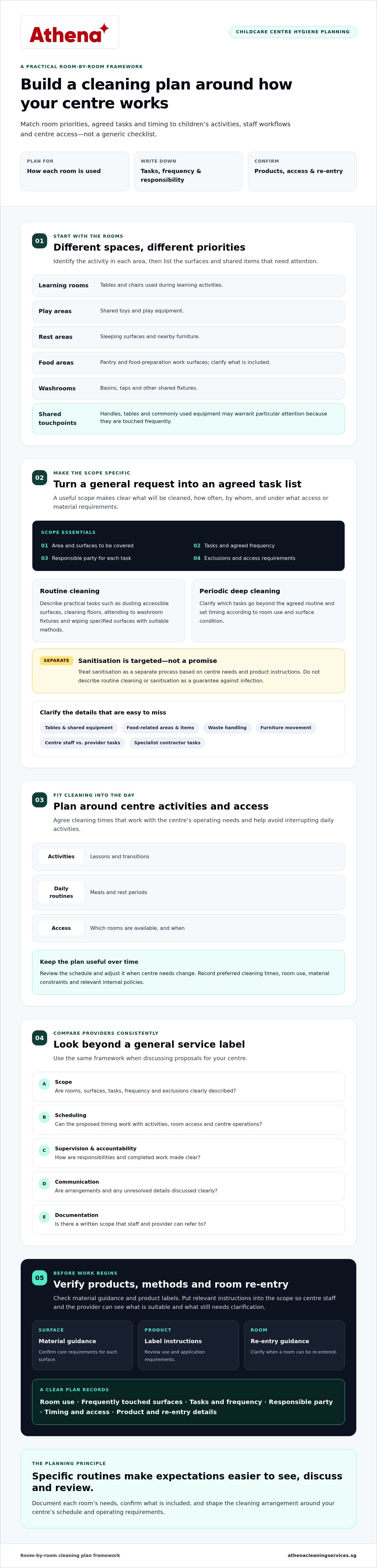
Start with the activity in each space, then identify surfaces that are handled often. Play areas may involve shared toys and equipment; rest areas include sleeping surfaces and nearby furniture; learning rooms see regular use of tables and chairs. Food preparation areas and pantries need attention to work surfaces, while washrooms have basins, taps, and other shared fixtures. Handles, tables, and commonly used equipment may warrant particular attention because they are touched frequently.
Before setting methods, confirm how each surface should be cared for. Check material guidance and product labels for instructions on use, application, and room re-entry. Include these details in the scope so centre staff and a prospective provider can see what is suitable and what still needs clarification.
How does cleaning support a well-maintained childcare environment?
Consistent routines help staff know what has been addressed, make visible upkeep easier to monitor, and clarify who is responsible for shared spaces. Clear expectations can also help fit cleaning around lessons, meals, rest periods, and transitions rather than interrupting them. These are practical housekeeping benefits, not promises of particular health or safety outcomes.
Before comparing childcare centre cleaning services singapore, record how each room is used, which surfaces are touched often, preferred cleaning times, material constraints, and relevant internal policies. This gives provider discussions a specific starting point. Providers can explain how a proposed commercial cleaning or sanitisation scope matches your documented needs, while you verify any product or procedural details that remain unclear.
What childcare centre cleaning services should cover in Singapore
A useful scope turns a general request for childcare centre cleaning services singapore into an agreed task list. Specify the rooms and surfaces, the work to be done and how often, and whether centre staff or the provider is responsible. Labels such as “regular cleaning” or “deep clean” aren’t precise enough on their own.
A clear cleaning scope lists each area, the surfaces and tasks to be covered, the agreed frequency, the responsible party, and any exclusions or access requirements. Clarify whether kitchens or food preparation areas, eating spaces, shared equipment, and high-contact points are included. Also agree how waste should be handled, whether furniture may be moved, and which tasks belong to centre staff or a specialist contractor. For instance, specialised needs such as pest management or treating centre transport vehicles are typically outsourced to dedicated providers like Ninja Pest Control rather than routine cleaning staff.
Which routine tasks belong in a centre cleaning scope?
Describe routine work in practical terms, such as dusting accessible surfaces, cleaning floors, attending to washroom fixtures, and wiping specified surfaces with suitable methods. List tables and shared equipment explicitly rather than assuming they are covered by general surface cleaning. Confirm which food-related areas and items are included, and who handles work outside the provider’s agreed scope.
Check that proposed methods suit each surface and material. Before work begins, review relevant product instructions, including application requirements and any guidance on when a room can be re-entered. Record access arrangements too, so staff and cleaners know which rooms are available and when.
When should a centre consider periodic deep cleaning or sanitisation?
Periodic deep cleaning can cover tasks beyond the agreed routine. Set its timing according to room use, surface condition, and the centre’s documented needs. Sanitisation is distinct from ordinary cleaning. Ask the provider to explain which areas and surfaces it covers, what process is proposed, and what the service excludes. Don’t treat either term as a guarantee of infection prevention.
For Singapore-specific reference, operators can review the MOE’s clear guidelines on managing infectious diseases and check which guidance applies to their centre. Confirm proposed products, their instructions, and any room re-entry guidance before agreeing to sanitisation work.
- Rooms: List classrooms, rest areas, washrooms, kitchens, eating spaces, and shared facilities.
- Tasks and frequency: State what is cleaned, how often, and which work is periodic or specialised.
- Responsibilities and logistics: Clarify exclusions, staff-owned tasks, access, waste handling, and furniture movement.
- Products and procedures: Confirm material suitability, application instructions, and room re-entry guidance.
Athena Team Cleaning provides commercial cleaning and sanitisation services in Singapore. If you’re considering its services, discuss your centre’s cleaning scope and confirm whether the required rooms and tasks can be accommodated before requesting a quote.
How to compare childcare centre cleaning providers in Singapore
Compare providers against the same written brief, not just their package names or quoted schedules. A consistent framework helps you assess whether a proposed service fits your centre’s needs, policies, and daily operations. For childcare centre cleaning services singapore, ask providers to describe relevant commercial cleaning work, but don’t assume that experience means they have childcare-specific credentials or protocols.
| What to compare | Questions to ask |
|---|---|
| Scope | Which rooms, surfaces, and tasks are included? What is excluded, and who handles excluded work? |
| Schedule | How often will each task be completed? How will timing fit with centre activities and access arrangements? |
| Supervision | Who defines the task list, checks completion, and follows up on missed or incomplete tasks? |
| Communication | Who is the centre’s contact for routine coordination or service concerns, and how should issues be raised? |
| Documentation | Will the agreed scope, frequency, exclusions, and relevant service records be provided in writing? |
What questions should a centre ask before appointing a cleaner?
Confirm who can access the premises, what working hours are proposed, and how access will be coordinated with staff. Ask the provider to put included tasks, exclusions, and service frequency in writing. Clarify how completion is checked and who follows up if agreed work isn’t carried out. These details make expectations easier to review and reduce reliance on verbal assurances.
How can operators assess product and process suitability?
Ask for the names and intended uses of proposed products, along with the relevant manufacturer instructions. Check how the work will be coordinated with children’s presence and the centre’s own policies, including instructions on application and room re-entry. Don’t accept broad descriptions such as “child-safe” or “non-toxic” without product information and a clear explanation of how the product will be used.
Use current official guidance as a reference point, not as a substitute for checking how a provider’s proposed work fits your centre. The ECDA and NEA advisory offers local context on high standards of personal hygiene and sanitation. Confirm which guidance applies to your centre and document any requirements that should shape the service scope.
For a broader framework for assessing service quality and reliability, consult this professional cleaning company buyer’s guide. Use your comparison table to identify gaps, request written clarification, and choose a provider whose proposed scope can be checked against your centre’s needs.
How to schedule childcare centre cleaning around children and staff
A workable cleaning schedule starts with the centre’s daily rhythm, not a provider’s standard time slot. Map activities, room use, staff access, and restricted areas first. Then separate tasks that can fit around normal operations from work that needs an empty room, such as more disruptive floor or furniture work. This helps protect learning and rest routines while setting clear expectations for access.
How should a centre map cleaning tasks to its daily routine?
Use this sequence to build a schedule that staff and cleaners can follow:
- Map the day. Note activity periods, meals, rest times, transitions, and when each room is occupied.
- Match tasks to access. Identify which routine tasks can be carried out without disrupting activities and which require a vacant room.
- Set timing and responsibilities. Agree on working hours, access arrangements, and who tells the cleaning team when rooms are available or restricted.
- Plan for changes. Decide who communicates schedule changes or additional requests, and how the provider should acknowledge them.
- Review and adjust. Check whether the plan is practical once in use, then revise it when the centre’s routines or needs change.
Assign responsibility for confirming room availability instead of leaving it to assumption. For example, nominate a centre contact to alert the provider if a scheduled area is still in use, and agree on what happens if access isn’t possible. Include the communication method and contact details in the service arrangement so staff know how to report a change or concern.
How can cleaning completion be reviewed consistently?
Keep a simple record of the date, area, task status, and any follow-up notes. This gives centre staff and the provider a shared reference if work is missed or an area needs attention. Agree in advance who checks the record, who receives concerns, and how quickly they should be raised and acknowledged.
Review the schedule when room use, occupancy patterns, or centre needs change. A room used differently may need a revised task frequency or access window. A change in daily activities may also make an existing cleaning slot disruptive. For operators comparing childcare centre cleaning services singapore, a provider’s willingness to discuss timing and document responsibilities can matter as much as the proposed task list.
Athena Team Cleaning offers flexible scheduling for its commercial cleaning services. Discuss your centre’s rooms and cleaning schedule with the team, and confirm whether the proposed timing and scope can accommodate your operating needs.
Choosing childcare centre cleaning services in Singapore: practical next steps
Turn your cleaning requirements into a decision process: define what the centre needs, check whether a provider’s capabilities appear suitable, agree on a written scope, then review how the service works in practice. This helps you compare childcare centre cleaning services singapore based on fit and clarity rather than broad claims or package labels.
What information should a centre prepare for a cleaning quote?
Give providers a practical picture of the premises and the work you’re considering. Include room types, areas needing regular attention, preferred service times, access arrangements, and operational constraints, such as rooms that can only be entered when unoccupied. Separate everyday cleaning tasks from sanitisation or specialist requirements so each can be assessed clearly.
- Premises: Describe the centre’s rooms, shared facilities, and surfaces requiring attention.
- Timing and access: Share preferred service windows, room availability, access procedures, and any restrictions.
- Priorities: List routine tasks, then identify sanitisation or specialist work separately.
- Requirements to confirm: Note relevant centre policies and ask about proposed products, instructions, and room re-entry guidance.
A detailed brief helps a provider respond to the actual request and shows what needs to be resolved before work begins. Ask for the proposed tasks, frequency, exclusions, and responsibilities in writing. Confirm who will coordinate schedule changes and follow up on concerns.
How can Athena Team Cleaning be considered for a centre?
Athena Team Cleaning provides commercial cleaning and sanitisation services in Singapore, with flexible scheduling. Centre operators can discuss these options against their documented needs. This is not a claim of childcare-specific credentials or protocols. Confirm directly whether the company can accommodate your centre’s requirements, which rooms and tasks can be included, and whether proposed products and timing suit your policies and operations.
Before agreeing to a service, make sure the scope is specific and access and communication arrangements are understood. Ask for a clear explanation of any sanitisation process. Then review the work against the agreed plan and raise gaps through the contact process established with the provider.
Have your room list, preferred timing, task priorities, and known constraints ready. Request a cleaning quote from Athena Team Cleaning to discuss your centre’s needs and confirm whether its commercial cleaning and sanitisation services are a suitable fit.
Build a cleaning plan your centre can use
Effective childcare centre cleaning services singapore start with a plan shaped around each room, frequently used surfaces, and the centre’s daily schedule. Define routine tasks separately from periodic cleaning or sanitisation, and put responsibilities, product details, access arrangements, and service frequency in writing.
When comparing providers, look for clear answers about scope, supervision, communication, and how completion is reviewed. A well-documented plan gives your team a practical basis for checking whether the service continues to fit as room use and operational needs change.
Athena Team Cleaning provides commercial cleaning and sanitisation services in Singapore and offers flexible scheduling. Centre teams can discuss their rooms, preferred timing, and sanitisation needs, then confirm directly whether the required scope and products are suitable. Quote requests are available online, by phone, or by email.
Request a cleaning quote from Athena Team Cleaning and take the next step toward a clearly scoped, thoughtfully scheduled cleaning arrangement for your centre.
Frequently Asked Questions
How often should a childcare centre be professionally cleaned?
Cleaning frequency should reflect how rooms are used, how often surfaces are touched, and the centre’s documented requirements. Set out routine tasks and their frequency separately from periodic deep cleaning or sanitisation. Check current guidance from the relevant Singapore authorities when establishing the plan, and review it if room use or centre needs change. A provider can help clarify a proposed schedule, but the centre should confirm it meets its requirements.
What should childcare centre cleaning services include?
A clear scope may cover classrooms, play and rest areas, washrooms, food preparation or eating spaces, floors, furniture, and specified high-contact surfaces. State the exact tasks, frequency, and who is responsible for each area. Clarify whether shared equipment, waste handling, furniture movement, and periodic or specialist work are included. Don’t rely on a broad package label; ask for the proposed scope and exclusions in writing.
Are ordinary commercial cleaning services suitable for childcare centres?
They may be suitable if the provider can meet the centre’s documented scope, schedule, access arrangements, and product requirements. Don’t assume general commercial experience means the provider has childcare-specific credentials or protocols. Ask about relevant commercial work, request written task details, and check whether proposed methods align with centre policies and current official guidance. Confirm any specialist needs directly before appointing a provider.
How can a childcare centre check whether cleaning products are appropriate?
Request each product’s name, intended use, and relevant manufacturer instructions. Check that the proposed use suits the surface and task, and ask how the product will be applied. Clarify any precautions and room re-entry guidance, then compare these details with centre policies. Avoid relying on unverified descriptions such as “child-safe” or “non-toxic.” If instructions or suitability remain unclear, resolve that before agreeing to the work.
Can cleaning be scheduled while children are at the centre?
Some tasks may be scheduled during operating hours if the centre and provider agree that the work can be carried out without disrupting activities or entering restricted areas. Other tasks may need an empty room. Map activities and room access, then agree on timing, staff contacts, and how changes will be communicated. Confirm product instructions and any room re-entry guidance before scheduling work in occupied areas.
What is the difference between cleaning and sanitisation?
Cleaning generally removes visible dirt and everyday soil from surfaces. Sanitisation is a separate process intended for specified surfaces or situations, and its method and product instructions should be clearly explained. Ask which areas are covered, how the process will be carried out, and whether there are precautions or room re-entry instructions. Neither cleaning nor sanitisation should be presented as a guarantee against infection.
How do I compare childcare centre cleaning quotes in Singapore?
Compare quotes against the same written brief, including room types, tasks, frequency, preferred timing, access needs, and exclusions. Check whether routine cleaning, periodic work, and sanitisation are described separately, and ask who supervises completion and handles concerns. For childcare centre cleaning services singapore, also confirm product details and schedule suitability rather than comparing price alone. Request clarification where a quote uses broad or undefined terms.
Frequently Asked Questions
Which childcare centre areas need different cleaning priorities?
How does cleaning support a well-maintained childcare environment?
Which routine tasks belong in a centre cleaning scope?
When should a centre consider periodic deep cleaning or sanitisation?
What questions should a centre ask before appointing a cleaner?
How can operators assess product and process suitability?
How should a centre map cleaning tasks to its daily routine?
How can cleaning completion be reviewed consistently?
What information should a centre prepare for a cleaning quote?
How can Athena Team Cleaning be considered for a centre?
How often should a childcare centre be professionally cleaned?
What should childcare centre cleaning services include?
Are ordinary commercial cleaning services suitable for childcare centres?
How can a childcare centre check whether cleaning products are appropriate?
Can cleaning be scheduled while children are at the centre?
What is the difference between cleaning and sanitisation?
How do I compare childcare centre cleaning quotes in Singapore?
Related articles