
Alternative to a maid in Singapore: what works for HDB and condo homes
In this article
- What are the realistic alternatives to a maid in Singapore?
- How much does a maid cost compared with part-time cleaning?
- How many hours does an HDB flat or condo need?
- Which jobs will a cleaner not cover, and how do you fill the gap?
- Why humidity and mould change how often you should clean
- How do you choose a cleaning company you can trust at home?
- Comparison at a glance
- Frequently asked questions
- Sources
- Related Athena cleaning services in Singapore
The most practical alternative to a maid in Singapore is a part-time cleaner who visits weekly or fortnightly for three to four hours, backed by a deep clean once or twice a year. You pay for the hours you use instead of a full-time salary, levy and board, and nobody needs a spare room. A typical HDB or condo household spends roughly S$200 to S$650 a month this way, against S$1,200 to S$1,800 for a live-in helper.
This guide compares every realistic option, shows costs in SGD, and says plainly which jobs a cleaner will not do, so you can decide before you sign anything.
What are the realistic alternatives to a maid in Singapore?
Most households asking this question are not short of floor space. They are short of time. The housework piles up between work, school runs and weekends, and a live-in helper feels like a big commitment for what is mainly a cleaning problem. Four routes cover almost every case, and many families end up combining two of them.
Part-time cleaner on a recurring plan
The same person or crew arrives on a fixed day, usually for three to four hours, and works through floors, bathrooms, kitchen surfaces, dishes and sometimes laundry or ironing. Weekly is the most common rhythm for families. Fortnightly suits couples and smaller flats where the home does not get heavy daily use.
One-off deep cleans
A deep clean goes where a routine visit does not: inside the oven, behind appliances, grout lines, window tracks, and the mould that builds in bathroom corners. Many households book one before Chinese New Year, after a renovation, or at the start and end of a tenancy. If you rent, our guide to the best end of tenancy cleaning in Singapore explains what landlords and agents usually inspect.
A hybrid of both
A fortnightly part-time visit plus two deep cleans a year is the pattern we see most often from dual-income HDB and condo households. The routine visit keeps the surface layer under control, and the deep clean resets the parts that quietly degrade.
Targeted help for single chores
If laundry is the real pain point, a wash-and-fold service or a dryer solves it without any cleaner at all. If floors are the issue, a robot vacuum and mop handles daily dust between visits. These tools do not replace a person, but they stretch the hours you do pay for.
How much does a maid cost compared with part-time cleaning?
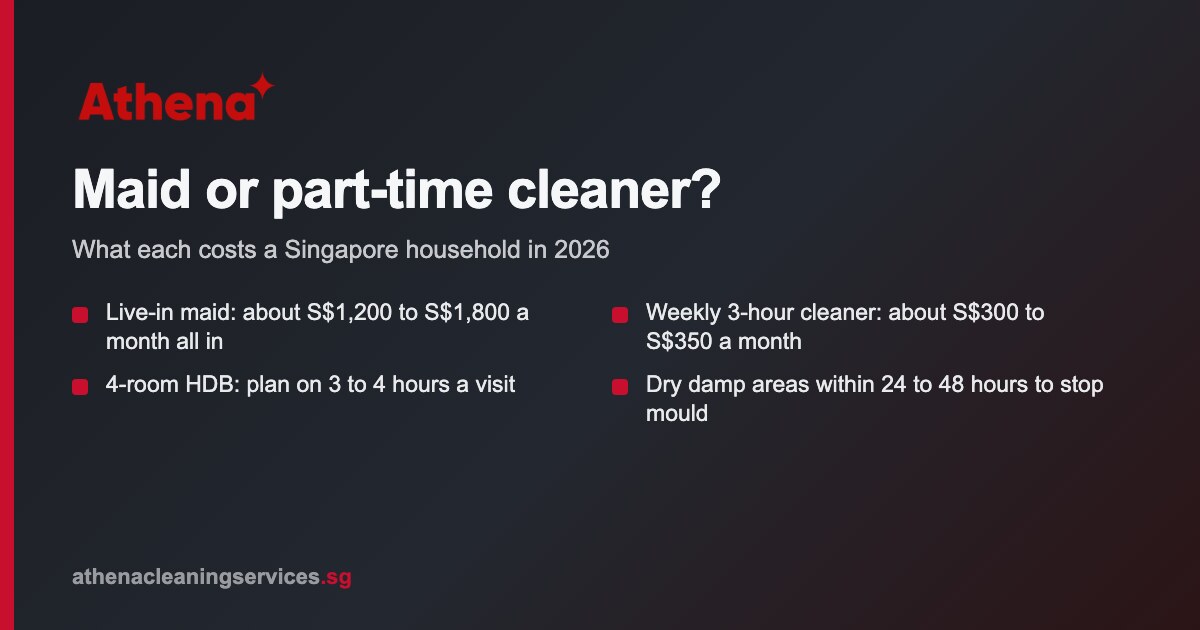
A live-in helper looks cheap on the salary line and expensive once everything is added. Typical monthly salaries for a foreign domestic worker sit around S$600 to S$800, but you also pay the Ministry of Manpower levy (S$300 a month at the standard rate, with a lower concessionary rate for eligible households with young children, elderly members or persons with disabilities), food, medical insurance, and the security bond. Add the placement fee, which commonly runs from S$1,500 to S$3,500 depending on the agency and whether you hire a transfer or a new arrival. Spread over a two-year contract, most households land between S$1,200 and S$1,800 a month all in. Check the current levy and rules on the MOM site before you budget, because they are revised from time to time.
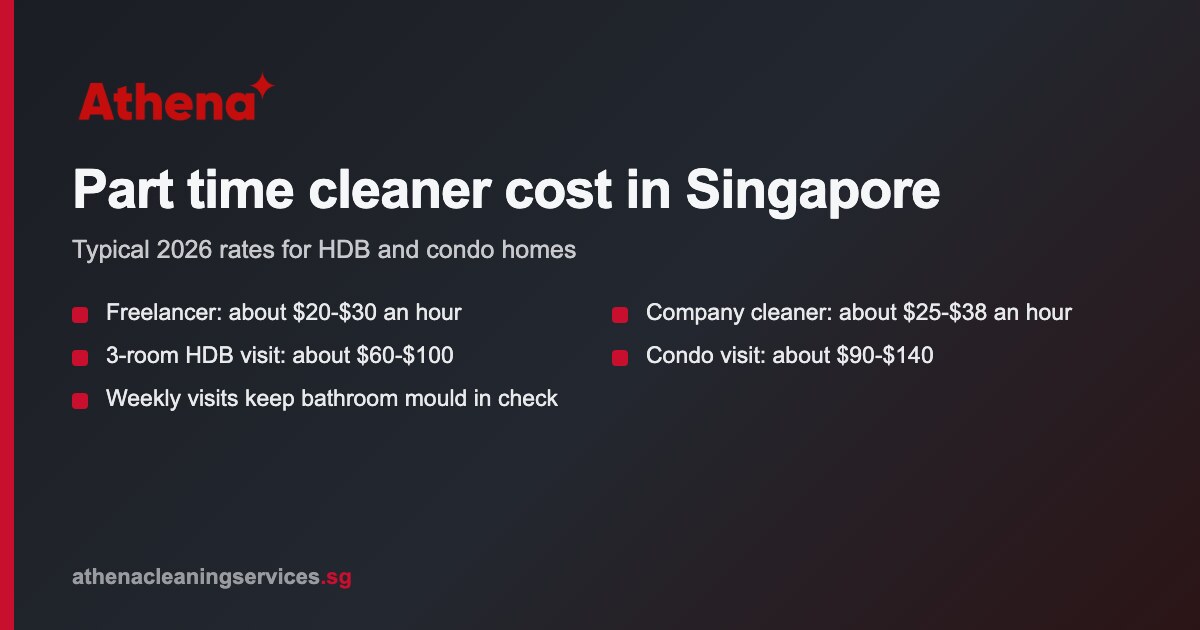
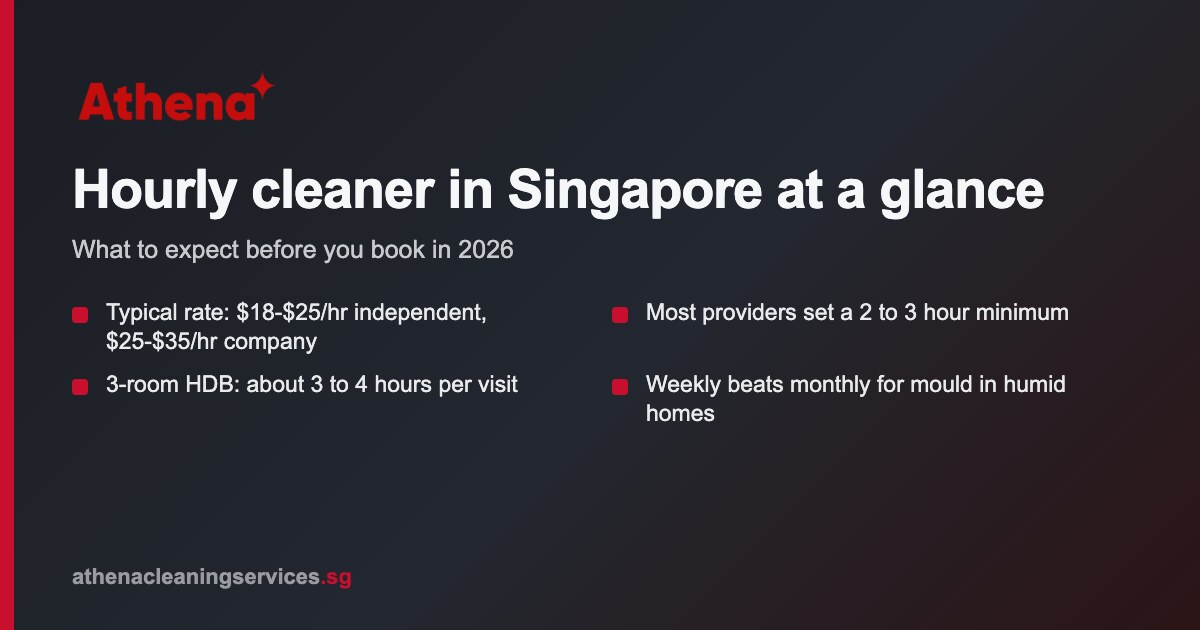
Part-time cleaning is billed by the hour. A typical Singapore range is S$20 to S$35 an hour, usually with a three or four hour minimum per visit. At S$25 an hour, a three-hour weekly visit costs about S$320 a month, and a four-hour fortnightly visit about S$215. Two visits a week for a family of five might reach S$650.
Cost is only half the comparison. A live-in helper is present every day and can cook, mind children and care for an elderly parent. A cleaner cannot. If the pressure in your home is mostly dust, bathrooms and laundry, paying for a full-time role to cover a few hours of cleaning is poor value. If you need daily caregiving, a cleaner solves a different problem, and you should read the section on gaps below before ruling out a helper.
Before agreeing to any prepaid bundle, read the contract terms. The Consumers Association of Singapore (CASE) receives recurring complaints about prepaid packages in the service sector, and its guidance on contracts, refunds and what to do if a company closes is worth ten minutes before you pay for a block of sessions.
How many hours does an HDB flat or condo need?
Hours depend on floor area, number of bathrooms and how many people live there. The figures below are typical working ranges from home cleaning in Singapore, not fixed rules, and a good company will adjust after seeing the home.
HDB flats
A 3-room flat of about 65 sqm usually needs three hours a visit. A 4-room flat of about 90 sqm sits comfortably in three to four hours, and a 5-room or executive flat of 110 sqm or more often needs four hours or two cleaners for a shorter session. Two bathrooms add roughly 30 minutes each when they are cleaned properly, because tiles, glass and fixtures take longer than a quick wipe.
Condos and landed homes
A two or three bedroom condo of 80 to 120 sqm is similar to a 4 or 5-room HDB, but extra features add time: balconies, long glass runs, wet and dry kitchens, and helper rooms. Landed homes with multiple floors typically need a team of two for four to five hours.
Choosing the rhythm
Weekly suits families with children, pets, or anyone who cooks daily. Fortnightly suits two adults who are out most of the day. Monthly is usually too long a gap in Singapore, because moisture does the damage in between visits. If you are unsure, start weekly for a month and drop to fortnightly if the home stays in good shape.
For renovation jobs the maths changes entirely. Dust from cement, grout and paint needs several passes and a different method, and our checklist for post renovation cleaning in Singapore sets out the order crews should follow so that you are not paying twice.
Which jobs will a cleaner not cover, and how do you fill the gap?
Honesty here saves disappointment. A cleaner does not cook, supervise children, care for an elderly parent or stay in the home between visits. If those are the reasons you were considering a maid, you need a second plan alongside the cleaning one.
Meals
Meal delivery, cooked-food stalls near HDB estates and weekend batch cooking cover most weekday needs. The HealthHub healthy living resources from Singapore's Ministry of Health are a practical reference if you are rebuilding family meals around less cooking time.
Children
Infant care centres, childcare centres and student care centres run through the school year and are the usual substitute for a helper who minds kids. Grandparents, where available, fill the school-holiday gaps.
Elderly family members
Daycare centres, home nursing and home personal care services exist for seniors who need regular support. A household that needs daily physical assistance should treat this as a care decision first and a cleaning decision second.
Surfaces that need specialist methods
Some items are better left to technicians than to a general cleaner. Leather, fabric and mattresses all need the right products and drying time, and our guides on leather sofa cleaning in Singapore and allergen removal for mattress cleaning explain what the process involves and how long the item stays out of use afterwards.
Why humidity and mould change how often you should clean
Singapore's relative humidity regularly sits above 80 per cent, and a bathroom that is wet twice a day never fully dries between uses. That is why a plan that works in a temperate country can fail here. A home cleaned monthly can look fine on the surface while grout, silicone seals and the underside of mattresses are already growing mould.
The US EPA's guidance on mould cleanup in your home says wet or damp materials should be dried within 24 to 48 hours to prevent growth. In practice that means wiping down shower glass, opening windows after showers, and airing wardrobes, none of which a fortnightly cleaner can do for you between visits. A cleaner can remove what has built up and show you where the home holds moisture, and the daily habits still sit with the household.
Bathrooms are the first place this shows. Black lines in tile grout, pink film on shower curtains and a musty smell under the vanity are all signs that a weekly clean is overdue. Our guide to bathroom cleaning for tiles, grout and fixtures in Singapore covers which products suit which surfaces, and which ones damage silicone or natural stone.
Dust and pests are the other humidity-linked issues. The National Environment Agency's public cleanliness guidance is a reminder that standing water, food waste and unmanaged rubbish are what draw pests into a home, so bins, drains and flower pot trays belong on your cleaning list as much as floors do.
How do you choose a cleaning company you can trust at home?
You are letting people into a private space, often when you are out. These checks take a few minutes and filter out most of the problems.
Licence, insurance and staffing
Cleaning businesses in Singapore are licensed by NEA, so ask for the licence number and confirm it. Ask whether cleaners are the company's own employees on valid work passes or freelancers placed through an app, because accountability differs. Ask what happens if an item is damaged, and request the insurance details in writing.
Pricing that you can read
A fair quote states the hourly rate, the minimum visit length, whether GST applies, and what is included. Be wary of a price that only appears after a visit to your home, or one that changes when you ask about a recurring plan.
Consistency
The best part-time plans send the same cleaner or crew each time, because they learn your home. Ask whether that is guaranteed and what happens if your regular cleaner is on leave.
Trial first
Book one visit before committing to a block of sessions. Walk through the home afterwards with the cleaning list in hand, and note anything missed. A good company asks for that feedback and fixes it on the next visit.
Comparison at a glance
| Option | Typical monthly cost (SGD) | Hours of help | Best for | Main limit |
|---|---|---|---|---|
| Live-in maid (foreign domestic worker) | S$1,200 to S$1,800 all in | Daily, including cooking and care | Families needing childcare or eldercare | Levy, bond, agency fee and a spare room |
| Weekly part-time cleaner (3 hours) | S$300 to S$350 | About 13 hours | Families with children or pets in HDB or condo | No cooking or caregiving |
| Fortnightly part-time cleaner (4 hours) | S$190 to S$250 | About 9 hours | Couples and small 3-room or 4-room flats | Moisture builds between visits |
| Twice-weekly cleaner (3 hours each) | S$600 to S$700 | About 26 hours | Large condos, landed homes, big households | Higher cost, still no caregiving |
| Deep clean twice a year | S$200 to S$450 per visit | One-off, 4 to 8 hours | Homes with a routine plan or none at all | Does not maintain between visits |
| DIY with a robot vacuum and laundry service | S$40 to S$150 plus device cost | Daily dust only | Small flats with light routines | You still do bathrooms and kitchens |
Frequently asked questions
Is a part-time cleaner cheaper than a maid in Singapore?
For cleaning alone, usually yes. A weekly three-hour visit at a typical S$20 to S$35 an hour costs roughly S$260 to S$450 a month, while a live-in helper commonly costs S$1,200 to S$1,800 once salary, levy, food, insurance and agency fees are added. A maid also covers cooking and care, which a cleaner does not, so the comparison depends on what you need done.
How many hours of cleaning does a 4-room HDB flat need?
Three to four hours a visit is a typical range for a 4-room flat of about 90 sqm with two bathrooms. Weekly visits tend to take closer to three hours because the home stays in good shape. A first visit or a fortnightly schedule often takes the full four.
Can a cleaner come while I am at work?
Many households arrange access through a building concierge, a smart lock with a temporary code, or a trusted neighbour. Confirm in advance how entry will work, who will be on site and how you will be notified when the crew arrives and leaves. A company that sends its own employees makes this easier to manage than a freelancer app.
Do part-time cleaners cook or look after children?
No. A part-time cleaning service covers floors, bathrooms, kitchen surfaces, dishes and in many cases laundry and ironing. Cooking, childcare and eldercare need a different arrangement, such as childcare or student care centres, home care services or meal delivery.
How do I check that a cleaning company is licensed in Singapore?
Cleaning businesses need a licence from the National Environment Agency, so ask the company for its licence number and verify it with NEA. Also ask for proof of insurance and whether cleaners are its own employees. If a company is reluctant to share these, treat that as a reason to look elsewhere.
How often should I deep clean my home in Singapore?
Twice a year is a sensible default for most homes, and more often if you have a baby, pets, a household member with allergies, or a bathroom that stays damp. Singapore's humidity means mould and grime form faster than in cooler climates, so a deep clean before Chinese New Year and another mid-year works well for many families.
Sources
- Consumers Association of Singapore (CASE)
- HealthHub healthy living resources
- mould cleanup in your home
- National Environment Agency's public cleanliness guidance
Related Athena cleaning services in Singapore
Related articles