
Formaldehyde smell after renovation in Singapore: what it is and how to clear it
In this article
- Why a newly renovated Singapore flat smells of chemicals
- Is the smell dangerous, and what symptoms to watch for
- How long the formaldehyde smell lasts after renovation
- Where the smell comes from and how long each source lasts
- What you can do yourself in the first two weeks
- Do cheap meters, sprays and air purifiers work?
- When to call a professional and what it costs in Singapore
- Comparison at a glance
- Frequently asked questions
- Sources
- Related Athena cleaning services in Singapore
The formaldehyde smell after renovation in Singapore is the gas that new carpentry, laminate flooring, glue and paint release into a closed-up flat. It is the sharp "new furniture" odour you notice the moment you open the door. In most HDB, BTO and condo homes it is strongest in the first three months and fades over one to two years. You can cut it sharply in the first few weeks with cross-ventilation, a dehumidifier and a proper post-renovation clean.
This guide covers where the smell comes from, which readings matter, what is worth doing yourself and when to pay for help.
Why a newly renovated Singapore flat smells of chemicals
Formaldehyde is a colourless gas used in the resins that bind plywood, MDF and particle board. Almost every built-in wardrobe, kitchen cabinet, TV feature wall and vanity in a Singapore renovation is made from one of these boards. Once the carpenter finishes, the boards keep releasing formaldehyde slowly for months. This is called off-gassing, and it is a different problem from the dust and debris that the builders leave behind.
The smell usually carries more than formaldehyde. Paint, varnish, sealant, wood glue and the adhesive under vinyl flooring release other volatile organic compounds (VOCs). Together they make the "chemical" smell that people describe at handover. The US EPA facts about formaldehyde page lists pressed-wood products and glues as common indoor sources, which matches what we find in local homes.
Why Singapore flats hold the smell longer
Three local habits make it worse. First, many owners keep windows shut after renovation because of dust, noise or security, so the gas has nowhere to go. Second, we run air-conditioning for hours a day, which recirculates the same air. Third, heat and humidity speed up off-gassing. Warm boards release more gas than cool ones, and a bedroom at 30 degrees with the windows closed can smell far stronger at midday than at night.
HDB flats with a long, narrow layout and windows on one side only are the hardest to air out. A dual-aspect unit, where you can open windows at both ends, clears much faster.
Is the smell dangerous, and what symptoms to watch for
At the levels found in most new homes, formaldehyde is an irritant. The usual short-term complaints are watery or burning eyes, a scratchy throat, a runny nose, coughing and headaches. People with asthma, eczema or allergic rhinitis often notice flare-ups first. Babies, young children, older adults and pregnant women are the groups worth protecting first, because they spend more time indoors or react more strongly.
Long-term, high exposure is a different matter. The World Health Organization household air fact sheet covers the wider health effects of poor indoor air, and the EPA lists formaldehyde as a known human carcinogen at sustained high exposure. A newly renovated flat that you air out and that settles over a year is not the same situation as breathing high levels every night for a decade. Take it seriously, but you do not need to panic.
What the numbers mean
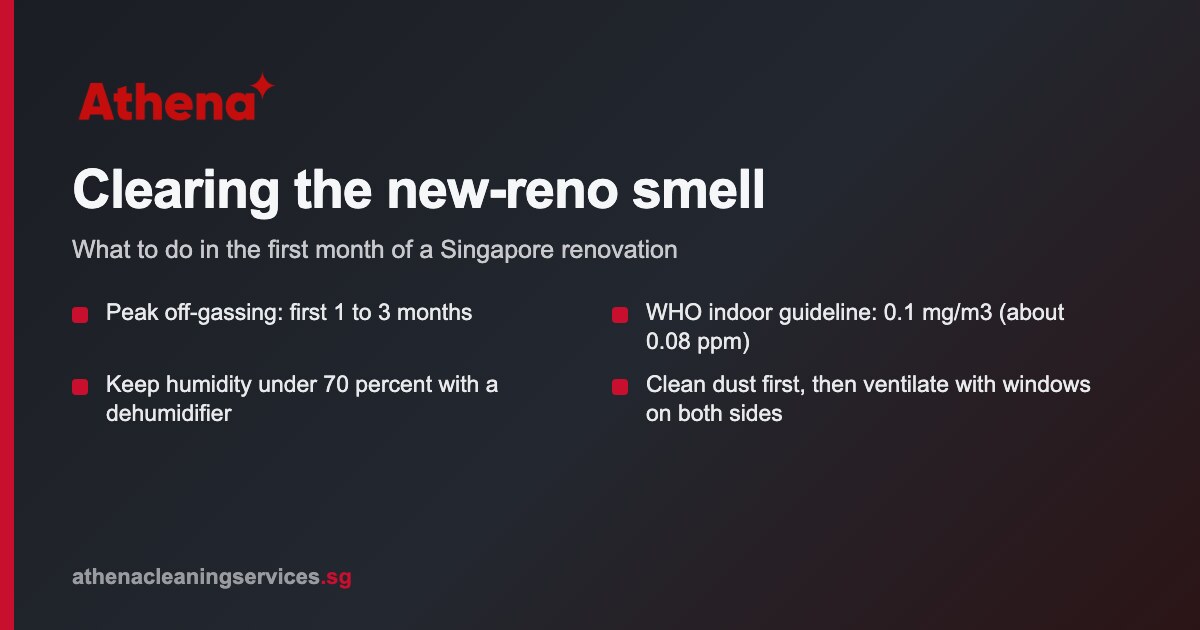
The WHO indoor guideline for formaldehyde is 0.1 mg/m3 (about 0.08 ppm) over a 30-minute average. Readings below that are generally treated as acceptable for a home. A fresh renovation with a lot of carpentry can read above it for the first weeks, which is why many owners wait before moving in, especially with a newborn.
If anyone at home gets repeated headaches, breathing trouble or eye irritation that eases when they leave the flat, speak to a doctor. HealthHub has general guidance on healthy living and when to seek care.
How long the formaldehyde smell lasts after renovation
There is no single answer, because the timeline depends on how much board is in the flat, how it was sealed and how well the unit is ventilated. As a typical range, off-gassing is strongest in the first one to three months, drops noticeably by six months and continues at a low level for one to two years. Edges, drawers and the insides of wardrobes that were left unsealed keep releasing gas longest.
A 4-room BTO with a modest amount of carpentry will usually settle faster than a 5-room flat or condo with floor-to-ceiling wardrobes in every room. Light-coloured laminates and veneers that are sealed on every face release less than raw board edges.
What speeds it up and what slows it down
- Speeds up: warm rooms, high humidity, large amounts of unsealed board, new mattresses and sofas delivered in the same week.
- Slows down: windows opened on both sides of the flat, a dehumidifier running at 50 to 60 percent humidity, wardrobe doors left open in the early weeks.
If the smell has not dropped at all after three months of airing, look for a source you missed. A damp cabinet base, a wet-room panel or fresh silicone that never cured can all keep a chemical or musty smell alive.
Where the smell comes from and how long each source lasts
Knowing the source tells you where to focus. The table below compares the usual suspects in a Singapore renovation, with typical ranges rather than guarantees. Use it to decide what to ventilate, what to wipe and what to simply wait out.
Built-in carpentry is almost always the biggest contributor because of its surface area. A single full-height wardrobe has several square metres of board inside it, and most of it faces into a closed space where gas builds up.
Flooring is the second one to check. Vinyl planks and the adhesive beneath them smell strongly in the first two weeks and then ease. Tiles themselves do not off-gas, but the grout, sealant and adhesive used with them can smell for a short time.
What you can do yourself in the first two weeks
Most of the useful work is cheap and starts before you move in. The aim is to move air through the flat, keep humidity down and remove the fine dust that holds onto odours.
Ventilate properly, not just occasionally
Open windows and the main door grille so air moves across the flat, and keep them open for as many hours as security allows. Leave wardrobe doors and drawers open while you do it. Running a fan to push air out of one window while another is open moves far more gas than an open window alone. In the rainy months, ventilate on dry afternoons and use a dehumidifier when you have to close up.
Control humidity
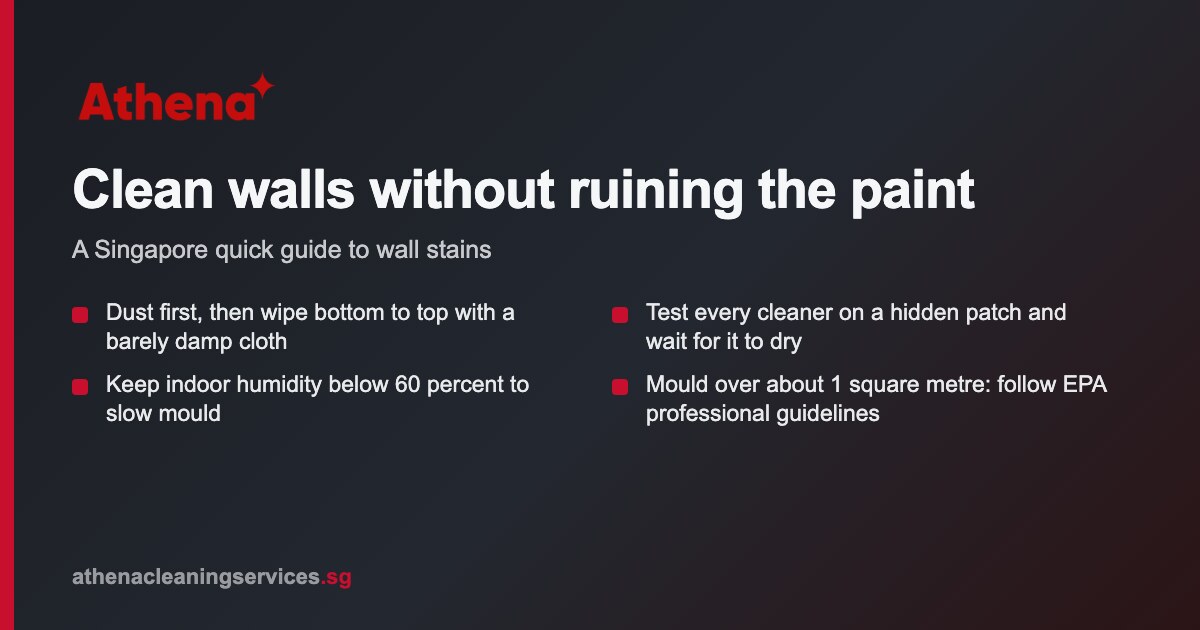
Humidity above about 70 percent encourages mould and makes the boards smell worse. Singapore homes sit above that for much of the year, so a dehumidifier in the bedroom is worth running during the first month. NEA's public cleanliness guidance is aimed at shared spaces, but the same logic on keeping surfaces dry and clean applies inside your flat.
Clean the dust first
Fine construction dust carries odour and irritates airways on its own. A thorough clean of surfaces, inside cabinets and floors removes it. Our checklist for post renovation cleaning singapore lists the order to work in, and 5 essential steps for effective post renovation cleaning singapore explains why dust comes before mopping. If you want to time it right, post renovation cleaning when to clean after reno covers when to book.
Do not mask the smell with scented sprays, candles or air fresheners. They add more VOCs and make it harder to tell whether the real smell is fading. For general upkeep, the US EPA indoor air quality guidance recommends source control and ventilation first, and air cleaners only as a supplement.
Do cheap meters, sprays and air purifiers work?
Handheld formaldehyde meters sold online for roughly $20 to $80 are a rough guide at best. Many cannot tell formaldehyde from alcohol, perfume or cleaning spray fumes, and their readings drift. They are useful for watching a trend, such as whether the number falls week to week with the same meter in the same room. They are a poor basis for deciding whether a baby can sleep there.
Accurate testing needs professional equipment or a lab sample taken over a set period. If you are deciding when to move in with someone vulnerable, a proper test is worth the cost.
Sprays and fogging
Cheap surface fogging can reduce the smell for a few days, but it does not stop the boards releasing gas from inside. Be careful with any service that promises a flat is "fully cleared" in under an hour. Ask what product is used, what reading is taken before and after, and how the result is measured.
Air purifiers and plants
A purifier with a large activated carbon filter helps with VOCs and odour when the windows are closed, but it is slow in a big room and the filter saturates. Plants do very little at the scale of a whole flat, so do not rely on them. Ventilation remains the main fix.
When to call a professional and what it costs in Singapore
Call for help when the smell is still strong after a few weeks of airing, when a baby, pregnant family member or someone with asthma is moving in, or when a handover inspection already shows reading problems. A good provider starts with a measurement, treats the flat, then measures again.
Typical market pricing for professional formaldehyde or VOC treatment in Singapore is around $300 to $600 for a 3 to 4 room HDB, $500 to $900 for a 5-room or executive flat, and $700 to $1,500 or more for a condo or a home with heavy carpentry. Treat these as ranges, not quotes. Price follows floor area, the amount of new carpentry and the starting reading. Always get a written quote for your own unit.
Clean first, then treat
Treatment works best on a clean flat. Dust and residue absorb treatment product and give a false sense of progress. Book the clean first, as described in post renovation deep cleaning singapore, then arrange any air treatment. For a fuller picture of the process, see the post renovation cleaning singapore 2026 guide.
If you are handing over a BTO, the timing of your defects check and the cleaning matters. Our page on hip cleaning service before after handover singapore explains how the two fit together. If you want a ready-to-move-in finish, see post renovation cleaning services singapore move in ready.
If a provider's price looks far below the range above, or a company will not say how it measures results, check them with the Consumers Association of Singapore at CASE before paying a deposit.
Comparison at a glance
| Source | Typical smell in first month | Typical off-gassing period | What helps most |
|---|---|---|---|
| Built-in wardrobes and cabinets (plywood, MDF, particle board) | Strong, sharp, worst in closed wardrobes | 6 months to 2 years, tapering | Open doors and drawers, cross-ventilation, dehumidifier |
| Feature walls and TV consoles | Moderate to strong | 3 to 12 months | Keep room ventilated, avoid sealing with extra coatings |
| Vinyl or laminate flooring and adhesive | Strong for the first 1 to 2 weeks | 2 to 8 weeks | Open windows, mop only with damp cloth, wait before closing up |
| Wall paint, varnish and sealant | Strong, solvent-like | 1 to 4 weeks | Air out with fans, keep humidity under 70 percent |
| New mattress, sofa and curtains | Mild to moderate | 2 to 8 weeks | Unwrap early, air in a ventilated room before use |
| Wet-room panels and fresh silicone | Mild, sometimes musty | 1 to 3 weeks if cured, longer if damp | Allow full curing, check for trapped moisture |
Frequently asked questions
How long does formaldehyde smell last after renovation in Singapore?
As a typical range, the smell is strongest in the first one to three months, falls clearly by six months and can continue at a low level for one to two years. Flats with a lot of carpentry, poor airflow and high humidity sit at the longer end. Opening windows on both sides of the unit and running a dehumidifier shortens the worst period.
Is it safe to move into a new BTO or renovated condo while it still smells?
For healthy adults, a mild smell after a few weeks of airing is usually tolerable. It is wiser to wait, or get a professional reading, if a baby, pregnant woman, older adult or someone with asthma will sleep there. If anyone has watery eyes, a sore throat or headaches that ease outside the flat, ventilate more and delay moving in.
How much does formaldehyde removal cost in Singapore?
As a typical market range, treatment costs about $300 to $600 for a 3 to 4 room HDB, $500 to $900 for a 5-room or executive flat and $700 to $1,500 or more for a condo or heavy carpentry. Price depends on floor area, new carpentry and the starting reading. Get a written quote for your own unit and ask how results are measured.
Do cheap formaldehyde meters from shopee or lazada give accurate readings?
Usually not. Low-cost meters often react to alcohol, perfume and cleaning fumes as well as formaldehyde, and they drift over time. Use one only to watch a trend in the same room. For a decision about moving in with a baby or pregnant family member, ask for a professional test.
Can I get rid of the smell by cleaning alone?
Cleaning removes the fine dust that holds odour and is the right first step, but it does not stop the boards releasing gas. Combine a thorough post-renovation clean with strong ventilation and humidity control. If the smell remains strong after a few weeks, consider a measured professional treatment.
Does air-conditioning make the formaldehyde smell worse?
It can. A closed room with the aircon running recirculates the same air, and warm boards release more gas. Air the flat first with windows open, then use the aircon in short periods while keeping a window or door open until the smell has dropped.
Sources
- US EPA facts about formaldehyde
- World Health Organization household air fact sheet
- HealthHub
- US EPA indoor air quality guidance
- NEA public cleanliness guidance
- CASE
Related Athena cleaning services in Singapore
Related articles