
How to clean your kitchen hood filter at home in Singapore
In this article
- Why hood filters clog faster in Singapore
- Check which type of hood filter you have
- How to clean a kitchen hood filter step by step
- What to do about the fan, housing and ducting
- How often should you clean a hood filter in Singapore?
- Cost: DIY versus hiring a cleaner in Singapore
- Common mistakes that wreck filters and kitchens
- Comparison at a glance
- Frequently asked questions
- Sources
- Related Athena cleaning services in Singapore
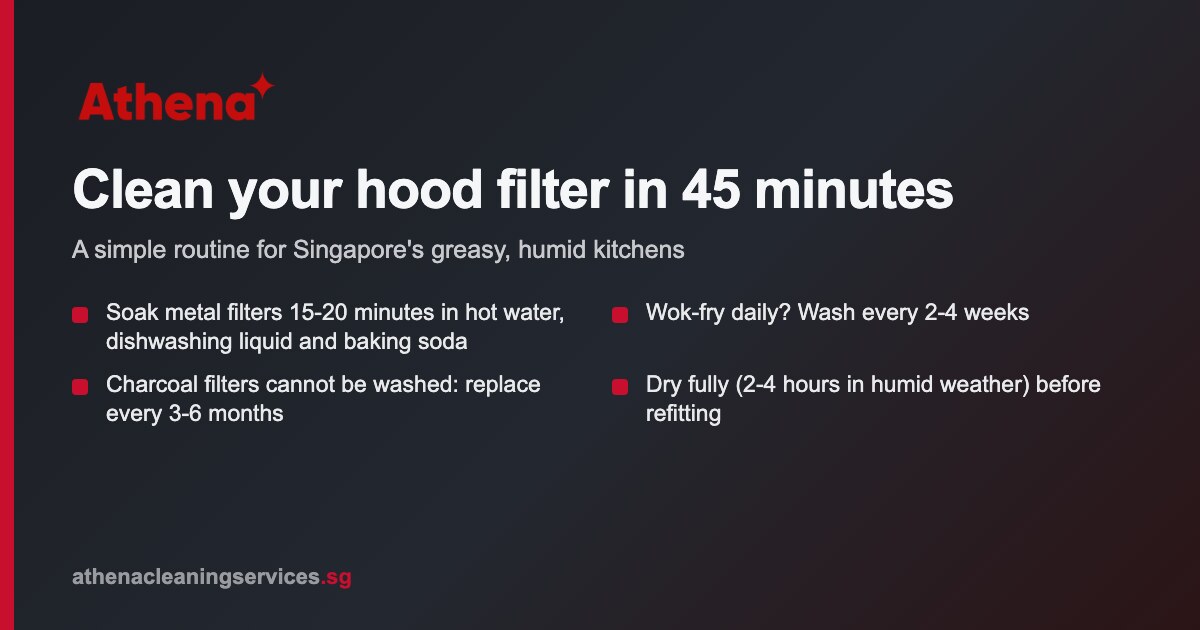
To clean a kitchen hood filter in Singapore, switch the hood off at the wall isolator, slide out the metal filters, and soak them for 15 to 20 minutes in very hot water with dishwashing liquid and a tablespoon or two of baking soda. Scrub gently with a soft brush, rinse well, and let the filters dry completely before you refit them. Charcoal filters cannot be washed and must be replaced.
This guide covers how to tell which filter you have, the exact steps, how often a typical HDB, BTO or condo kitchen needs it, what the job costs when you hire it out, and where the fan and ducting become a job for a technician rather than a weekend project.
Why hood filters clog faster in Singapore
Most Singapore home cooking involves a hot wok, shallow frying or deep frying, and all three throw fine oil droplets into the air. The hood filter is the first thing those droplets hit. In a compact HDB or BTO kitchen, or an open-concept condo kitchen that shares air with the living room, a clogged filter shows up fast: the hood gets louder, pulls less air, and the smell of last night's sambal hangs around until morning.
Humidity makes the problem worse. In a drier climate, grease on a filter tends to harden into a film. With indoor humidity often sitting around 70 to 90 percent here, the grease stays tacky and catches dust, lint and cooking particles. A silver aluminium mesh filter can turn amber within a few weeks of heavy use, and the build-up becomes harder to shift the longer you leave it.
It is worth the effort for air quality too. The US EPA's guidance on improving your indoor environment points to ventilation and source control as the main ways to keep cooking pollutants down at home. A hood only ventilates well when its filter is not choked with old oil.
Check which type of hood filter you have
Look before you soak anything. Most hoods sold in Singapore use one of three filter types, and treating them the same is the fastest way to ruin one.
Aluminium mesh filters
These are layers of thin metal mesh, common on slimline and chimney hoods. They are washable, but strong alkaline degreasers and long soaks in very concentrated solutions can darken aluminium. Stick to dishwashing liquid and baking soda, and avoid anything labelled as an oven or drain cleaner.
Stainless steel baffle filters
Baffle filters are angled metal channels, often found on higher-powered hoods built for heavy wok cooking. They are tougher, tolerate more scrubbing, and many are dishwasher-safe. Check the manual before you load one into the dishwasher, because some finishes dull over time.
Charcoal (carbon) filters
Recirculating hoods that do not vent outdoors use a charcoal filter to absorb odours. You will see these in some condos and flats without an external duct. They cannot be washed, and soaking one only ruins it. Replace it on the schedule in the manual, usually every three to six months in a busy kitchen.
Many recirculating hoods have both: a metal grease filter at the front and a charcoal filter behind it. Wash the metal one, replace the charcoal one. If you are unsure, the model number is usually on a sticker inside the hood once the filter is out.
How to clean a kitchen hood filter step by step
Set aside about 45 minutes, most of it soaking time. You need a basin or sink large enough to submerge the filter, dishwashing liquid, baking soda, a soft brush (an old toothbrush works for corners), a dry towel and rubber gloves.
Before you start
- Switch off at the isolator. Turn the hood off at the wall switch so the fan and lights cannot come on while your hands are inside.
- Remove the filters. Most slide out or release with a spring clip. Support the filter with your other hand, because oil drips as it comes loose.
- Line the area below. Put newspaper or a baking tray under the hood, or wipe down the hob first, so drips do not land on a clean stove.
The soak and scrub
- Run the water as hot as your tap allows. Add a generous squirt of dishwashing liquid and two to three tablespoons of baking soda. Expect fizzing and some foam.
- Submerge the filter for 15 to 20 minutes. For very heavy build-up, up to 30 minutes is fine. Longer soaks add little for aluminium and can dull the finish.
- Scrub with the grain of the mesh. Use the soft brush, working from the cleaner side outwards. Avoid steel wool, which scratches and leaves fragments in the mesh.
- Rinse with hot running water until it runs clear and the surface no longer feels slippery.
Dry before refitting
Shake off the water and stand the filter upright on a towel. In Singapore's humidity, a filter left on the counter can take two to four hours to dry fully. Pointing a fan at it brings that down to around an hour. Do not refit a damp filter: trapped moisture breeds mould and a sour smell the first time you cook.
The soak water is full of oil. Let it cool, wipe sludge from the basin with kitchen paper into the bin, and avoid tipping large amounts of grease straight down the drain. The NEA's public cleanliness guidance is a useful reminder of why waste and grease should stay out of drains.
What to do about the fan, housing and ducting
With the filters out, you can see the underside of the hood, the lip around the opening and sometimes the blower wheel. Wipe the parts you can reach with a cloth dampened in warm water and dishwashing liquid, then dry them. Work slowly and keep liquid away from switches, wiring and the motor housing.
Leave the motor, the blower and the ducting alone. Prising the fan apart without the manufacturer's service instructions can void your warranty and leave oil in places that damage the motor. In a typical HDB flat the duct runs through the ceiling void to an outlet on the exterior wall, and neither you nor a general cleaner should be dismantling it. If the hood is rattling, vibrating or producing a burning smell, stop using it and call the brand's service line or a licensed appliance technician.
Wipe the outside of the hood weekly if you cook daily. Stainless steel responds well to a microfibre cloth and a little dishwashing liquid, wiped with the grain. A thin film on the outside is easy to remove; a brown, sticky one is a sign the filters inside are overdue.
How often should you clean a hood filter in Singapore?
The honest answer depends on how you cook, not on a calendar. A household that stir-fries or wok-fries most days will see a visible film within two to four weeks. A household that mostly steams, boils and reheats can often stretch to every two or three months. As a typical range, monthly is a sensible default for a family kitchen.
Use the hood itself as the signal. If the fan sounds louder than it used to, if steam lingers over the hob instead of vanishing, or if you can drag a finger across the mesh and lift a sticky line, the filter is overdue. Cleaning a lightly soiled filter takes minutes. Cleaning a neglected one can take an hour of soaking and a second round.
Charcoal filters follow a different rule: replace them on the schedule in the manual, or sooner if cooking smells linger after you finish. Keep a spare so you are never cooking without one while you wait for an order.
Cost: DIY versus hiring a cleaner in Singapore
Doing it yourself costs a few dollars in dishwashing liquid and baking soda. Hiring a cleaner makes sense when the filters are heavily caked, when you cannot reach the hood safely, or when the kitchen is part of a wider clean. The table below shows typical ranges for Singapore in 2026. Treat them as ballparks, since prices depend on hood size, access and how long the grease has been building.
Hood filter cleaning is often bundled into a full kitchen degreasing visit, which also covers the hob, tiles, cabinets and exhaust area. If you are tackling a newly renovated unit, our guide to 5 essential steps for effective post renovation cleaning in Singapore shows where the kitchen fits in the sequence.
Before paying anyone, get the price in writing. The Consumers Association of Singapore (CASE) publishes consumer guidance on checking quotes and terms before you commit to a service provider, and the same applies to a cleaning booking.
Common mistakes that wreck filters and kitchens
The most common mistake is washing a charcoal filter. It looks like it is working because the water runs through it, but the carbon is ruined and the hood stops absorbing smells. The second is refitting damp filters, which invites mould in a humid flat. The EPA's mold cleanup guidance is clear that controlling moisture is the way to stop mould coming back, and a wet filter inside a warm hood is exactly the wrong place to leave it.
A third mistake is reaching for harsh chemicals. Oven cleaner and drain cleaner can strip anodised aluminium and leave residue that smells when the hood heats up. Gentle products and patience beat strong ones. If you want to keep chemical use low in a home with children, babies or anyone with asthma, HealthHub's healthy living resources are a good place to read up on home hygiene and respiratory health.
Finally, do not leave kitchen cleaning to the end of a long to-do list. A greasy hood is one part of a home that holds odours and dust. If you are already booking help for sofas, floors or bedrooms, such as a steam mattress clean or a deep clean on floor tiles after renovation, ask for the kitchen to be done in the same visit. Soft furnishings need their own schedule too, and our note on how often to clean carpets in Singapore helps you plan it.
Comparison at a glance
| Filter type | Washable at home? | Best method | Typical drying time (humid weather) | Typical replacement cost (SGD) |
|---|---|---|---|---|
| Aluminium mesh | Yes | 15-20 minute hot soak with dishwashing liquid and baking soda, soft brush | 2-4 hours (about 1 hour with a fan) | S$20-60 |
| Stainless steel baffle | Yes, many are dishwasher-safe | Hot soak and brush, or dishwasher if the manual allows | 1-3 hours | S$40-120 |
| Charcoal (carbon) | No | Do not wash; replace on the manual's schedule | Not applicable | S$15-50 per filter |
| Professional in-home hood filter clean | Done by a cleaner | Degreasing soak, hand scrub and rinse, often part of a kitchen clean | Done on site | S$60-150 per hood |
Frequently asked questions
How often should I clean my kitchen hood filter in Singapore?
For a household that wok-fries or stir-fries most days, every two to four weeks is a typical range. Lighter cooking can stretch to every two or three months. Clean sooner if the hood sounds louder, steam lingers, or the mesh feels sticky.
Can I put my kitchen hood filter in the dishwasher?
Many stainless steel baffle filters can go in the dishwasher, but check the manual first. Aluminium mesh filters can darken in the dishwasher's strong detergent, so hand-wash those. Charcoal filters must never be washed or put in a dishwasher.
How do I clean a very greasy kitchen hood filter without harsh chemicals?
Soak it in very hot water with dishwashing liquid and baking soda for 20 to 30 minutes, then scrub with a soft brush along the mesh. For thick, tacky build-up, repeat the soak instead of reaching for oven cleaner, which can damage aluminium and leave a chemical smell when the hood heats up.
How much does it cost to have a kitchen hood filter cleaned professionally in Singapore?
As a typical range, expect around S$60 to S$150 per hood for an in-home filter clean, depending on size, access and how heavy the build-up is. A wider kitchen degreasing visit usually costs more, so get a written quote that says exactly what is included.
Is it safe to clean the hood fan and motor myself?
Only clean the parts you can see and reach with a damp cloth, with the power off at the isolator. Do not dismantle the motor, blower or ducting. Those need the manufacturer's service team or a licensed technician, and opening them yourself can void the warranty.
My HDB hood has a charcoal filter. how often should I replace it?
Follow the manual, which is commonly every three to six months in a busy kitchen. If cooking smells linger after you finish, replace it sooner. The metal grease filter in front of it can still be washed monthly.
Sources
- improving your indoor environment
- public cleanliness guidance
- CASE
- mold cleanup guidance
- HealthHub's healthy living resources
Related Athena cleaning services in Singapore
Related articles