

How to remove mould on wooden furniture in Singapore homes
In this article
- Why mould grows on wooden furniture in Singapore
- Mould, mildew or water damage: what you are looking at
- How to clean mould off wooden furniture, step by step
- Mould treatment options by furniture type: costs and drying times
- Mould on new carpentry after renovation
- How to stop mould coming back in an HDB or condo
- When to call a professional
- Comparison at a glance
- Frequently asked questions
- Sources
- Related Athena cleaning services in Singapore
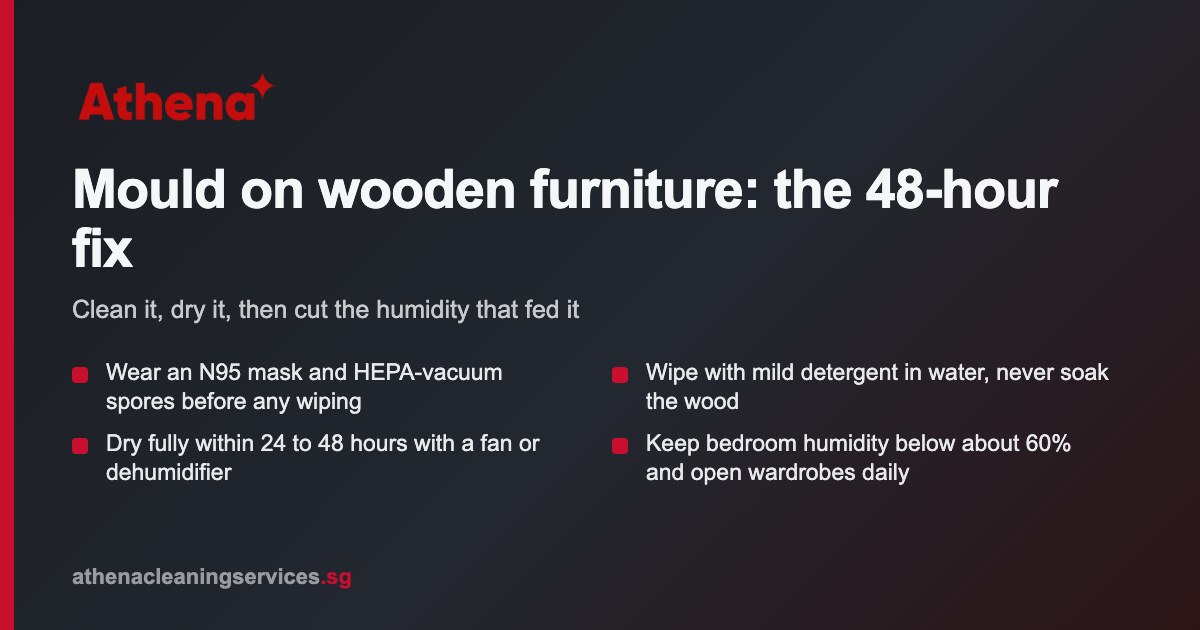
Mould on wooden furniture in Singapore comes from humid air, closed-up rooms and carpentry built against damp walls, and light growth can be cleaned at home. Vacuum the loose spores with a HEPA vacuum, wipe the surface with mild detergent in water, dry the piece fully within a day or two, then bring humidity down with a dehumidifier and daily airflow.
Deep growth in raw particleboard, swollen panels, or patches spread across several rooms need a professional or a replacement panel. This guide covers wardrobes, bed frames, shoe cabinets and kitchen carpentry in HDB, BTO and condo homes, with typical 2026 costs in SGD.
Why mould grows on wooden furniture in Singapore
Mould needs three things: moisture, something to feed on, and still air. Singapore supplies the moisture almost every day. Relative humidity commonly sits between 70 and 90 per cent, and it rains in every month of the year. Wood, plywood, and the paper and glue inside particleboard all work as food. Spores are already in the air of every home, so the real trigger is a surface that stays damp for a few days with nothing moving over it.
The US EPA makes the same point in its mould cleanup guidance: controlling moisture is the only lasting way to control mould, and cleaning without fixing the damp source just resets the clock.
Where it usually starts
Mould rarely begins on the front of a door. It begins where air stalls. Check these spots first:
- Wardrobe back panels and bottom corners, especially where the wardrobe sits flush against an external wall or a wall shared with a bathroom.
- The underside of storage beds and the slats beneath the mattress.
- The sink cabinet in the kitchen, where a slow trap leak or steam keeps the board damp.
- Shoe cabinets near the main door that hold rain-wet shoes in a closed box.
- Drawer bottoms and shelf undersides, which are often raw, unsealed board.
How the home type changes the risk
New BTO flats have wall plaster and screed that keep releasing moisture for weeks after handover, so freshly built wardrobes pressed against them are at risk. Older resale HDB flats often have bathroom-side wardrobes with no gap behind them. Condo units left empty for a few weeks, with the air-con off and windows shut, grow mould on loose furniture too. Ground-floor rooms in landed homes tend to be damper than upper floors.
Habits matter as much as buildings. Drying laundry in the bedroom, closing a wardrobe on a damp towel, and switching the air-con off all day then on all night all push moisture into the wood. The cold night-time air-con also cools the back panel, and warm humid air condenses on it.
Mould, mildew or water damage: what you are looking at
Spend a minute identifying the problem before scrubbing, because the fix differs. Mildew is flat, powdery and white or grey, and it sits on the surface. Mould looks fuzzy or spotted, in green, black, brown or white, and often comes with a musty smell. Water damage shows as a dark tide-mark ring with no fuzz, and it means a leak or condensation has soaked the board.
Two quick tests
First, wipe a small hidden patch with a damp cloth. If the surface comes up clean, the growth was on top. If a dark stain stays in the grain, the roots have gone into the wood. Second, press the tip of a screwdriver into the worst spot. Sound wood resists. If the surface crumbles, feels spongy or the board has swollen at the edge, the material has failed and cleaning will not rescue it. Particleboard and MDF that have swollen from water do not shrink back, and the panel needs replacing.
Check the room as well. A smell that returns within days of cleaning, condensation on windows, or peeling paint near the furniture all point to a moisture source behind the piece, such as a leak from a neighbouring bathroom wall.
Health and who should not do the cleaning
Mould can set off sneezing, itchy eyes and a blocked nose, and it can aggravate asthma. If someone at home has asthma, an allergy, or is an infant or an elderly person with chest problems, have another adult do the cleaning or hire a professional, and speak to a doctor if symptoms persist. HealthHub carries general healthy-living information from Singapore's Ministry of Health.
How to clean mould off wooden furniture, step by step
This method suits growth smaller than about one square metre on a single piece. The EPA suggests treating patches larger than roughly 10 square feet, which is about 0.9 square metres, as a bigger job that may need a professional.
Set up safely
Wear an N95 mask, gloves and goggles. Open the windows and point a fan outwards. In an HDB flat, move small pieces to the service yard or balcony. Never brush mould dry, because that throws spores into the air and onto the next surface.
The cleaning steps
- Empty the piece. Wash fabric items on a hot cycle and dry them completely. Items with a musty smell that will not wash out should go to a dry cleaner.
- Vacuum the surface, joints and corners with a HEPA-filter vacuum to lift loose spores.
- Mix warm water with a few drops of dish detergent. Wring the cloth until it is barely damp and wipe along the grain. Rinse the cloth often and do not soak the wood.
- For stubborn marks on solid wood, test a hidden spot with a 1:1 mix of white vinegar and water. Wipe, then go over it once with a cloth dampened in plain water.
- Dry the piece with a fan or dehumidifier. The EPA advises drying within 24 to 48 hours, because damp wood simply regrows mould.
- Once it is bone dry, lightly sand surface staining on solid wood and reseal it with a clear sealant or wax. Seal the raw edges of plywood and board where you can.
Seal used cloths and the vacuum dust bag in a plastic bag before throwing them out.
Why bleach is the wrong tool
Bleach looks effective because it whitens stains, but wood is porous, and the liquid does not reach the roots. It also adds water, can discolour the finish, and the fumes irritate the airways. The EPA does not recommend routine bleach use for mould cleanup, and detergent and water plus thorough drying does the job on non-porous and lightly affected surfaces.
Mould treatment options by furniture type: costs and drying times
Not every piece deserves the same effort. A solid wood table can be sanded and refinished, while a swollen particleboard cabinet door is cheaper to replace than to treat. The table below lists typical home methods, drying times and professional price ranges for Singapore homes in 2026. Prices are typical ranges before GST and differ by size, access and how far the growth has spread, so confirm with a written quote.
Costs for the supporting gear are modest. A hygrometer costs about S$10 to S$25, a tub of moisture absorber S$3 to S$8, and a household dehumidifier rated 12 to 20 litres a day roughly S$150 to S$400. Replacing a damaged carpentry panel is a carpenter's job and is quoted separately.
If the same piece keeps failing after treatment, the furniture is rarely the problem. Look at the wall behind it, the room's airflow, and what is stored inside.
Mould on new carpentry after renovation
Mould on new wardrobes and kitchen cabinets is common in the first year of a new BTO or renovated resale flat. The walls behind the carpentry are still drying, the board is often raw on the hidden faces, and many owners keep the doors shut while the flat sits empty between handover and move-in. Closed boxes in warm, humid air are exactly where mould settles.
New boards also release formaldehyde from the glues used in plywood and particleboard. The US EPA's formaldehyde facts note that emissions fall over time and that ventilation helps. So the fix for fresh carpentry is the same as for mould: keep doors ajar, run the air-con with a dehumidifier for the first weeks, and let the flat breathe.
What to do in the first months
Do not load a new wardrobe with sealed clothing bags on day one. Leave a gap of a few centimetres behind it if the design allows, and ask your carpenter to seal exposed board edges and add small ventilation gaps. If mould appears within the first year, tell your contractor in writing with photos, because renovation warranties on carpentry commonly run for a year. Check the terms in your contract.
Fine renovation dust also holds moisture and feeds growth, so a proper builder's clean helps. Our guide to post-renovation cleaning steps and the post-renovation cleaning checklist cover what to wipe down before the wardrobes get filled.
How to stop mould coming back in an HDB or condo
Cleaning fixes this month's mould. Humidity control fixes next month's. The EPA's indoor air quality guidance recommends keeping indoor humidity between 30 and 50 per cent. In a Singapore flat that is hard to reach without constant dehumidifying, so a practical target is to stay below roughly 60 per cent, checked with a hygrometer on the wardrobe wall.
A routine that works
- Run a dehumidifier in the bedroom for a few hours daily during the wet months, and keep doors closed while it runs.
- Open wardrobe and cabinet doors for 15 to 30 minutes every day, and leave them ajar when the room is empty.
- Pull furniture a few centimetres away from external and bathroom walls where you can.
- Dry laundry outside the bedroom, and never store damp towels, gym bags or wet shoes inside cabinets.
- Place moisture absorbers in wardrobes and shoe cabinets and replace them when full, usually monthly in humid weeks.
- Fix leaks early. A slow sink-trap drip or a weeping bathroom wall will defeat every other step.
Bathroom-side walls deserve special attention. Grout and silicone failure lets moisture through, and our guide to cleaning bathroom tiles, grout and fixtures shows how to keep that source dry. Mattresses sit on wooden bases too, and a damp bed base grows mould under the slats. Our mattress allergen removal methods explain how to keep the whole bed dry and clean.
When to call a professional
Book help when the growth covers more than about one square metre, when it returns within a few weeks of cleaning, when board has gone soft or swollen, or when a household member has asthma or a weak immune system. A musty smell that survives cleaning is another sign that the growth is inside the carpentry, where a cloth cannot reach.
Professionals use HEPA extraction, controlled treatment of the surface and fast drying equipment, and they can tell you honestly whether a panel should be replaced. Typical charges for treating one piece of furniture sit around S$100 to S$350 depending on size and condition, as shown in the table above. Ask any provider for a licence number, because NEA licenses cleaning businesses in Singapore, and ask for a written quote before the visit.
Renters and move-outs
If you are a tenant, deal with mould on built-in carpentry before handover. Landlords can raise it at the final inspection and may deduct repair costs from the deposit. Our end of tenancy cleaning guide lists what inspectors usually check. Athena's team can inspect affected furniture and rooms and give you a quote on WhatsApp.
Comparison at a glance
| Furniture type | Common Singapore trigger | Best home method | Drying time | Typical professional cost (SGD) |
|---|---|---|---|---|
| Solid wood bed frame or table | Humid bedroom, sealed under-bed storage | Detergent wipe, diluted vinegar on stubborn spots, light sanding and resealing | 24 to 48 hours with a fan | S$80 to S$200 per piece |
| Laminated plywood wardrobe | Back panel against an external or bathroom wall | HEPA vacuum, detergent wipe, doors left open, gap behind | 24 to 48 hours | S$120 to S$300 per wardrobe |
| Particleboard or MDF kitchen cabinet | Sink-trap leak, cooking steam | Fix the leak first, wipe and dry; replace if swollen | 2 to 3 days; swollen board does not recover | S$150 to S$350 treatment, panel replacement quoted separately |
| Shoe cabinet | Rain-wet shoes stored closed | Empty, wipe, dry, add moisture absorbers | About 1 day | S$80 to S$180 |
| Rattan or cane chair | Balcony exposure in the wet season | Dry brush outdoors, damp cloth, a few hours of dry air | Same day | S$60 to S$150 |
Frequently asked questions
Can I use bleach on mould on wooden furniture?
Bleach is not a good choice for wood. The wood is porous, so the liquid does not reach the roots, and the added water can feed regrowth. It can also discolour the finish. Detergent in water, followed by fast and thorough drying, works better. The US EPA does not recommend routine bleach use for mould cleanup.
How long does wooden furniture take to dry after mould cleaning?
Solid wood and laminated board usually need 24 to 48 hours with a fan or dehumidifier running, which matches the EPA's advice to dry within that window. Particleboard and MDF can take two to three days, and board that has swollen will not return to its original shape. In Singapore's wet months, dry in an air-conditioned room with a dehumidifier rather than leaving the piece in a humid corridor.
How much does professional mould removal on furniture cost in Singapore?
As a typical range, treating one piece costs about S$80 to S$350 before GST, depending on size and how far the growth has spread. A wardrobe sits at the upper end. Replacing a damaged carpentry panel is billed separately by a carpenter. Always get a written quote and confirm that the company holds a valid NEA cleaning licence.
Is mould on wardrobes in a new BTO flat normal?
It is common, not harmless. New walls keep releasing moisture for weeks, and closed carpentry traps it. Leave doors ajar, run a dehumidifier, and keep a gap behind the wardrobe where possible. If mould appears in the first year, photograph it and tell your contractor in writing, as renovation warranties on carpentry often run for a year.
Is mould on wooden furniture harmful to health?
For many people it causes mild symptoms such as sneezing, itchy eyes and a blocked nose, and it can aggravate asthma. People with asthma, allergies or weak immunity should avoid doing the cleaning. See a doctor if symptoms continue, and read the general guidance on HealthHub.
Sources
Related Athena cleaning services in Singapore
Related articles