
Leather Sofa Cleaning and Conditioning: A Complete Care Guide

In this article
- Key Takeaways
- Table of Contents
- Leather Sofa Cleaning and Conditioning: Why Regular Care Matters
- Leather Types and Finishes: Match Conditioning to the Sofa
- Home Care or Professional Leather Sofa Cleaning: Which Fits?
- A Safe Leather Sofa Cleaning and Conditioning Routine
- Professional Leather Sofa Care with Athena Team Cleaning
- Make Your Sofa’s Next Care Step a Confident One
- Frequently Asked Questions
What if the safest way to clean your leather sofa is to start by doing less? The wrong product, excess moisture or vigorous scrubbing can affect the finish. Effective leather sofa cleaning and conditioning starts with identifying the material and understanding what it needs.
If you’re unsure whether your sofa needs a light wipe or a deeper clean, you’re not alone. This guide explains how the leather finish influences product choice, how to follow a gentle routine and when conditioning may be suitable. You’ll also learn to distinguish routine care from marks or wear that may need professional attention. Careful maintenance helps keep your sofa looking cared for, while professional upholstery cleaning can complement your routine when surface care isn’t enough.
Key Takeaways
- Identify your sofa’s leather finish before choosing a cleaner or conditioner, and follow the furniture maker’s care guidance.
- Use a cautious routine: remove loose dust, test products discreetly and keep moisture and pressure to a minimum.
- Understand how cleaning and conditioning differ, and why a conditioner must suit the specific finish.
- Use home care for light upkeep, but pause if you notice persistent soil, widespread marks or surface damage.
- Consider professional upholstery cleaning from Athena Team Cleaning when your sofa needs care beyond routine surface maintenance.
Leather Sofa Cleaning and Conditioning: Why Regular Care Matters
Cleaning and conditioning have different purposes. Cleaning removes surface soil and residue. Conditioning is intended to support the feel and appearance of compatible leather finishes. Treating them as interchangeable can lead to unnecessary product use, especially when the sofa’s finish isn’t suited to a general-purpose conditioner.
A sofa collects more than visible dust. Everyday contact transfers body oils from hands and arms, while clothing, crumbs and airborne particles leave residue in seams and favourite seating spots. Open windows and regular use can also bring dust indoors. A quick, regular inspection helps you notice changes before reaching for a treatment.
Dullness, a tacky feel or visible grime are reasons to inspect the surface, not proof of a particular problem. A worn patch may have a different cause from removable soil. Applying cleaner or conditioner without understanding the finish can make matters worse, so use the sofa’s care label or maker’s instructions to guide your next step.
Leather sofa conditioning is a finish-compatible treatment intended to support the leather’s feel and appearance, not repair damage. Leather sofa cleaning and conditioning should depend on the material and its condition, rather than follow a fixed, one-size-fits-all schedule.
What cleaning and conditioning each do
Cleaning uses a suitable, controlled method to lift surface dirt and residue. A dusty seat may need only careful dust removal. For a visible mark, review the sofa’s care guidance before using a product.
Conditioning is intended for finishes that are compatible with the treatment. It isn’t automatically needed for every sofa, and it won’t repair peeling, deep cracks or structural damage. Don’t assume a conditioner will restore an uncertain or damaged surface.
Signs your sofa may need attention
Check for grime along seams, dull areas where people sit most or residue that remains after ordinary dusting. These signs are a prompt to inspect the sofa and review the manufacturer’s care instructions.
Light, loose soil is different from a persistent mark or a deteriorating finish. Pause before trying stronger products or scrubbing repeatedly, particularly if you don’t know the leather type. Careful observation helps distinguish routine surface care from an issue that needs more specialised attention.
Leather Types and Finishes: Match Conditioning to the Sofa
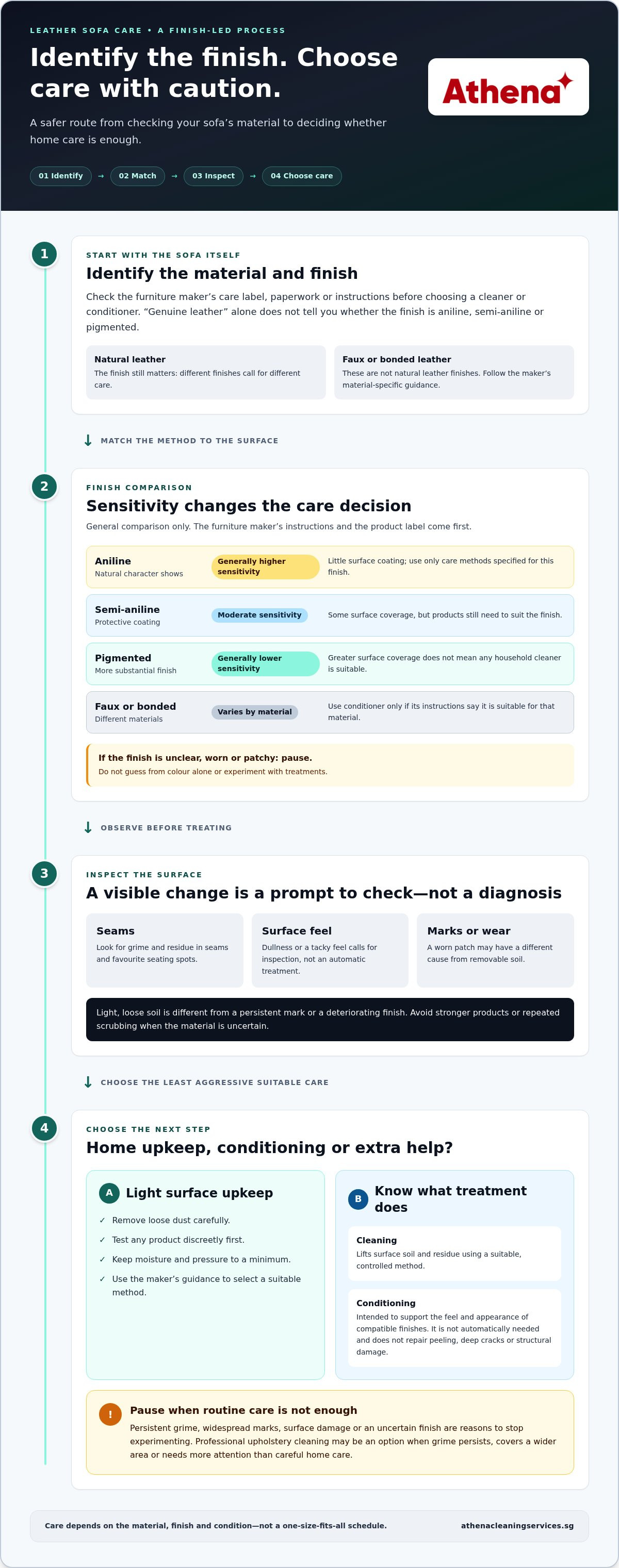
Identify the sofa’s finish before choosing a cleaner or conditioner. The finish affects how the surface may respond, so choose products based on the finish rather than guesswork. “Genuine leather” describes natural leather, but it doesn’t tell you whether the surface is aniline, semi-aniline or pigmented. These finishes don’t all call for the same care.
The table provides a general comparison, not a substitute for care instructions. Follow the furniture maker’s guidance and product label first. If the finish is unclear or visibly worn, don’t experiment with treatments.
| Material or finish | Relative sensitivity | Cautious care consideration |
|---|---|---|
| Aniline leather | Generally higher | Its surface shows more of the hide’s natural character, so use only care methods specified for that finish. |
| Semi-aniline leather | Moderate | A protective coating offers some surface coverage, but it still needs finish-compatible products. |
| Pigmented leather | Generally lower | A more substantial pigmented surface finish provides greater coverage. Don’t assume it can withstand any household cleaner. |
| Faux or bonded leather | Varies by material | These aren’t natural leather finishes. Follow the maker’s care label and use conditioner only if its instructions say it’s suitable. |
Aniline, semi-aniline and pigmented leather
Aniline leather typically has little surface coating, allowing more of the hide’s natural markings to show. That open appearance can also make it more sensitive to spills and unsuitable products. Semi-aniline leather has a protective coating, while pigmented leather has a more substantial pigmented surface finish. A product intended for one finish may not suit another.
Look for care details in the sofa paperwork or on its label rather than trying to identify the finish by colour alone. If the finish is worn, patchy or uncertain, pause before applying anything. The Leather Working Group provides information on leather-industry environmental practices and sourcing, but your furniture maker’s guidance remains the authority for your sofa’s care.
Faux and bonded leather need different care
Faux leather is synthetic, while bonded leather is made from leather fibres combined with other materials. Neither should automatically be treated like aniline or pigmented natural leather. Check the maker’s care label, and use a leather conditioner only if its instructions say it’s suitable for that material.
Matching the method to the surface is central to careful leather sofa cleaning and conditioning. When a sofa needs more than routine home care, Athena Team Cleaning provides upholstery cleaning as a practical complement to your maintenance routine.
Home Care or Professional Leather Sofa Cleaning: Which Fits?
Choose home care for light, surface-level upkeep. Professional upholstery cleaning is an option when grime persists, covers a wider area or needs more attention than a careful routine can provide. The decision isn’t based only on how dirty the sofa looks. Its material, finish and condition also matter.
More product or harder scrubbing won’t necessarily improve the result. Extra moisture and friction can spread residue or affect the surface, especially if the finish is delicate or uncertain. The EPA Leather Tanning and Finishing Guidelines explain that leather production involves tanning and finishing processes. This is one reason sofa surfaces shouldn’t be treated as interchangeable. Use the furniture maker’s instructions to guide care.
| Home care | Professional upholstery cleaning |
|---|---|
| Suitable tasks: Removing loose dust and carrying out gentle, routine surface care in line with the sofa’s instructions. | Suitable tasks: Addressing persistent grime or broader soil across the sofa when routine surface care hasn’t been enough. |
| Limitations: Light home maintenance may not shift ingrained soil or older marks. Don’t keep repeating a treatment if the surface isn’t responding. | Limitations: The appropriate approach depends on the furniture and its condition. Cleaning should not be assumed to repair a worn or damaged finish. |
| Pause if: Colour transfers to the cloth, the finish changes or the surface feels tacky. | Consider service if: Grime remains after careful upkeep or the sofa needs broader upholstery attention. |
When careful home maintenance is enough
For ordinary upkeep, remove loose dust gently and follow the care label for any surface treatment. A fresh, minor mark may respond differently from an old or ingrained stain, so don’t treat them as the same cleaning task. If a cautious attempt changes the colour or feel, stop instead of applying more product or pressure.
A tacky feel, colour transfer or visible change to the finish is a reason to stop. Continued home treatment could add risk without resolving the issue. Review the furniture maker’s care guidance before trying another method.
When professional upholstery cleaning may help
Persistent grime, widespread soil or a sofa that needs more than routine surface care are reasons to consider professional help. The suitable approach depends on the furniture and its condition, so don’t assume a method used on other upholstery will suit every leather finish.
Athena Team Cleaning provides upholstery cleaning as a practical complement to careful home maintenance. If your sofa needs more than routine upkeep, explore professional upholstery cleaning for broader care.
A Safe Leather Sofa Cleaning and Conditioning Routine
A careful routine is about control, not effort. Work in sequence, keep moisture and product use to a minimum, and stop if the surface reacts unexpectedly. The basic order is simple: check the care guidance, remove loose dust, test discreetly, clean gently and let the sofa dry naturally.
Use the furniture maker’s instructions and the cleaner’s label throughout. They take priority over general advice, especially if you’re unsure of the finish. Follow these steps:
- Check the care guidance. Read the sofa’s care label or maker’s instructions before choosing a cleaner. Confirm that the product is intended for the specific leather finish, and avoid treatments the guidance rules out.
- Remove loose dust. Use a clean, soft cloth or a vacuum with a suitable soft-brush attachment to lift dust and debris. Work gently around seams and crevices. Don’t press or drag the tool across the surface.
- Test discreetly. Put a small amount of the approved cleaner on a soft cloth, not directly on the sofa. Test an inconspicuous area, then let it dry fully. Check for changes in colour, texture or finish before proceeding.
- Clean gently. If the test area remains unchanged, follow the product directions and use a light touch. Avoid abrasive tools, harsh chemicals and excess water. More cleaner or harder scrubbing doesn’t guarantee a better result and may affect the surface.
- Dry naturally. Let the sofa air-dry away from direct heat and sunlight. Don’t use a hair dryer or place it near a heater to speed up the process.
Clean gently and test before treating the whole sofa
Testing gives you a chance to spot an unwanted reaction before it reaches a visible or frequently used area. If colour transfers to the cloth, the finish changes or the test area feels tacky after drying, stop. Don’t continue across the sofa or try to counteract the reaction with another product.
Keep the cloth only lightly damp if the cleaner’s directions call for it. Apply product sparingly and avoid soaking seams, which may hold moisture longer than the open surface. Let the test area dry before deciding whether to proceed.
Condition only when the finish and instructions allow
Conditioning is optional, not a required final step for every sofa. Check the furniture maker’s guidance and the conditioner label to make sure the treatment suits the finish. Don’t rely on a fixed calendar. Follow the product directions and the sofa’s specific care advice.
If conditioning is permitted, apply it sparingly as directed and remove any excess according to the instructions. Keep the sofa away from direct heat while the treated surface dries. If the finish is uncertain or visibly deteriorating, pause rather than applying another treatment.
For more involved sofa care, Athena Team Cleaning provides upholstery cleaning. Request an online quote for upholstery cleaning as a complement to careful home maintenance.
Professional Leather Sofa Care with Athena Team Cleaning
Careful home maintenance works for loose dust and light surface soil, but it may not be enough when grime persists or the sofa needs broader attention. Professional upholstery cleaning can complement your regular routine. Athena Team Cleaning provides residential and commercial cleaning, including upholstery cleaning, so sofa care can be handled as a dedicated service rather than another task to manage at home.
Leather sofa cleaning and conditioning still depends on the sofa’s material, finish and condition. Professional upholstery cleaning shouldn’t be mistaken for a promise of a particular leather treatment or result. When requesting a quote, describe what you’ve noticed, such as which areas look soiled, whether marks remain after light upkeep and what care instructions you have. These details help explain the cleaning needs you have in mind.
What a professional service adds to routine care
Upholstery cleaning can take deeper maintenance off your home-care list. Consider it when surface dusting no longer addresses persistent grime or several areas of the sofa need attention. Routine care remains useful between services, but it doesn’t mean repeatedly applying products or scrubbing harder when soil doesn’t lift.
Athena Team Cleaning offers flexible scheduling and online quote requests. Include the sofa’s material if you know it, the areas that need attention and any relevant care guidance. Clear details help you request a quote tailored to the work you have in mind, without assuming every leather surface needs the same approach.
Take the next step for your sofa
If the sofa needs only light upkeep, continue with gentle care guided by its maker’s instructions. If grime persists, marks cover a wider area or you’re unsure how to proceed without affecting the finish, professional upholstery cleaning may be a practical next step. Pause before trying stronger products to avoid adding to surface wear.
For related guidance on broader sofa care, see Upholstery Deep Cleaning: Refreshing Your Sofa and Fabric. When you’re ready to arrange professional attention, submit an online quote request to Athena Team Cleaning and describe your sofa’s cleaning needs.
Make Your Sofa’s Next Care Step a Confident One
Let the sofa’s condition guide your next move. A quick inspection can help you decide whether it needs ordinary care or professional support, without reaching for extra products just to feel proactive. Keep the care instructions somewhere easy to find so you can respond confidently when a mark appears.
Good leather sofa cleaning and conditioning isn’t about doing more. It’s about making a considered choice that respects the material and helps you care for the sofa over time. If a cleaning concern goes beyond routine home maintenance, avoid guessing at a stronger treatment.
Request an online quote from Athena Team Cleaning and describe what your sofa needs. Flexible scheduling makes it easier to arrange upholstery cleaning around your plans.
Request an upholstery cleaning quote to take the next step for your sofa.
Frequently Asked Questions
Can I use vinegar to clean a leather sofa?
Don’t treat vinegar as a universal leather cleaner. Household acids may affect some finishes, and results vary with the surface’s condition. Check the sofa maker’s care instructions and use only a cleaner labelled as suitable for that finish. If you’re unsure, don’t apply a product across the sofa or to a visible area.
Can I use a steam cleaner on a leather sofa?
Don’t assume a steam cleaner is suitable for leather. Heat and moisture may affect the surface or finish, and the right care depends on the sofa’s materials and manufacturer guidance. Check the care label before using a steam device. For routine upkeep, start by removing dust without moisture. Avoid heat or damp treatments unless the furniture maker specifically permits them for your sofa.
How can I tell whether my sofa is aniline or pigmented leather?
Start with the furniture label, product paperwork or manufacturer’s care guide, which may name the finish. Aniline leather generally shows more natural variation, while pigmented leather has a protective surface coating. Appearance alone isn’t conclusive, particularly if the sofa is older or has been treated. If you can’t identify the finish, don’t experiment with cleaners or conditioners. Keep the documentation handy for future care decisions.
What should I do if ink gets on a leather sofa?
Don’t rub the ink, apply alcohol or use a household stain remover without checking the sofa’s care instructions. Blot only if the maker’s guidance recommends it, using a clean material and minimal pressure. Ink can behave differently on different finishes, and an improvised treatment may spread the mark or alter the surface. If it persists, consider professional upholstery cleaning rather than applying more products.
Why does a leather sofa feel sticky after cleaning?
Stickiness may come from leftover cleaner, conditioner, body oils or other surface residue. Don’t add more product to fix it. Check the cleaner’s directions and the sofa’s care guidance, then use only the recommended removal method. If the surface remains tacky, changes colour or feels different after drying, stop further treatment. Note which products you used, as that information can help guide the next care step.
Can a professional cleaning service remove old leather sofa stains?
Old stains can be difficult to treat because they may settle into or alter the finish. Whether a mark can be removed depends on the leather type, the stain and previous cleaning attempts, so removal isn’t guaranteed. A professional upholstery cleaning service can address the sofa’s cleaning needs with an approach suited to its condition. Avoid further home treatments that could worsen the mark.
Frequently Asked Questions
Can I use vinegar to clean a leather sofa?
Can I use a steam cleaner on a leather sofa?
How can I tell whether my sofa is aniline or pigmented leather?
What should I do if ink gets on a leather sofa?
Why does a leather sofa feel sticky after cleaning?
Can a professional cleaning service remove old leather sofa stains?
Related articles