
Common Office Cleaning Complaints: Causes, Fixes and Next Steps

In this article
- Key Takeaways
- Table of Contents
- Common Office Cleaning Complaints: What Employees Notice First
- Why Office Cleaning Problems Recur: Find the Cause Before Blaming
- How to Compare Fixes for Common Office Cleaning Complaints
- A Practical Process for Reporting and Resolving Cleaning Complaints
- Resolve Persistent Office Cleaning Complaints with Athena Team Cleaning
- Set a Clear Standard for a Better-Maintained Office
- Frequently Asked Questions
What if recurring cleaning problems are less about effort and more about a process that doesn’t match the office? Missed bins, dusty shared surfaces or restrooms that keep falling below expectations can quickly undermine confidence in workplace cleaning. The common office cleaning complaints often point to a gap in task frequency, scope or follow-through, not just a one-off oversight.
It’s reasonable to expect cleaning tasks to be completed consistently, and raising concerns shouldn’t feel uncomfortable. A clear record of what’s happening and where can help turn frustration into a fair, practical conversation about workplace needs.
This guide explains why office cleaning issues recur and how to address them. You’ll learn how to distinguish an isolated miss from a pattern, assess whether the cleaning scope suits your office, and compare options such as adjusting routines, documenting concerns or using professional office cleaning and building maintenance support. We’ll also cover constructive ways to report problems and track whether agreed changes are working, so you can build a clearer path to a cleaner, more consistently maintained workplace.
Key Takeaways
- Spot the visible signs that can signal inconsistent upkeep, from dusty surfaces to missed bins and streaked floors.
- Consider how task expectations, room access, timing and high-use areas may contribute to recurring concerns.
- Compare a clearer task list, schedule changes, focused communication and professional support to find a practical fit for common office cleaning complaints.
- Use a simple observe, document, report, agree and review process to make concerns specific and easier to follow up.
- See how commercial office cleaning and building maintenance can support a more consistent approach when issues persist.
Common Office Cleaning Complaints: What Employees Notice First
Repeated, visible cleaning issues can distract staff and weaken confidence in how the workplace is maintained. A dusty meeting table may be easy to overlook once, but noticing it before every client visit tells a different story. The common office cleaning complaints employees raise often concern clear, observable details: what looks untouched, what was missed, or what seems inconsistent from one visit to the next.
Look at the area where an issue appears. This helps make a concern specific rather than treating every cleaning task as one broad problem.
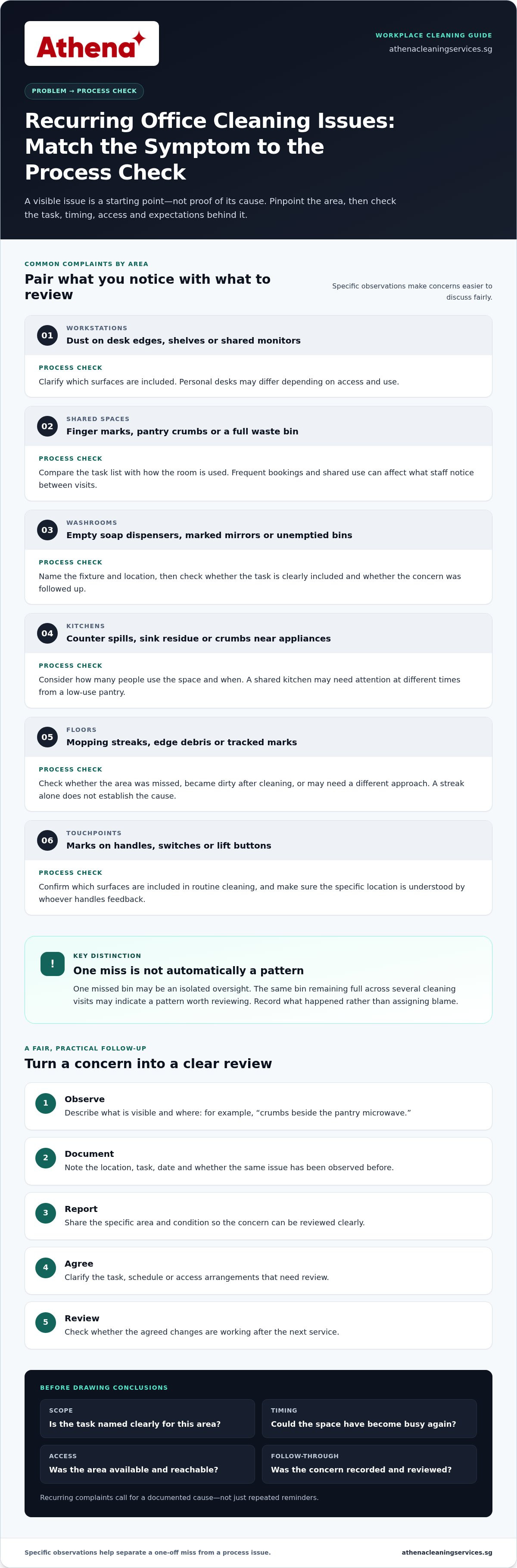
- Workstations: Dust on desk edges, shelves or shared monitors may stand out, while personal desks can differ depending on access and use.
- Shared spaces: Finger marks on meeting-room tables, crumbs in a pantry seating area or a full waste bin are easy to notice between bookings.
- Washrooms: Staff may report an empty soap dispenser, visible marks on a mirror or a bin that hasn’t been emptied.
- Kitchens: Spills on counters, residue around a sink or crumbs left near appliances can make the space feel inconsistently maintained.
- Floors: Streaks after mopping, debris along edges or a newly tracked mark may be more obvious in high-traffic routes than in quieter rooms.
- Touchpoints: Marks on door handles, switches or lift buttons can prompt questions about which surfaces are included in routine cleaning.
The same observation can mean different things across teams. A meeting room used throughout the day may show marks sooner than a rarely occupied office; a kitchen shared by several departments may need attention at different times from a low-use pantry. The broad range of tasks associated with cleaning roles, outlined in Janitor, is a useful reminder that visible results depend on what work is expected and where it takes place.
A complaint describes someone’s experience, not the cause. A streaked floor doesn’t by itself establish whether the area was missed, became dirty after cleaning, or needs a different approach. Treat the observation as a starting point for investigation, not automatic proof of poor service. That distinction keeps the discussion fair and helps identify whether the task, timing or expectation needs attention.
Which cleaning issues are most noticeable in an office?
Start with what can be seen or described precisely: “crumbs beside the pantry microwave” is more useful than “the kitchen is dirty.” Note the surface or fixture, its location and the condition observed. This detail gives whoever reviews the concern a clearer picture, especially when several teams use the same shared area.
When does a one-off issue become a recurring complaint?
Record the location, task, date and whether you’ve observed the same issue before. One missed bin is an isolated oversight; the same bin remaining full across several cleaning visits may indicate a pattern worth reviewing. Focus on the record rather than blame. Repeated, specific observations make it easier to discuss expectations and decide what to examine next.
Why Office Cleaning Problems Recur: Find the Cause Before Blaming
A repeated concern doesn’t automatically mean someone failed to do the work. Sometimes the task wasn’t included in the agreed scope; sometimes it was completed, but the area became busy again before staff noticed. In a shared office, people can also have different ideas about what “clean” means. One team may expect a meeting room to be reset after every booking, while the written task list may describe a different routine.
Start by tracing the observation back to the process. A task that was missed calls for a different response from one that is being done but no longer suits how the office is used. Changing occupancy, foot traffic, room bookings and access arrangements can all affect what employees see. Recurring complaints need a documented cause, not just repeated reminders.
Could the cleaning scope or schedule be unclear?
Compare the task list with the reported area and activity. Does the scope name the room and surface, or use a broad phrase such as “clean shared areas”? Are employees expecting a task to happen more often than the agreed routine? These differences can leave staff and cleaners working to separate assumptions, even when each believes expectations are clear.
Consider how the space is used, too. A room with frequent bookings may need a different approach from one used occasionally. Don’t assume one schedule fits every office. Use observed patterns to identify where the current frequency or method may need review.
Are access, communication, or follow-up contributing?
Check practical details before drawing conclusions. Was the room available at the time of service? Are access arrangements understood, and does the person handling feedback know which area is involved? Then see whether the concern was recorded, assigned for action and reviewed after the next service. This is a diagnostic checklist, not an assumption that any one step has failed.
Use the following questions to narrow the cause:
- Scope: Is the task named clearly, including the relevant area?
- Timing: Could the space have become busy again after the work was completed?
- Access: Was the area available and reachable during the service?
- Method: Is the task being completed, but not producing the expected result?
- Follow-up: Was the concern reviewed after action was taken?
These checks help separate a missed task from a frequency or method issue. For example, if a task is absent from the written scope, repeating the same reminder won’t resolve the gap; the expectation needs to be clarified. If it is included but the area’s use has changed, the routine may need adjustment. If access is the obstacle, clearer arrangements may be the practical fix.
Keep the conversation factual: describe the location, expected task and observed result, then agree on what to review. This gives everyone a fair basis for improvement. If recurring issues point to a broader need for consistent commercial cleaning or building maintenance, professional office cleaning support may be a practical next step.
How to Compare Fixes for Common Office Cleaning Complaints
The right response depends on what the evidence shows. A single missed task may call for a clear, focused reminder; the same issue across several visits may point to a scope or schedule that needs review. A mark on carpet or another specialist surface may need a different cleaning approach from routine upkeep. Match the fix to the pattern, then check whether the reported problem changes.
Use this comparison to weigh practical options:
| Option | When it may fit | Limit | What to monitor |
|---|---|---|---|
| Clarify the task list | A specific area or task is missing, vague or understood differently by staff. | A clearer list won’t resolve access barriers or specialist surface concerns by itself. | Whether the named task is completed consistently on later visits. |
| Adjust the schedule | A high-use area becomes untidy again between planned cleaning visits. | A change in timing may not address unclear scope or an unsuitable method. | Whether the area’s condition better matches its use after the adjustment. |
| Communicate with staff | Shared spaces are left untidy after use, or expectations differ across teams. | Reminders rely on staff participation and don’t replace agreed cleaning tasks. | Whether the behaviour or concern continues, and where it occurs. |
| Use professional cleaning support | Issues persist, require a consistent service response, or involve specialist cleaning needs. | The scope still needs to reflect the office’s areas and requirements. | Whether agreed tasks and the reported areas are addressed over subsequent visits. |
Start with the simplest change that fits the evidence. A clearer checklist can name each room, surface and task, making expectations easier to communicate. Review whether the change improves the reported issue over subsequent visits. If the task is already clear but an area repeatedly needs attention, examine whether its use or cleaning frequency has changed. Focused staff communication may help where shared-space habits contribute, but it shouldn’t be used to shift responsibility for contracted cleaning tasks.
Professional support may be appropriate when complaints continue or an issue calls for dedicated cleaning expertise. Athena Team Cleaning provides commercial office cleaning and building maintenance, as well as carpet cleaning and sanitization services. Carpet concerns can be considered alongside guidance on choosing a professional cleaning company, while remembering that a specialist service addresses a different need from routine office cleaning.
Keep the review measurable without making it complicated: note the area, the agreed change and what you observe after later visits. If the issue remains, revisit the cause rather than repeating the same correction. That makes it easier to distinguish a one-off oversight from a recurring process problem and choose the next step with care.
A Practical Process for Reporting and Resolving Cleaning Complaints
A useful report turns a general frustration into an issue someone can investigate and follow up. Keep the process simple: observe what happened, record the details, report it through the agreed workplace channel, decide what action to take, then review the result. This approach helps staff raise common office cleaning complaints constructively and gives office managers a clear record instead of relying on repeated verbal reminders.
- Observe: Identify the visible issue and the precise area. Separate what you saw from what you think may have caused it.
- Document: Note the date, location, task or surface involved, and whether the same concern has occurred before.
- Report: Send the information to the responsible workplace contact or through the established reporting process.
- Agree on action: Clarify what should happen next, who will follow up, and when the outcome will be reviewed.
- Review: Revisit the same area and task after the next relevant cleaning visit, then record whether the concern was resolved or remains open.
What details make a complaint easier to act on?
Be specific and neutral. “The pantry counter beside the sink had visible residue on Tuesday afternoon” gives more useful context than “the pantry is not clean.” Add whether you’ve noticed it before and state the correction you’re seeking, such as including that surface in the agreed routine. A photo can help show the condition, but use one only when appropriate and permitted by workplace policies. Avoid assigning blame or assuming intent.
For repeat concerns, keep a shared record that’s easy for the relevant people to update. A simple log can include the date reported, area, observed issue, responsible contact, agreed action, review point and outcome. This makes it easier to see whether reports refer to the same task or separate issues, and reduces the chance that a concern disappears in an informal conversation. Limit access to people who need the information, in line with workplace practices.
How should office managers check whether the fix worked?
Set a reasonable review point tied to the next cleaning visit that includes the task in question. Compare the same location and condition against the original report, rather than relying on a general impression of the whole office. If the issue is resolved, close the record with the review outcome. If it persists, keep it visible and revisit the agreed action, scope or conditions affecting that area.
Keep the exchange professional and focused on improvement. A concise update can acknowledge the report, state the action agreed and explain when it will be reviewed. This creates a fair process for staff and a practical basis for follow-up. If recurring concerns call for a more consistent cleaning arrangement, request a quote for office cleaning support from Athena Team Cleaning.
Resolve Persistent Office Cleaning Complaints with Athena Team Cleaning
Once you’ve identified a pattern, clarified the task and chosen a response, review what happens next. That simple cycle helps turn common office cleaning complaints into a practical discussion about the workplace, rather than a series of disconnected reminders. If concerns continue, professional support may help provide a more consistent service approach that reflects the areas and tasks your office needs.
Athena Team Cleaning provides commercial office cleaning and building maintenance in Singapore. Its service attributes include flexible scheduling and thorough disinfection. These services can be considered when recurring concerns involve routine office upkeep or a need to discuss cleaning requirements for the workplace.
What to include when requesting office cleaning support
Describe the office areas involved, the concerns that keep recurring and the outcome you’re seeking. For example, explain whether a concern relates to a shared workspace, a floor surface or an area with frequent use. Note how often the issue has appeared and any agreed task or routine that relates to it. This context gives the team a clearer basis for a service discussion tailored to the workplace.
Before making an enquiry, it can help to gather a brief summary:
- Areas: Identify the rooms or surfaces that need attention.
- Pattern: Describe what has recurred and when it is most noticeable.
- Current expectations: Share the relevant tasks or routine, if available.
- Desired outcome: Explain what a consistently maintained space would look like for your team.
- Specialist needs: Mention concerns involving carpets or other surfaces that may call for a dedicated cleaning service.
Specific examples are more useful than a broad label such as “the office is not clean.” They help distinguish an isolated oversight from a repeated concern and clarify which areas matter most. You don’t need to assign blame or determine the cause before starting a discussion. A clear account of what staff have observed is a useful first step.
Take the next step toward a consistently maintained office
Bring together your observations, the areas involved and the outcomes you need. This gives the service conversation a practical starting point, whether you’re addressing recurring routine tasks, building maintenance needs or cleaning requirements for a particular surface. The goal is a clear understanding of the workplace, followed by an approach that can be reviewed against the concerns raised.
For persistent issues, a well-defined request can help move the discussion from repeated complaints to a more considered cleaning plan. Athena Team Cleaning offers online quote requests, as well as contact by phone or email. Request an office cleaning quote from Athena Team Cleaning to discuss the areas and recurring concerns affecting your workplace.
Set a Clear Standard for a Better-Maintained Office
Recurring cleaning concerns can be an opportunity to define what a well-maintained workplace should look like for your team. Use the observations you’ve gathered to shape a practical standard, one that reflects how your office is used and gives everyone a clearer basis for reviewing the results. Addressing common office cleaning complaints this way can help shift attention from frustration to steady, considered improvement.
If your workplace needs ongoing support, Athena Team Cleaning provides commercial office cleaning and building maintenance, with flexible scheduling and thorough disinfection among its stated service attributes. A clear description of your office and its needs can help start a focused conversation about the right approach.
Take the next step toward a more consistently maintained workplace. Request an office cleaning quote from Athena Team Cleaning. A practical plan can begin with one clear concern and grow into a better routine for the whole office.
Frequently Asked Questions
Why do office cleaning complaints keep happening?
Office cleaning complaints can recur because task expectations are unclear, the schedule no longer suits how spaces are used, access is limited, or follow-up is incomplete. These are possibilities to investigate, not assumptions about a cleaning team. For example, a room used more often after a team change may need a different routine. Record the location and repeated issue, then review the agreed tasks and subsequent results together.
What are the most common complaints about office cleaning?
Common concerns include dusty work surfaces, bins that haven’t been emptied, streaked floors, untidy shared kitchens and washroom issues. What staff notice can depend on how they use the office: a team that eats in a shared pantry may focus on counters, while another may notice meeting-room floors. Group reports by location and task. This helps managers see whether several comments point to one recurring issue or different expectations.
How should employees report a cleaning complaint at work?
Describe the specific area, visible issue, date and whether you’ve noticed it before. “Marks remained on the meeting-room table after Tuesday’s use” gives a manager more to work with than “the office is dirty.” Keep the message factual and respectful, and follow your workplace’s reporting procedures. If you include a photo, avoid capturing sensitive information or people, and follow internal policies for taking and sharing images.
How can an office manager tell whether a cleaning complaint has been resolved?
At the agreed review point, compare the same area and task with the original report. Check whether the issue is absent and whether it returns on later visits, taking changes in room use into account. Record what you observed, rather than relying only on a general impression. Close the report if resolved. If it persists, revisit the relevant task scope or routine and keep the concern open for further review.
Should an office change its cleaning schedule when complaints arise?
Not automatically. First determine whether the concern relates to cleaning frequency, a task that was missed, restricted access or a specialist cleaning need. A schedule adjustment may suit a space that has become busier, but it won’t necessarily fix unclear responsibilities or an inaccessible area. Use the complaint record to identify the likely cause, then change the routine only if it addresses that specific issue.
When should a business consider professional office cleaning support?
Consider professional support if concerns continue despite clear expectations, affect several areas or involve specialist needs such as carpet cleaning or sanitization. Before discussing support, note which spaces are involved, what has recurred and what your workplace needs from the cleaning arrangement. This context helps keep the discussion focused. There isn’t one solution for every office; the appropriate services and routine depend on the areas and tasks involved.
Frequently Asked Questions
Which cleaning issues are most noticeable in an office?
When does a one-off issue become a recurring complaint?
Could the cleaning scope or schedule be unclear?
Are access, communication, or follow-up contributing?
What details make a complaint easier to act on?
How should office managers check whether the fix worked?
Why do office cleaning complaints keep happening?
What are the most common complaints about office cleaning?
How should employees report a cleaning complaint at work?
How can an office manager tell whether a cleaning complaint has been resolved?
Should an office change its cleaning schedule when complaints arise?
When should a business consider professional office cleaning support?
Related articles