
Workplace Hygiene Standards Singapore: The 2026 Comprehensive Guide
In this article
- Key Takeaways
- Table of Contents
- Understanding the Regulatory Landscape of Workplace Hygiene in Singapore
- The Environmental Sanitation (ES) Regime for Offices
- Critical Standards for Indoor Air Quality (IAQ) and High-Touch Surfaces
- Implementing a Robust Hygiene Management System (HMS)
- Elevating Standards with Athena’s Professional Office Cleaning
- Make Workplace Hygiene a Lasting Business Priority
- Frequently Asked Questions
What if an office looks spotless but still falls short on the hygiene practices that protect staff and support business continuity? Understanding workplace hygiene standards singapore can be confusing. NEA’s Environmental Sanitation Regime applies to specified high-risk premises, while MOM’s workplace safety framework sets broader employer responsibilities.
Clear requirements, workable cleaning schedules and a way to review results help turn complex guidance into consistent routines. A practical hygiene programme can support a safer, more comfortable workplace and help your team manage its responsibilities.
This guide explains how NEA and MOM requirements differ, which workplaces must follow the mandatory Environmental Sanitation Programme, and how its measures can provide a useful benchmark for offices. It also covers routine and periodic cleaning, infectious-disease risks in workplace assessments, and the role of indoor air quality guidance. Use the steps below to plan sanitation and maintenance around your workplace’s needs.
Key Takeaways
- Understand how workplace hygiene standards singapore distinguish MOM’s broader workplace safety duties from NEA requirements for specified premises.
- Learn which workplaces must follow the Environmental Sanitation Regime and how its structured approach can inform office hygiene planning.
- Explore how SS 554 provides an indoor air quality benchmark, alongside practical attention to high-touch surfaces.
- Build a hygiene management system by identifying workplace risks and turning cleaning needs into consistent routines.
- See how Athena Team Cleaning’s office cleaning, sanitization and maintenance services can support a well-maintained workplace.
Understanding the Regulatory Landscape of Workplace Hygiene in Singapore
Workplace hygiene standards singapore sit within two connected frameworks. The National Environment Agency (NEA) addresses environmental sanitation and public health, while the Ministry of Manpower (MOM) oversees workplace safety and health. For employers, hygiene is more than a cleaning task. It is part of managing risks that can affect staff well-being and business continuity.
In practice, workplace hygiene includes keeping shared surfaces and facilities clean, reducing the spread of infectious disease, and maintaining a safe environment for employees. The broader idea of Understanding Hygiene explains why consistent habits matter, but workplace responsibilities are shaped by Singapore’s laws and guidance.
The Role of the NEA in Public Health
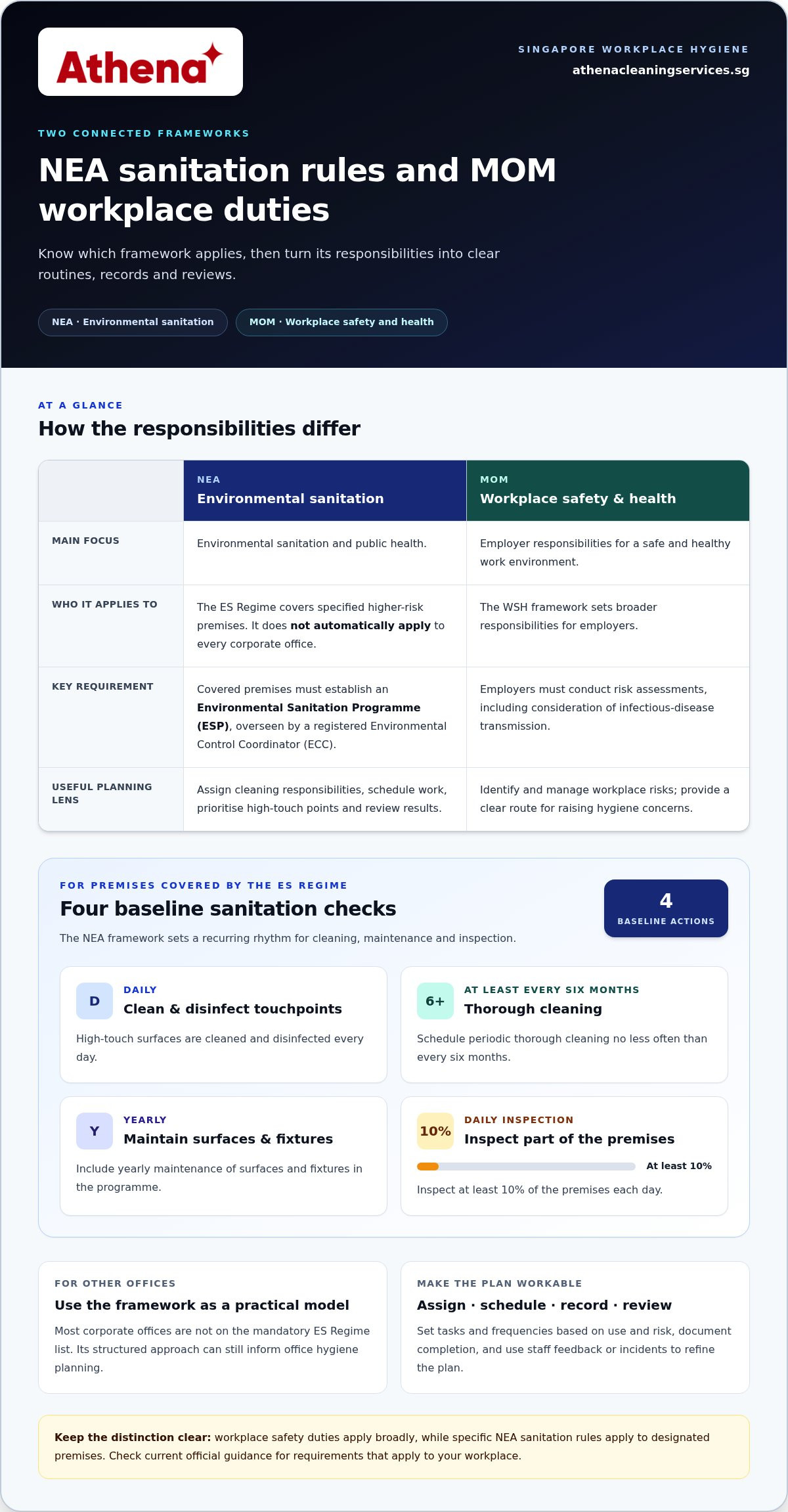
The Environmental Public Health Act is part of Singapore’s public-health framework and supports measures related to environmental sanitation. One NEA measure for certain specified premises is the Environmental Sanitation (ES) Regime. It requires those premises to establish an Environmental Sanitation Programme (ESP), overseen by a registered Environmental Control Coordinator (ECC).
Most corporate offices aren’t on the mandatory ES Regime list, so its legal requirements don’t automatically apply to every office. Its structured approach can still help with planning: assign responsibilities, schedule cleaning, prioritise high-touch points and review whether routines are working. The SG Clean quality mark can signal attention to hygiene, but it does not replace applicable legal duties or guarantee that every workplace risk is controlled.
MOM Workplace Safety and Health Guidelines
The Workplace Safety and Health (WSH) Act provides the wider framework for employers to maintain a safe and healthy work environment. Employers must conduct risk assessments, including consideration of infectious-disease transmission. The WSH (General Provisions) Amendment Regulations 2026, S 703 of 2026, were enacted in 2026. Businesses should review current official guidance to understand how applicable provisions affect their workplace.
A clear process for raising hygiene concerns helps management identify issues early, from an overflowing washroom bin to recurring reports of illness. If several staff members develop similar symptoms, record and escalate the concern through the organisation’s health and safety process. Reporting duties and routes depend on the circumstances, so follow current instructions from the relevant authorities rather than assuming every cluster follows the same procedure.
From Basic Cleaning to Managed Hygiene
A tidy reception area is not the same as a managed hygiene programme. Dust-free desks can coexist with neglected touchpoints, inconsistent washroom checks or tasks that are difficult to verify. A written schedule, assigned accountability and records of completed work make it easier to maintain standards and follow up on gaps.
- Identify high-use spaces and surfaces, such as meeting rooms, pantry counters and shared equipment.
- Set cleaning frequencies based on use and risk, then document completion.
- Review staff feedback and incidents to refine the plan.
This is not a shift from voluntary cleaning to universal mandatory sanitation. It is a layered system: workplace safety duties apply broadly, while specific NEA sanitation rules apply to designated premises. A disciplined programme that goes beyond the minimum can help teams maintain a consistent standard of care.
The Environmental Sanitation (ES) Regime for Offices
The NEA’s Environmental Sanitation (ES) Regime applies to specified higher-risk premises, not automatically to every corporate office. Operators of covered premises must establish an Environmental Sanitation Programme (ESP), overseen by a registered Environmental Control Coordinator (ECC). Other offices can use the framework as a practical model while determining which requirements apply to their premises.
An Environmental Sanitation Management Plan (ESMP) can document the site-specific procedures and responsibilities used to carry out a programme. The NEA framework calls the required programme an ESP. Use the correct term in formal records, and make procedures clear enough for cleaners, facilities teams and managers to follow.
Build a Site-Specific Sanitation Plan
Start with how the premises are used. A busy shared pantry, frequently booked meeting rooms and a lightly used records room have different cleaning needs. For premises covered by the ES Regime, baseline requirements include daily cleaning and disinfection of high-touch surfaces, periodic thorough cleaning at least every six months, yearly maintenance of surfaces and fixtures, and daily inspection of at least 10% of the premises.
Turn those requirements into practical procedures. Define who cleans each area, which tasks are routine, when deeper work is scheduled and how completion is checked. A routine procedure may cover touchpoints and visible soil. A periodic deep-cleaning procedure should list the areas and fixtures to address. Document how to escalate bodily-fluid contamination or suspected infectious-disease spread, following applicable workplace procedures and official public-health guidance.
Records, Training and Inspections
Maintain records that make the programme easy to review, including dated task logs, inspection findings, corrective actions and cleaning schedules. Digital logs can improve access and traceability, but the priority is a complete, legible record. Train in-house staff and cleaning teams on site procedures, safe product use and how to report missed tasks or unusual incidents.
NEA officers may assess compliance at premises covered by the regime. Keep the ESP, inspection records and supporting procedures organised so the responsible team can explain how work is done and how gaps are corrected. There is no single universal checklist for every office inspection; requirements depend on the premises and applicable rules. MOM’s separate monitoring framework covers particular workplace hazards, with requirements that vary by exposure. Review MOM's Hygiene Monitoring Requirements when relevant.
Cleaning contracts can set clear, outcome-focused expectations. Specify the required hygiene result, priority zones, inspection method and process for addressing deficiencies instead of relying only on a task list. For covered premises, failure to meet applicable obligations can lead to enforcement. WSH Act penalties may be severe, including fines of up to S$1 million for corporate bodies. This is not a fixed penalty for every ES shortfall.
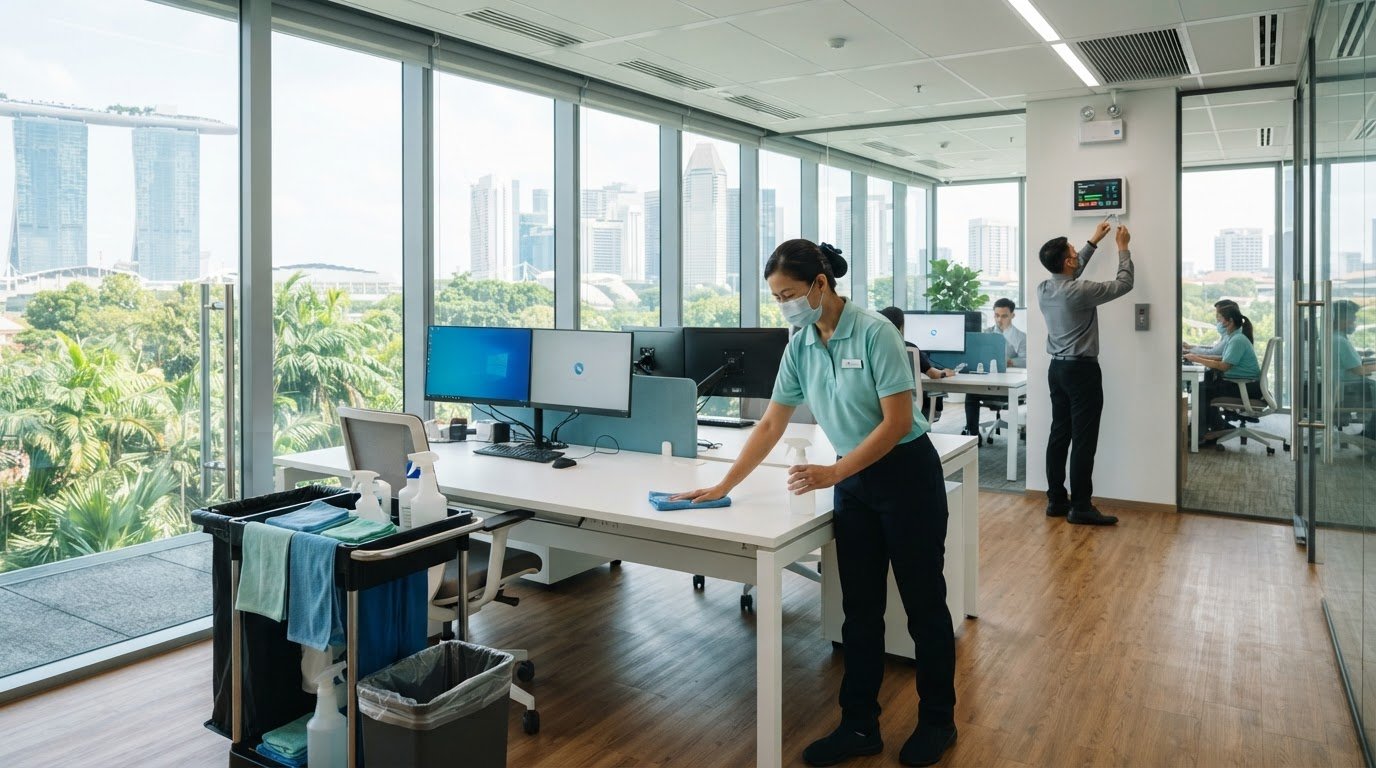
A disciplined schedule and careful execution help facilities teams keep track of cleaning and follow-up. Professional office cleaning and sanitization can support consistent attention to frequently used areas as part of a well-managed workplace programme.
Critical Standards for Indoor Air Quality (IAQ) and High-Touch Surfaces
A clean desk tells only part of the story. Air quality and frequently handled surfaces also shape the hygiene experience in an office, even when problems aren’t visible. Singapore Standard SS 554, the Code of Practice for Indoor Air Quality for Air-Conditioned Buildings, provides a recognised benchmark for managing indoor environments. It is technically voluntary, but MOM may refer to it when assessing indoor air quality complaints under the Workplace Safety and Health framework.
For workplace hygiene standards singapore, this means looking beyond surface appearance. Apply indoor air quality guidance thoughtfully, maintain high-touch areas consistently and treat cleaning as one part of a wider approach to workplace health.
Achieving Better Indoor Air Quality
Use SS 554’s benchmarks to guide monitoring and follow-up. The article’s reference figures are a carbon dioxide level that should not exceed 1,000 ppm, a PM2.5 target below 12 μg/m³, and relative humidity that should not exceed 70%, with 40–60% noted as an ideal range. These are reference points, not a substitute for assessing the building’s conditions, ventilation and applicable guidance.
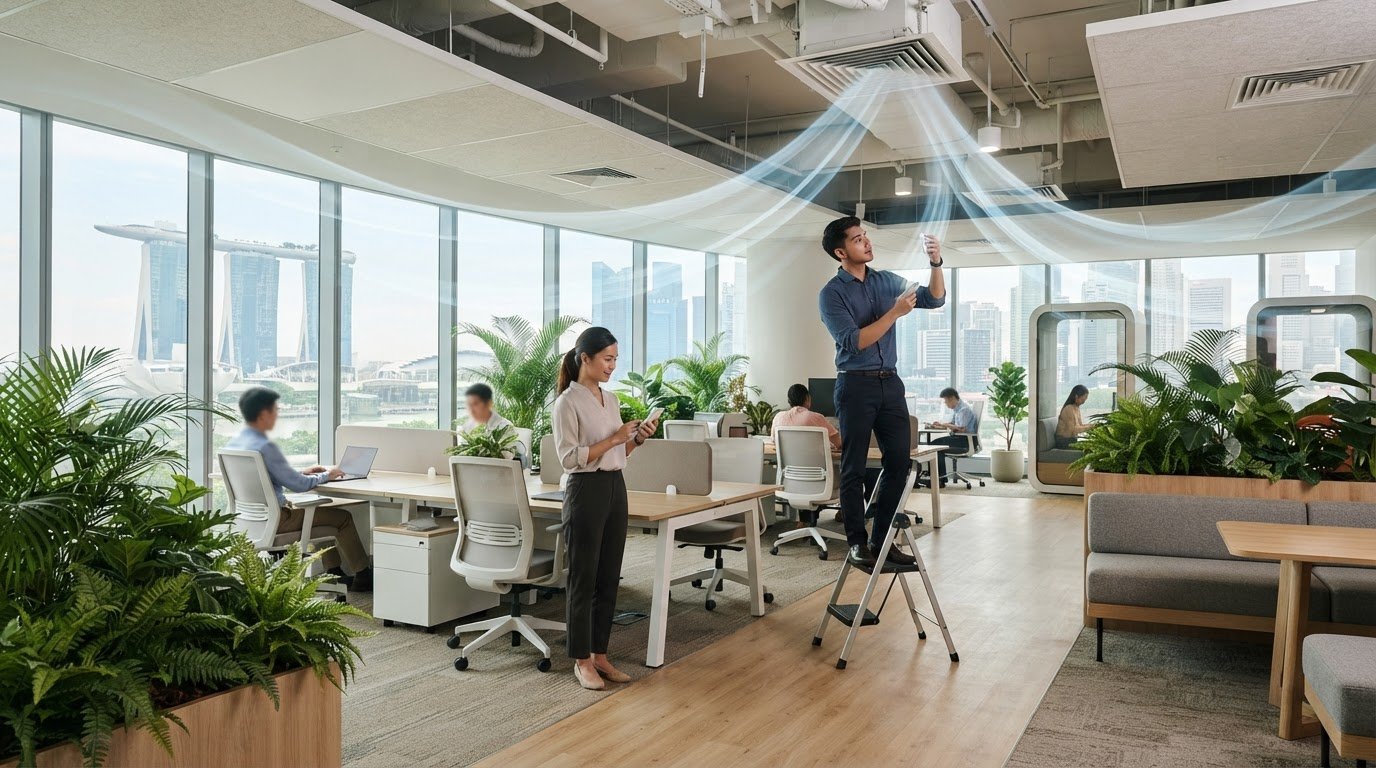
Start with the building’s air-conditioning and ventilation routines. Keep maintenance records, respond to reported stuffiness or persistent odours, and coordinate inspection of filters and air-handling components with the building maintenance team. Duct cleaning is not a universal remedy or a stated SS 554 requirement. Consider it in light of system condition and a suitable maintenance assessment.
Air purifiers with HEPA filtration can help capture airborne particles in the area they serve, but they don’t remove carbon dioxide or replace adequate ventilation. Treat them as a supplementary measure, not proof that a space meets SS 554. If readings raise concern, investigate the cause and review ventilation and system operation rather than relying on a device alone.
High-Touch Surface Protocols
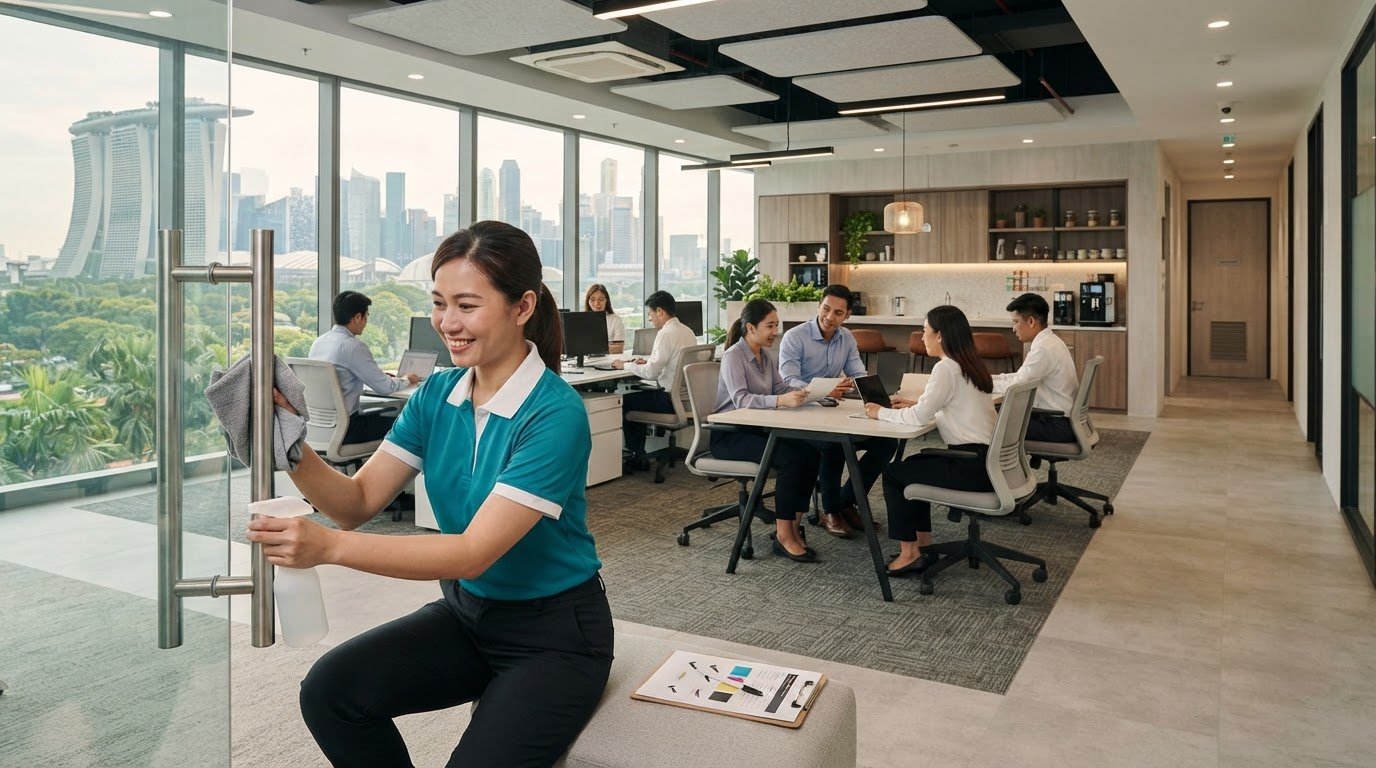
Build a clear routine around lift buttons, door handles, pantry counters, shared equipment and meeting-room touchpoints. Set the frequency according to how heavily each area is used, and increase attention when circumstances warrant it. For premises covered by the NEA Environmental Sanitation Regime, the baseline includes daily cleaning and disinfection of high-touch surfaces. Other offices can use this as a practical benchmark without treating it as a universal legal requirement.
- Clean visibly soiled surfaces before applying disinfectant.
- Use products suitable for the surface and follow the label directions.
- Keep the surface visibly wet for the stated contact time, known as dwell time.
- Use clean cloths and an orderly workflow to reduce transfer between areas.
Don’t assume a product is suitable just because it is described as a disinfectant. Check its intended use and instructions, including dilution and contact time, and avoid unsupported claims that a product is “NEA-approved.” Technique matters: wiping a product away too soon may prevent it from achieving the contact time stated on its label.
Consistent procedures, careful product use and professional sanitization of high-frequency areas can help reduce cross-contamination risks. Together, these measures bring air conditions and everyday touchpoints into a deliberate, manageable hygiene programme.
Implementing a Robust Hygiene Management System (HMS)
A robust Hygiene Management System turns cleaning from a response to visible mess into a planned, reviewable part of workplace operations. It connects risk assessment, task schedules, staff responsibilities and follow-up, so a missed pantry clean or recurring concern doesn’t disappear into an informal conversation. In Singapore, the system should reflect the premises, activities and applicable workplace requirements, not rely on a generic checklist.
Assess Risks Before Setting Routines
Start by walking through the workplace and mapping how people use it. Mark high-traffic routes, shared equipment, pantry areas, meeting rooms and facilities where food, moisture or frequent contact may create additional hygiene concerns. Compare current routines with observed conditions and the relevant requirements for the premises. This creates a practical gap list instead of a general intention to “clean more.”
ATP testing can be one way to check for organic residue on selected surfaces. It provides a measurable indicator for comparing results over time, but it doesn’t identify a specific pathogen or prove that a surface is free of infectious risk. Use it alongside visual checks, cleaning records and appropriate procedures. Review findings, assign corrective actions and update the assessment when the workplace layout, usage or risk profile changes.
Make the Schedule and Feedback Work Together
Create a master schedule that separates daily tasks from periodic or deep cleaning. Assign each task to a role, specify the area and expected outcome, and record completion in a format supervisors can review. Daily attention may cover shared touchpoints and pantry surfaces, while planned deep cleaning can address carpets and upholstered furniture that collect soil through regular use. Set frequencies according to use, condition and relevant requirements.
Employees are part of the system, too. Make it straightforward to report a spill, an empty soap dispenser or a cleaning task that appears to have been missed. Review feedback regularly, look for repeat issues and communicate what was addressed. This builds shared responsibility without shifting professional cleaning duties onto staff.
If cleaning is handled through a service arrangement, assess how its scope supports workplace risk controls. Look for clear task specifications, reliable records, attention to high-use areas and a process for handling concerns. The professional cleaning company Singapore guide offers a related perspective on aligning cleaning support with workplace needs. Review the programme regularly so your workplace hygiene standards singapore plan stays relevant as office use and expectations evolve.
For more consistent routine office cleaning, deep cleaning and attention to high-frequency areas, explore Athena’s professional office cleaning and sanitization as part of your hygiene management approach.
Elevating Standards with Athena’s Professional Office Cleaning
A reliable hygiene programme needs more than a written schedule. Cleaning tasks must be carried out consistently, with attention to how people use the space and where soil or frequent contact can create hygiene concerns. Athena Team Cleaning provides commercial office cleaning, building maintenance and sanitization services to support the upkeep of shared work environments.
Professional cleaning can help turn hygiene plans into practical routines. A business can identify high-frequency areas for regular attention, then coordinate deeper cleaning for furnishings and flooring that need a different approach. This does not transfer an employer’s legal responsibilities to a cleaning provider, but it can support a consistent programme and give facilities teams clearer oversight of day-to-day sanitation.
A Meticulous Approach to Office Sanitation
Effective office sanitation starts with the space itself. Athena Team Cleaning's office cleaning and sanitization services support routine care of work areas and shared touchpoints. Carpet and upholstery cleaning address furnishings that accumulate soil through everyday use, while parquet and marble floor polishing help maintain hard-floor finishes as part of broader building care. Each task has a distinct purpose, so match the work to the surface and site priorities.
That care supports more than appearance. It helps businesses maintain a fresher, orderly environment, while a considered cleaning plan can make it easier to follow internal routines and keep records of completed work. Where NEA’s Environmental Sanitation requirements apply, businesses remain responsible for meeting them. Professional cleaning can support the cleaning components of their programme.
Trust, Precision and Practical Support
Commercial cleaning is an important part of workplace upkeep, not a task to rush through. Clear priorities, consistent attention to detail and services suited to the premises help businesses maintain shared spaces. Managers can focus on reviewing the hygiene system and responding to risks while cleaning work supports the routines they have established.
Professional cleaning can also support business continuity by helping teams maintain common areas and respond systematically to everyday sanitation needs. It does not guarantee regulatory compliance or replace an employer’s risk assessment, staff responsibilities or required oversight. Instead, it provides hands-on support that can complement these measures and help connect a documented cleaning plan with the condition of the workplace.
For businesses putting workplace hygiene standards singapore into practice, Athena Team Cleaning's commercial cleaning and sanitization services can support office routines, from frequently used areas to carpets, upholstery and floors. Choose services that fit your workplace’s hygiene priorities, then review results against your procedures and applicable requirements.
Explore Athena Team Cleaning's professional office cleaning and sanitization services to support your workplace hygiene routines.
Make Workplace Hygiene a Lasting Business Priority
Strong workplace hygiene is an ongoing commitment, not a one-time reset. Decide what a healthier, better-maintained office should feel like for the people who work there, then make that standard part of everyday operations. A consistent approach to workplace hygiene standards singapore can support staff confidence and help your business stay attentive to its responsibilities.
Athena Team Cleaning provides commercial cleaning, including office cleaning and sanitization, to support the upkeep of workplaces and shared spaces.
Explore office cleaning and sanitization support from Athena Team Cleaning to plan cleaning that fits your workplace’s needs.
Frequently Asked Questions
What are the mandatory NEA cleaning frequencies for Singapore offices?
There’s no single mandatory NEA cleaning schedule for every Singapore office. The Environmental Sanitation Regime applies to specified premises, where requirements include daily cleaning and disinfection of high-touch surfaces, thorough periodic cleaning at least every six months, yearly maintenance of surfaces and fixtures, and daily inspection of at least 10% of the premises. These measures can also guide a strong internal schedule for other offices.
Is the SG Clean certification still mandatory for workplaces in 2026?
No universal SG Clean certification requirement for all workplaces is established by the guidance covered here. The mark should not be confused with legal obligations under the Environmental Sanitation Regime, which apply to specified premises. Businesses should identify which rules apply to their premises and refer to current NEA information before treating a certification or quality mark as a compliance requirement.
How does MOM define a safe and hygienic workplace environment?
MOM’s framework centres on the employer’s duty to provide a safe and healthy workplace, supported by risk assessment and appropriate risk controls. For hygiene, this means considering conditions that may affect workers, including infectious-disease transmission, and managing identified risks. A workplace assessment might consider shared facilities, cleaning arrangements and how staff can report hygiene concerns, rather than relying on appearance alone.
What is an Environmental Sanitation Management Plan (ESMP)?
An ESMP is a site-specific way to document how sanitation tasks, checks and responsibilities are organised. Under NEA’s Environmental Sanitation Regime, the required programme is called an Environmental Sanitation Programme (ESP), overseen by a registered Environmental Control Coordinator. A workplace plan can explain how the programme is carried out, who handles each task, how inspections are recorded and how issues are followed up.
How often should office carpets and upholstery be professionally cleaned?
There isn’t a universal professional-cleaning interval for every office carpet or upholstered chair. Set a schedule based on foot traffic, visible soiling, spills, occupancy and the material’s care requirements. A heavily used reception area may need attention sooner than a lightly used meeting room. Keep cleaning records and review the schedule if odours, stains or recurring complaints suggest that the timing isn’t working.
What are the penalties for failing to meet workplace hygiene standards in Singapore?
Penalties depend on the specific legal duty breached and the circumstances. Under the WSH Act, non-compliance can carry substantial consequences, including fines of up to S$1 million for corporate bodies and possible imprisonment. That figure isn’t a fixed penalty for every cleaning lapse or ES Regime issue. Employers should identify applicable requirements, document risk controls and refer to current official guidance when assessing a potential breach.
Can I manage workplace hygiene in-house or do I need a professional service?
You can manage workplace hygiene in-house; there’s no general requirement for every office to hire a professional cleaning service. The employer remains responsible for applicable workplace duties either way. In-house teams need clear procedures, suitable capacity and reliable checks. Professional office cleaning or sanitization can support routine delivery, especially where specialist attention is needed for high-use areas, carpets or upholstery, while management retains oversight of the wider hygiene programme.
What is the role of an Environmental Sanitation Coordinator?
For premises covered by the ES Regime, the Environmental Sanitation Programme must be overseen by a registered Environmental Control Coordinator (ECC). The coordinator oversees the programme and helps ensure sanitation arrangements are organised and monitored. This role is distinct from carrying out cleaning tasks: cleaners perform assigned work, while the ECC oversees the programme and its implementation at specified premises.
Frequently Asked Questions
What are the mandatory NEA cleaning frequencies for Singapore offices?
Is the SG Clean certification still mandatory for workplaces in 2026?
How does MOM define a safe and hygienic workplace environment?
What is an Environmental Sanitation Management Plan (ESMP)?
How often should office carpets and upholstery be professionally cleaned?
What are the penalties for failing to meet workplace hygiene standards in Singapore?
Can I manage workplace hygiene in-house or do I need a professional service?
What is the role of an Environmental Sanitation Coordinator?
Related articles