
Mould mites in Singapore homes: how to identify and prevent them

In this article
- What mould mites are and why Singapore suits them
- How to identify mould mites
- Where mould mites show up in HDB, BTO, condo and landed homes
- How to prevent mould mites
- How to get rid of mould mites step by step
- Costs and options in Singapore
- When to call a professional
- Comparison at a glance
- Frequently asked questions
- Sources
- Related Athena cleaning services in Singapore
Mould mites are tiny pale mites, usually under half a millimetre long, that feed on mould. In Singapore you can identify them as white or tan specks that crawl on damp walls, leather and open dry food. To prevent them, keep indoor humidity under about 60%, fix leaks, dry laundry away from bedrooms, store food in sealed containers and wipe mould off before it spreads.
This guide shows how to identify mould mites in HDB, BTO and condo homes, how to prevent a return, what removal typically costs in 2026, and when one cupboard clean is no longer enough.
What mould mites are and why Singapore suits them
Mould mites are small arachnids, most often Tyrophagus putrescentiae, that live on mould and on food that has started to go musty. An adult is roughly 0.3 to 0.7 mm long, so a single mite is nearly invisible. You notice them when hundreds gather and the surface looks like fine flour that is slowly moving.
They do not bite and they do not feed on people. The concern is indirect. Their shed skins and droppings can irritate the nose, eyes and skin, and people with asthma, eczema or rhinitis tend to feel it first. The US EPA indoor air quality guidance links damp indoor conditions to mould and to the biological particles that come with it.
Why our climate helps them
Singapore sits close to the equator, and outdoor relative humidity commonly sits between about 70% and 90% through the year. Mould needs surface moisture and a little organic material, and it can start growing on a damp wall, wardrobe back panel or leather bag within a few days. Mould mites then arrive and multiply on it. They reproduce fastest in warm, humid air, which is the normal state of a closed-up flat.
That is why the fix has two halves. You remove the moisture that grows the mould, and you remove the mould, dust and food crumbs that feed the mites. Killing mites alone with a spray, while the wall stays damp, only buys you a few weeks.
How to identify mould mites
Look closely before you buy any spray. Mould mites leave a handful of clear signs, and most Singapore households spot them first in the kitchen or in a bedroom wardrobe.
Signs you can check in five minutes
- Moving white or beige dust on skirting boards, shelves, window sills or under furniture. Press a damp tissue on it. If the specks smear or you see them crawling, they are mites.
- A fine layer on dry food such as flour, oats, milk powder, rice, dried mushrooms or pet kibble, sometimes with a sweet, musty smell.
- Grey, green or black mould spots nearby, usually behind wardrobes, inside cabinets, on leather shoes and bags, or in a corner of the ceiling.
- Itching or sneezing that gets worse in one room and eases when you leave it.
A phone camera on full zoom or a cheap 10x magnifier is enough to see their oval, translucent bodies and long hairs.
Lookalikes that waste your time
Booklice are slightly larger, flatter and quicker, and they like damp paper and books. Dust mites are different again. They live in bedding and soft furnishings and are too small to see. Our guide to dust mites mattress singapore bacteria health risks explains how to tell that problem apart. Springtails, which jump, usually point to a leak or a wet planter.
If you find specks on one packet of food and nowhere else, throw that packet out and check the shelf. Odds are that packet was the whole problem.
Where mould mites show up in HDB, BTO, condo and landed homes
Mould mites go where moisture and mould build up. In Singapore, a few spots come up again and again.
Newly renovated and BTO homes
Fresh plaster, cement screed, paint and built-in carpentry release moisture for weeks after handover. A sealed wardrobe in a new BTO bedroom, with the aircon off all day, is close to an ideal breeding box. If you have just moved in, finish a proper builder's clean first. Our 5 essential steps for effective post renovation cleaning singapore covers dust, residue and the surfaces people forget.
Wardrobes, leather and soft furnishings
Closed wardrobes, shoe cabinets and storage boxes hold still, humid air. Leather sofas, handbags and shoes are a favourite because mould grows on the skin oils and dust that sit on them. If you spot a bloom, our 5 expert tips for leather sofa cleaning in singapore shows how to lift it without cracking the surface.
Kitchens, bathrooms and the service yard
Pantry shelves, open bags of flour and sugar, and pet food bowls are common. In bathrooms, grout lines and silicone seals hold moisture long after a shower, and mould starts there before it spreads to nearby walls. For wet areas, see our notes on a bathroom cleaner tiles grout fixtures singapore routine.
Ground-floor landed homes and units with a leaking window frame, a wet ceiling after a neighbour's pipe repair, or a bay window that never gets airflow tend to have the worst wall mould, and mites usually turn up on it within weeks.
How to prevent mould mites
Prevention in Singapore is mostly moisture control. The US EPA mould cleanup guidance says the only practical way to control indoor mould is to control moisture, and the same logic holds for the mites that feed on it.
Bring humidity down and keep it down
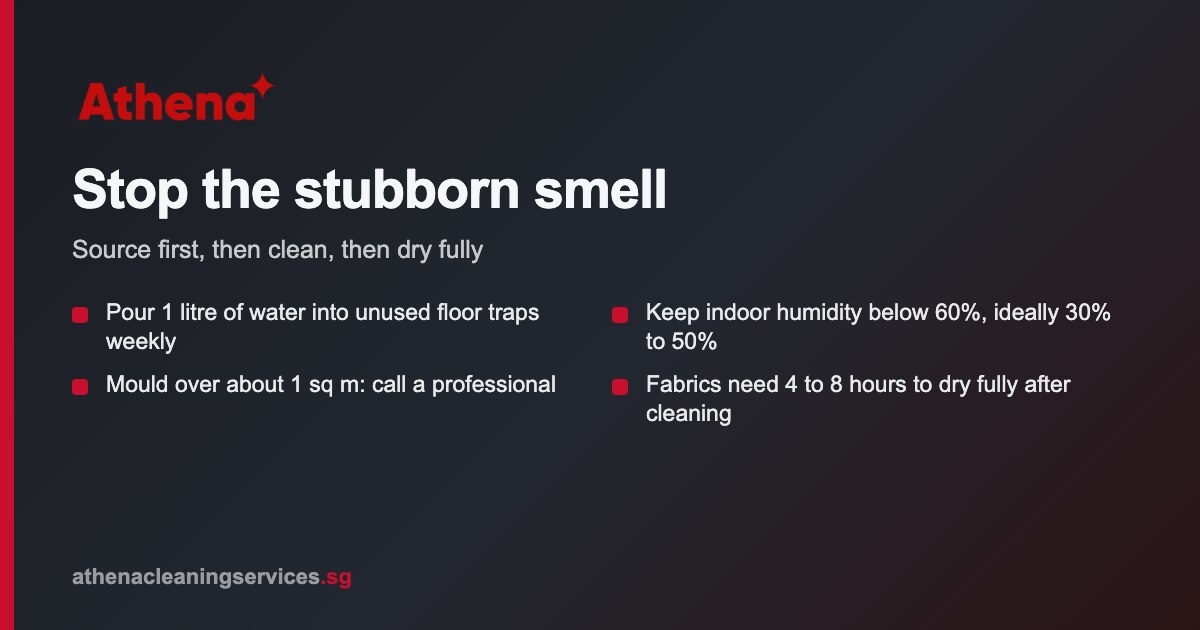
Aim for indoor relative humidity below about 60%, and closer to 50% if you can. A small hygrometer costs S$10 to S$25 and tells you the real number rather than a guess. Run the aircon on dehumidify or cool mode in occupied rooms, and use a portable dehumidifier in a bedroom that stays closed. Open windows during dry, breezy hours rather than during a rainy afternoon, which just brings humid air in.
Cut the moisture sources
- Dry laundry on the balcony or in a ventilated service yard. A closed bedroom traps the moisture.
- Run the bathroom exhaust fan or leave the window open for 20 to 30 minutes after a shower.
- Wipe condensation from window frames and aircon outlets.
- Report and repair leaks quickly. Check the ceiling, window frames and under-sink pipes monthly.
- Leave a gap of a few centimetres between furniture and external walls so air can move.
Store food and soft goods properly
Keep flour, grains, milk powder, pet food and dried goods in airtight containers, and finish opened packs within a few weeks. Put silica gel or moisture-absorbing boxes in wardrobes and shoe cabinets, and replace them roughly monthly. Air leather bags and shoes out every couple of weeks rather than leaving them sealed in a cupboard for months.
How to get rid of mould mites step by step
A single cupboard or shelf is a job you can do yourself in an afternoon. Follow the order below, because vacuuming first and wiping second stops you from smearing mites across a wider area.
The DIY sequence
- Bin the food. Throw out any infested packet in a sealed bag and take it to the chute straight away.
- Empty the space. Take everything out of the cupboard or wardrobe and check each item for specks and mould.
- Vacuum first. Use a vacuum with a brush attachment on shelves, corners and seams. Empty the canister or bag outside the home afterwards.
- Remove the mould. Wipe hard surfaces with warm water and detergent, then dry thoroughly. Do not mix bleach with other cleaners.
- Dry fully. Leave doors open with a fan or dehumidifier running for at least a day before you put things back.
- Treat soft items. Wash bedding and fabric at 60 degrees Celsius where the label allows, and dry in strong sun or a dryer.
For fabric sofas and cushions, simple spot treatments are covered in our 5 must try diy upholstery cleaning recipes all singapore homes must have.
What to skip
Do not fog the room with insecticide. Mould mites are not an insect problem, and sprays leave residue on surfaces your family touches. Removing the mould and the moisture works, and fogging does not. For anything larger than about 10 square feet of mould, the EPA suggests considering professional help, which is a sensible line to use in a Singapore flat too.
Costs and options in Singapore
Most homeowners end up combining a few of the options in the table below. The prices are typical ranges for Singapore in 2026, based on what home cleaning and dehumidifying products commonly cost, and your actual quote depends on unit size, access and how bad the growth is. Always ask for a written quote before booking.
If the problem is one packet and one shelf, your cost is a bin bag and an hour. If mites keep returning after a clean, the cause is nearly always humidity or a hidden leak, and no amount of wiping will fix a wall that stays wet. A dehumidifier and a leak repair are usually better value than repeat cleans.
Mattresses and upholstery deserve a separate check. If someone in the house wakes up itchy, see the 10 effective methods for allergen removal mattress cleaning singapore for what actually works on bedding.
When to call a professional
Call a professional when the signs are in more than one room, when mould covers a large wall or ceiling area, or when a member of the household has asthma, a respiratory condition or a weak immune system. The HealthHub healthy living resources are a sensible first stop for questions about allergy symptoms, and a GP can confirm whether your symptoms fit a mould or mite allergy.
Signs the problem is bigger than a cupboard
- A musty smell back within days of cleaning.
- The same ceiling patch, again.
- Mites on bedding, sofas and food in more than one room.
- Growth in every wardrobe of a new BTO or renovated flat.
A good cleaner will clean surfaces and soft furnishings properly, but cannot repair a leak. If the wall is wet behind the paint, ask your contractor or management office to trace the water source first. Tenants should also report water ingress to the landlord promptly, since it affects the deposit conversation. If you are handing a unit back, our guide to best end of tenancy cleaning singapore explains what landlords check.
Athena Cleaning Services can quote a whole-home deep clean for HDB, condo and landed homes, including wardrobes, sofas and mattresses. Message us on WhatsApp with a few photos and the unit size, and you will get a written price before anything is booked.
Comparison at a glance
| Option | Typical cost (SGD) | Time needed | Best for |
|---|---|---|---|
| DIY wipe and dry of one cupboard | S$0 to S$10 (detergent, cloth) | 1 to 2 hours, plus 1 day drying | Single shelf or wardrobe with a small patch |
| Moisture absorber or silica gel boxes | S$3 to S$10 per box, replace monthly | Set up in minutes | Wardrobes and shoe cabinets |
| Portable dehumidifier (10 to 20 litres a day) | S$150 to S$400 to buy, plus electricity | 2 to 4 weeks to settle humidity | Closed bedrooms and storerooms |
| Professional mattress or sofa treatment | S$80 to S$250 per piece | 1 to 2 hours, plus 2 to 4 hours drying | Itchy bedding or mites on upholstery |
| Whole-home deep clean (HDB 3 to 4 room) | S$300 to S$700 | 4 to 6 hours | Mites or mould in several rooms |
| Wall mould treatment and repaint after a leak repair | S$200 to S$600 per wall | 1 to 3 days including drying | Mould that keeps returning on one wall |
Frequently asked questions
Are mould mites harmful to my family in Singapore?
Mould mites do not bite or live on people, but they can still cause trouble. Their droppings and shed skins can irritate skin, eyes and airways, and people with asthma, eczema or allergic rhinitis often feel it first. Mould itself is usually the bigger concern for lungs. If someone has persistent symptoms that improve when they leave the home, see a GP rather than guess. The HealthHub healthy living pages are a good starting point for general information.
How do I tell mould mites from dust mites or booklice?
Mould mites are visible as moving white or tan specks, and they cluster on damp surfaces, leather and dry food. Dust mites live in bedding and carpets and are too small to see without a microscope. Booklice are a little larger, flatter and faster, and tend to sit on damp books and paper. A tissue smear test plus a magnifier settles most cases. If specks are only on food, treat the food as the source.
Why do mould mites appear in new BTO flats?
New plaster, cement screed, paint and carpentry release moisture for several weeks after handover. If the windows stay shut and the aircon is off during the day, humidity inside wardrobes and cabinets climbs and mould grows on dust and wood surfaces, which is exactly what the mites eat. Open windows on dry days, run a dehumidifier in closed bedrooms, leave wardrobe doors slightly ajar, and wipe away any early mould.
What humidity level should I aim for to prevent mould mites?
The US EPA suggests keeping indoor humidity below 60%, ideally between 30% and 50%. In Singapore, 50% to 60% is more realistic unless the aircon runs all day, and a S$10 to S$25 hygrometer tells you where you actually stand. Run the aircon in dehumidify mode. Rooms that stay shut need a portable dehumidifier, and laundry should dry outside the bedrooms.
How much does professional mould mite cleaning cost in Singapore?
As a typical range, a whole-home deep clean for a 3 to 4 room HDB flat costs about S$300 to S$700 before GST. Size and condition decide where in that range you land. Mattress or sofa treatment is usually S$80 to S$250 per piece, and mould treatment with repainting on a wall is often S$200 to S$600. Ask for a written quote and photos of the affected areas before you book, and ask whether leak repair is included.
Can I stop mould mites coming back for good?
You can lower the risk a lot, but only while humidity stays under control. Mites come back whenever walls, wardrobes or food stay damp. So fix leaks first, keep food in airtight containers, air out the bathroom and kitchen, and open every wardrobe once a month to look. Same wall going mouldy again? Ask a contractor to check for water behind it.
Sources
Related Athena cleaning services in Singapore
Related articles